Recurrent Platysmal Bands: Causes, Treatment, and What to Expect from a Neck Lift
February 24, 2026 | Neck Lift
Platysmal bands and recurrent platysmal bands are important topics when discussing
neck lifts, deep plane neck lifts, platysmaplasties, and limited neck lifts. Given that
almost every deep plane facelift, SMAS facelift, and High SMAS facelift involves a neck lift,
the issue of platysmal bands is also relevant in conversations about these facelifts.
First, we must define what a platysmal band is. In order to do that, it is important to have
an understanding of the anatomy of the platysma. The platysma is a thin muscle that
lies just beneath the skin and the subcutaneous adipose tissue of the neck. It stretches
from the mandible, or the jaw bone, all the way down to the clavicle, also known as the
collarbone. It is a superficial muscle, and beneath it lie many important structures,
including some of the deeper muscles of the neck, larger blood vessels, and important
nerves.
There are actually two platysma muscles — one on the right and one on the left. There
is variation among people with regard to how much the two muscles meet in the middle.
In some people they don’t meet at all, and in some people they are side-by-side for a
significant portion of the front of the neck.
Platysmal bands are most often seen in people as they age, and especially in people
where there is greater separation of the platysma muscles in the front. As people age,
the muscle tightens and pulls away from the deeper surface of the neck, especially with
contraction. Essentially, it bowstrings away from the position it maintained when the
person was younger — and we see this as platysmal bands.
In some instances, Botox can be used to relax the muscle, decreasing the platysmal
bands, but this is not a permanent solution. Addressing platysmal bands permanently
can be an important part of procedures that address neck anatomy, especially the
anatomy of the front of the neck. These procedures go by a variety of different names
and do have variations in what is actually done to the neck and sometimes to the face.
As I stated before, most facelifts — especially deep plane facelifts and high SMAS
facelifts — also involve a neck lift. When this is done, an incision is often made just
beneath and behind the chin in a hidden location to address some of the structures of
the neck, including the platysma. This is also true for some individuals who undergo
isolated neck lifts, meaning a neck lift without a facelift. Some people refer to this as a
submentoplasty, and some people speak of it purely as a platysmaplasty. In all of these
instances, when the platysma is addressed generally from the front, the platysma on
either side of the neck, where the angle — also called the cervical-mental angle —
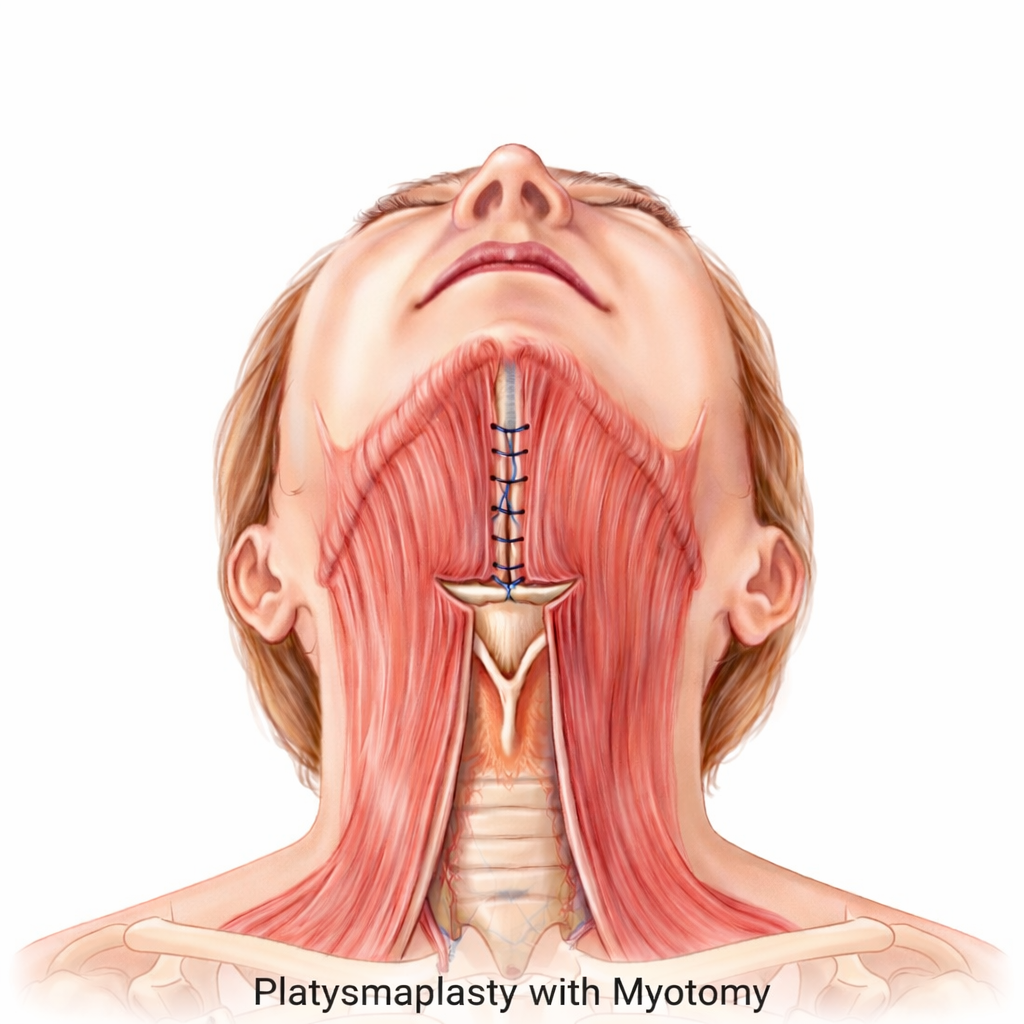
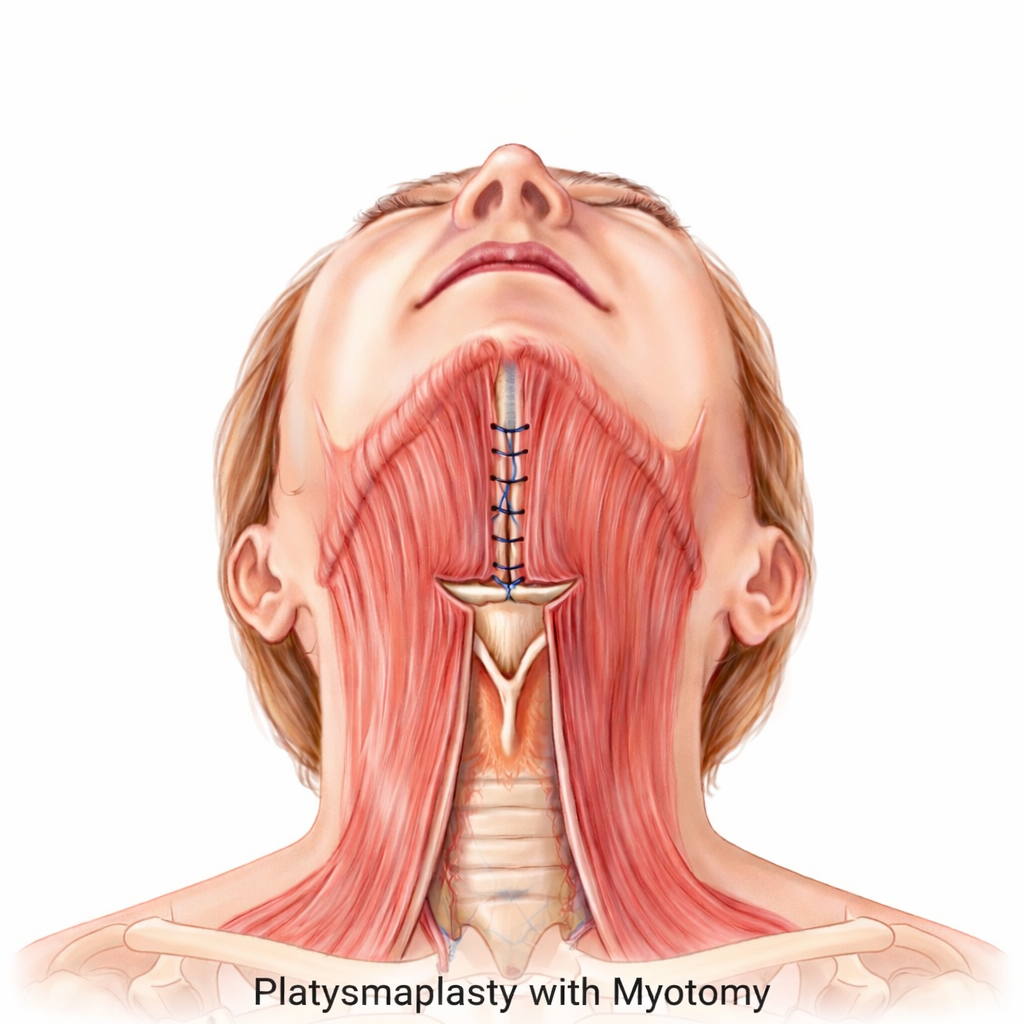
occurs, is elevated, brought to the midline, and sutured together. This alone can have
some impact on platysmal bands, but often a small notch, also called a myotomy, needs
to be made across the platysma, usually at that location where the cervical angle or the
deeper bend in the neck occurs. This myotomy, or disruption of the muscle, ends the
continuum of tension from the chin down to the collarbone and allows the muscle to lay
flatter against the deeper structures. In addition, when the muscle contracts in the
central portion, there is an interruption of the contraction which diminishes the visibility
of the platysmal band.
It is worth noting that addressing the platysma alone does not necessarily make a neck
lift a deep plane neck lift. A deep plane neck lift involves elevating the platysma off of
the deeper structures in the middle part of the neck prior to suturing it together, and
reducing some of the bulky tissues that can decrease the smooth contours and
definition of the neck and jaw. These structures are the anterior belly of the digastric
muscle and the submandibular gland. The anterior belly of the digastric is what is
referred to as a strap muscle of the neck. The anterior belly refers to the front portion of
it — the part that lies directly beneath the chin and anterior jaw. The muscle is not
entirely removed; just the bulky portion is reduced to give a smoother contour. Just
lateral to, or to the outside of, that is the submandibular gland. There are four major
salivary glands — two parotid and two submandibular glands — as well as minor
salivary glands. The submandibular glands can sag with age, but can also enlarge in
size with age, creating a bump-like appearance in the neck. These glands can be
precisely reduced in order to remove that bulge. When performed appropriately, this
maneuver can have a very impressive impact in terms of creating youthful neck
anatomy that is very difficult to achieve otherwise. You might wonder if removing a small
portion of a salivary gland can lead to dry mouth — in theory this is true; however, it is
extremely rare, and in fact in my practice in Austin, Texas, I have not had any patients
report significant issues with dry mouth after this procedure.
So we have discussed the platysma, platysmal bands, and how to address them in a
neck lift with a platysmaplasty. We have also discussed how, as part of a
platysmaplasty or deep plane procedure, important contour improvements can be
brought about by the skilled reduction of bulky muscles and salivary glands. It is now
important to provide a little more detail about neck lifts, especially as they relate to the
platysma muscle.
An anterior neck lift is a procedure in which the skin and platysma are addressed from
the front. Most neck lifts also involve incisions behind the ear. Through these incisions,
the skin is elevated and the platysma is also elevated. The platysma can be elevated
and repositioned posteriorly and secured to dense structures called the mastoid fascia
behind the ear. When this is done, it adds further definition to the area below the
jawline, improving both the neck and jaw contours. The skin is also re-draped in a way
that allows the removal of excess skin, further adding to the improvement in the neck. In
patients who have a lot of excess loose skin, the skin is elevated off of the outer surface
of the platysma throughout the entire expanse of the neck to allow significant draping
and the removal of a significant amount of excess skin. When I perform a neck lift in this
fashion — where there is dissection beneath the platysma but also dissection between
the platysma and the skin — I call it a dual plane neck lift, because there are two planes
of dissection. This is still a deep plane neck procedure, but it adds an extra element of
control that permits better draping and removal of skin in patients who need it. Some
patients, however, do not have a lot of excess skin, and those patients do not require
that the skin be separated from the underlying muscle.
In summary, the platysma is an important structure to understand and modify in order to
bring about satisfactory results in neck contouring procedures such as neck lifts.
Six Frequently Asked Questions
Is a facelift performed with a neck lift?
Not all facelifts involve neck lifts, but most do. Not all neck lifts involve facelifts, but
many do. The anatomy of the face and neck and the aging of the face and neck are
linked, and therefore facelifts and neck lifts are usually performed together. The one
exception can be younger individuals with no loose skin in the face and only mild
changes in the neck — these are patients who may undergo an isolated neck lift.
Is the platysma a superficial or deep muscle of the neck?
The platysma is a superficial muscle in the neck that extends from the clavicle up to the
jaw bone. It lies directly beneath the skin and the subcutaneous fat.
Is a platysmaplasty a deep plane neck lift?
Most people would not consider a platysmaplasty alone to be a deep plane neck lift.
Generally, when people talk about performing a deep plane neck lift, they are referring
to working beneath the platysma to reduce deeper structures such as the subplatysmal
fat, the anterior belly of the digastric muscle, and the submandibular gland.
What is the function of the submandibular gland?
The submandibular gland produces saliva. There are two of them, and together with the
two parotid glands, they make up the four major salivary glands. While there is a
theoretical risk of creating dry mouth with a submandibular gland reduction, it is
extremely rare, and I have not personally seen it in my practice.
Are drains used with a neck lift?
Whether or not drains are used with a neck lift is up to surgeon preference. Many
surgeons use small drains to reduce fluid collections; however, surgeons more
frequently rely on what is called hemostatic netting. Neither is proven to be better than
the other. I often use a very small drain — no larger than an IV catheter — and combine
it with the selective placement of hemostatic net sutures.
What is one of the more powerful ways to prevent recurrent platysmal
bands?
One of the more powerful ways to prevent recurrent platysmal bands is to perform a
platysmaplasty with suturing of the platysma at the midline down to the break point of
the neck, also known as the cervical-mental angle, but not suturing it inferior to that
point. Instead, placing a small myotomy — or notch — in the muscle at that location
disrupts the tension across those muscle fibers, reducing the likelihood that platysmal
bands will recur.
For Consultation Contact Dr. Weinfeld’s Team.