How Long Does a Facelift Take? What Patients Should Know Before Surgery
March 21, 2026 | Facelift
7 Minute Read
One of the most common questions that comes up during facelift consultations is: how long does this surgery take? Patients want to make sure their surgeon isn’t rushing — but they’re also understandably concerned about being under anesthesia for an extended period. This blog is designed to give patients considering a facelift, neck lift, deep plane facelift, or associated procedures a clear framework for thinking about the length of surgery and what it actually means for their safety and results.
The length of a facelift is not just a logistical detail — it reflects the depth of the work being done. Understanding why surgery takes as long as it does can actually be reassuring rather than concerning.
Table of Contents
- A Few Words About General Anesthesia
- The Relationship Between Time and Quality
- Two Analogies Worth Considering
- Is a Longer Anesthesia Riskier?
- How Long Does a Facelift Actually Take?
A Few Words About General Anesthesia
Before getting into the question of how long a facelift takes, it’s worth addressing the concern that often underlies it. Many patients are apprehensive about general anesthesia — and that’s understandable. Giving up control to a surgical team, even a highly trained one, can feel unsettling.
Two things are worth saying upfront. First, general anesthesia is an extremely safe process. Plastic surgeons and anesthesia teams are well trained, and modern safety protocols are thorough and well established. Second, facelifts don’t always have to be performed under general anesthesia — local anesthesia with or without IV sedation are options worth discussing. That said, general anesthesia is often the best and preferred choice for comprehensive procedures. One other concern that patients occasionally raise is the fear of waking up during surgery. This is an extremely rare occurrence, and in my own practice, I have never seen it happen.
The Relationship Between Time and Quality
Patients sometimes equate a longer procedure with greater risk, and a shorter one with greater efficiency. I understand the reasoning, but I’d encourage a different way of thinking about it. Time is not the only variable that matters. Safety and quality are the parameters that truly determine success — and both take time.
Here is a quick summary of why that is:
- Safety requires patience. Deep plane facelifts work within the deeper structures of the face, in close proximity to the nerves that control facial movement. I want plenty of time to work carefully in that area without feeling any pressure to move quickly.
- Excellence requires detail. It takes many steps — each performed with focused attention — to achieve a natural result. I like to tell patients: there are 1,000 steps to a facelift, and I want every one of them to be perfect. I’ve never actually counted, but I’m confident the number is at least that high.
- Cutting steps is not an option. I would never feel comfortable skipping any of the important steps in this procedure or rushing through them. The goal is always a result that I’m proud of and that the patient is thrilled with.
Why choose a shorter facelift option if the results are going to fall short? The time spent in the operating room is directly connected to the quality of the work being done.
Two Analogies Worth Considering
When patients are sorting through their feelings about surgical time, I find a couple of analogies helpful. Both speak to the same underlying idea: excellence simply takes more time.
Fine dining vs. fast food. A wonderful meal at a fine dining restaurant takes longer than grabbing fast food — not because something is wrong, but because the ingredients are better, the preparation is more careful, and the experience is more customized. Fast food has its place, and the people who prepare it care about what they do. But the level of craft, attention, and individualization is simply different. Most patients, when they think about it, don’t want fast food when it comes to their face.
A Mazda vs. a Maserati. Both are cars. Both have four wheels, a windshield, and seats. Both will get you from point A to point B safely. But that’s roughly where the similarities end. A Mazda takes somewhere between 20 and 30 hours to manufacture. A Maserati can take 200 to 300 hours — much of it involving direct, hands-on skilled craftsmanship. That’s a tenfold difference in production time. The analogy is fairly direct: if a facelift can be performed in half the time, it’s hard to imagine that the quality of the result is going to be the same, let alone better. There are exceptions, of course — but in my own practice, I know I perform a better facelift when I have given myself the time to do it right.
Is a Longer Anesthesia Riskier?
This is a fair question, and it deserves a clear answer. For healthy individuals, there is not a significant or meaningful increase in risk between a longer procedure and a shorter one. Patients undergoing a facelift are medically cleared in advance to make sure they are sufficiently healthy for general anesthesia — so this conversation applies specifically to that group.
A helpful analogy here: for healthy individuals, the statistical risk of a negative consequence from general anesthesia is lower than the risk of being in a car accident every single time you get in a car. That’s worth sitting with for a moment. General anesthesia, in and of itself, is a relatively safe undertaking for healthy patients.
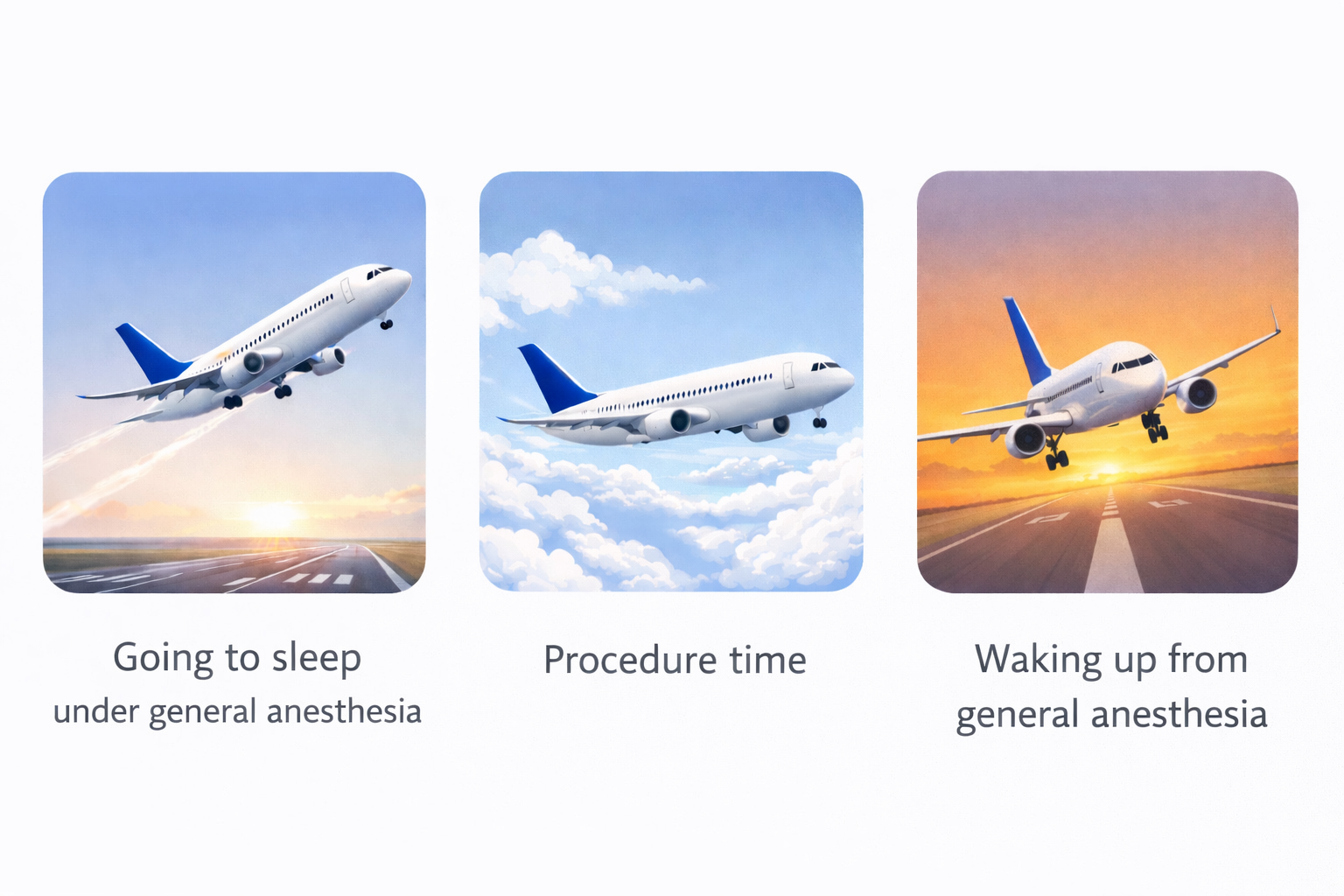
Another way to think about it: the technically challenging parts of general anesthesia are the induction and the emergence — going to sleep and waking up. The time in between is comparatively straightforward. It’s a bit like an airplane flight, where the takeoff and landing are the demanding portions and the cruise in between is less so.
How Long Does a Facelift Actually Take?
For patients who are interested in the actual time ranges, here is a general breakdown:
- Facelift and neck lift alone (with deep plane work in both the face and neck): typically 4 to 6 hours
- Facelift and neck lift combined with upper and lower eyelid surgery, a lip lift, and/or a brow lift: typically 6 to 9 hours
These are estimates, and they vary based on anatomy, the complexity of the dissection, and what is being done. For patients who prefer to avoid general anesthesia altogether, local anesthesia with IV sedation is an option worth discussing — though there are some trade-offs, which we can cover in a separate post.
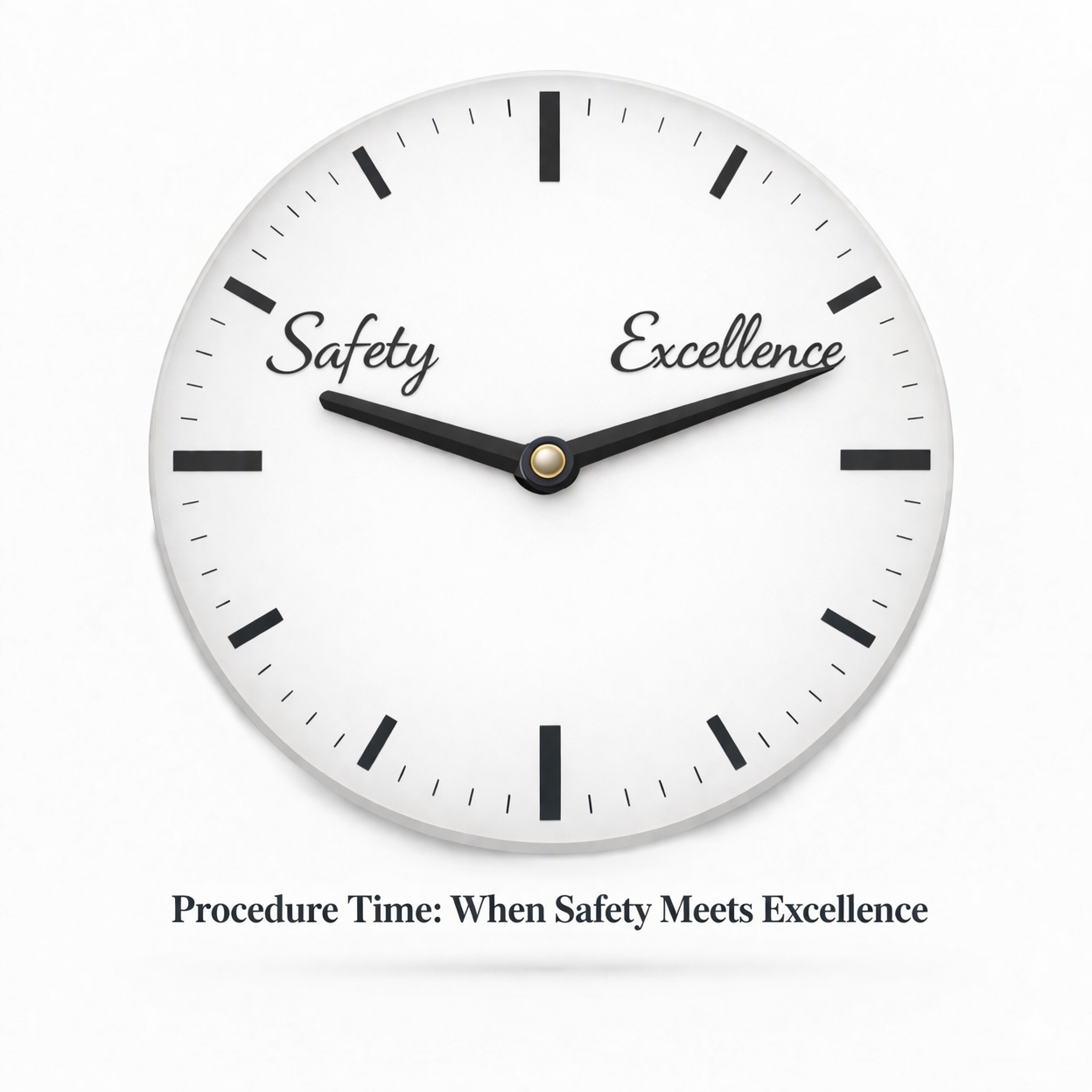
One thing I like patients to understand is that in the operating room, what matters is not what the clock says — it’s the status of the result and the status of the patient. I tell patients: the procedure is over when I look at the clock, and the short hand is on safety and the long hand is on excellence. That framing tends to be reassuring. And when you get down to it, most patients don’t actually want their surgeon to be in a rush.
To learn more about the deep plane facelift or to schedule a consultation, please call our office or reach out through our contact page.