
Jawline Surgery vs. Looksmaxxing: 4 Real Ways to Build a Jawline
November 01, 2026 | Chin Enhancement
By Adam Bryce Weinfeld, MD · Board-certified plastic surgeon · Austin, Texas · Updated November 1, 2026
Jawline surgery builds a stronger, more defined jaw by adding to the jaw bone or subtracting what hides it. Dr. Adam Weinfeld uses four approaches: fat grafting for a soft, subtle increase in volume, micronized cartilage grafting for a little more angularity, porous polyethylene implants for real projection, and 3D deep plane neck sculpting when the neck hides the jaw.
In this video
- 0:00 Why looksmaxxing misses the point
- 0:16 Fat grafting: soft, subtle volume
- 0:36 Cartilage grafting: your own or donor rib
- 1:20 Cartilage grafting results
- 1:31 Implants, and why I don't use silicone
- 2:29 Porous polyethylene implants
- 3:03 Chin implant results, and can it be removed?
- 3:34 When it's not the jaw alone: the neck
- 3:56 Neck liposuction and the pinch test
- 4:26 Deep structures liposuction can't reach
- 4:41 3D deep plane neck sculpting
- 5:07 Four approaches, one individualized plan
Key takeaways
- When a jawline looks weak, the problem is usually the jaw bone itself, so the answer is often to add to it: fat, cartilage or an implant.
- Fat grafting gives a very soft, very subtle increase in volume, a couple of millimeters in each direction, and about 70% of the fat injected along the jaw lasts.
- Micronized cartilage, your own or donor, is injected against the jawbone through small incisions inside the mouth while you're awake.
- Dr. Weinfeld has an 18-year history with porous polyethylene implants and uses them rather than silicone. Your tissue anchors to them, and he has removed them twice without problems.
- Sometimes the jaw isn't the problem: fat, a large submandibular gland or a bulky digastric muscle in the neck can hide it, and liposuction can't reach the deep structures.
What are great ways to build a stronger jawline?
It depends on what your face needs. There are four approaches to jawline surgery: fat grafting, cartilage grafting, porous polyethylene implants and 3D deep plane neck sculpting, used alone or combined.
Let me tell you why I don’t love the word looksmaxxing. First of all, that word is a little bit cringy, I think. But the reason I take objection with that word is that I think it underestimates the importance of creating a masculine appearance for someone that is natural or even dramatic.
The jaw is an important area that we can augment when we are trying to achieve an improvement in the masculine appearance. When a jawline looks weak, the problem is usually the jaw bone itself, which is why the answer is often to add to it.

Can fat grafting improve the jawline?
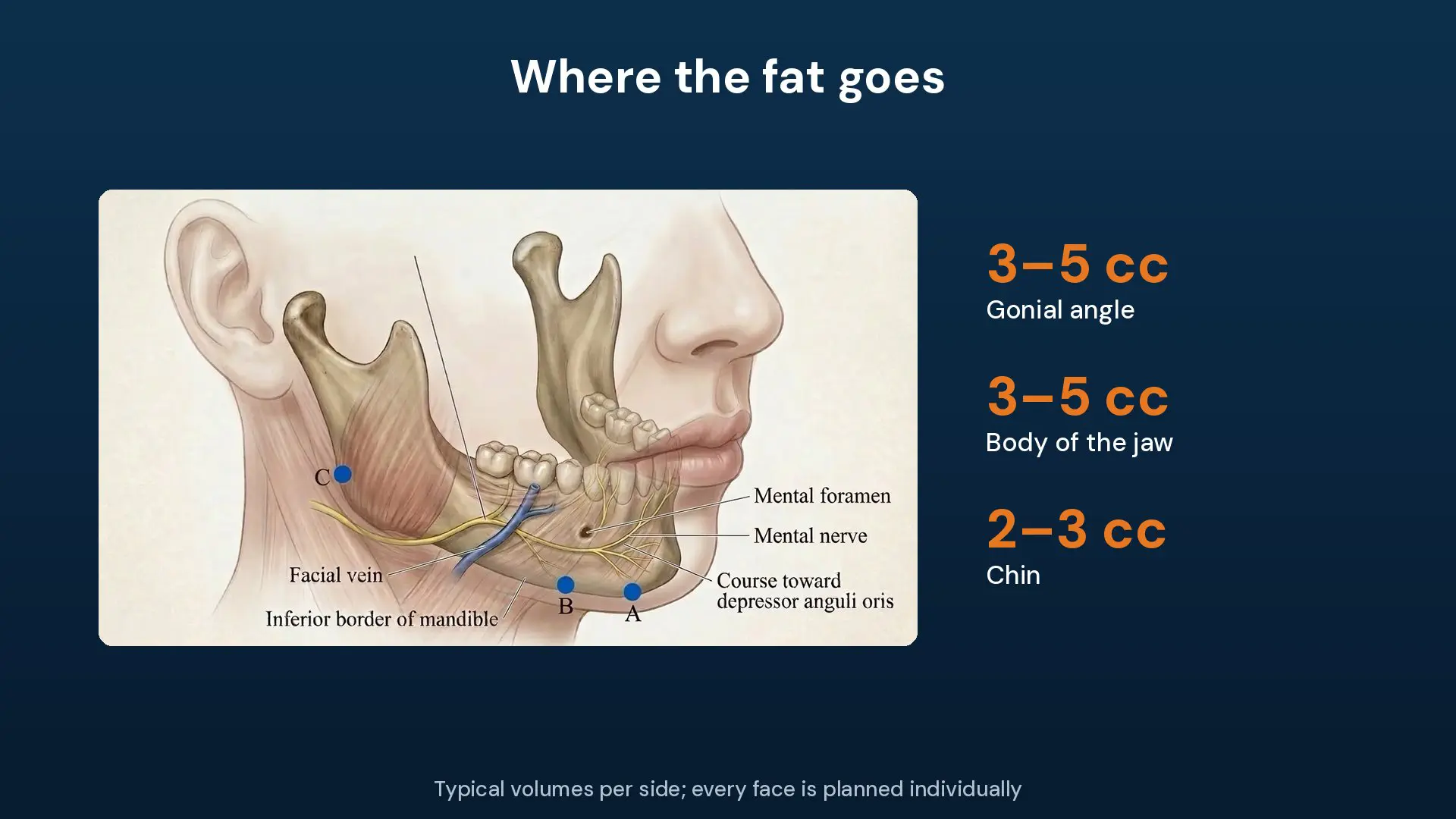
Yes, when you want a very soft, very subtle change. Fat grafting uses your own fat, placed along the angle of the jaw, the body of the jaw and the chin.
If someone’s looking for a very soft, very subtle increase in the volume, perhaps a couple of millimeters this direction, a couple of millimeters that direction, that’s where fat grafting is really quite excellent.
How long does fat grafted to the jaw last?
About 70% of the fat injected along the jaw lasts, meaning it is not resorbed. It can then fluctuate in volume, up and down, with changes in weight, but what ends up living should stay there long term and just mimic the behavior of fat elsewhere in the body, where it was taken from.
If you want a little more angularity than fat can give, that’s where cartilage grafting or a porous polyethylene implant comes in.
What is micronized cartilage grafting to the jaw?
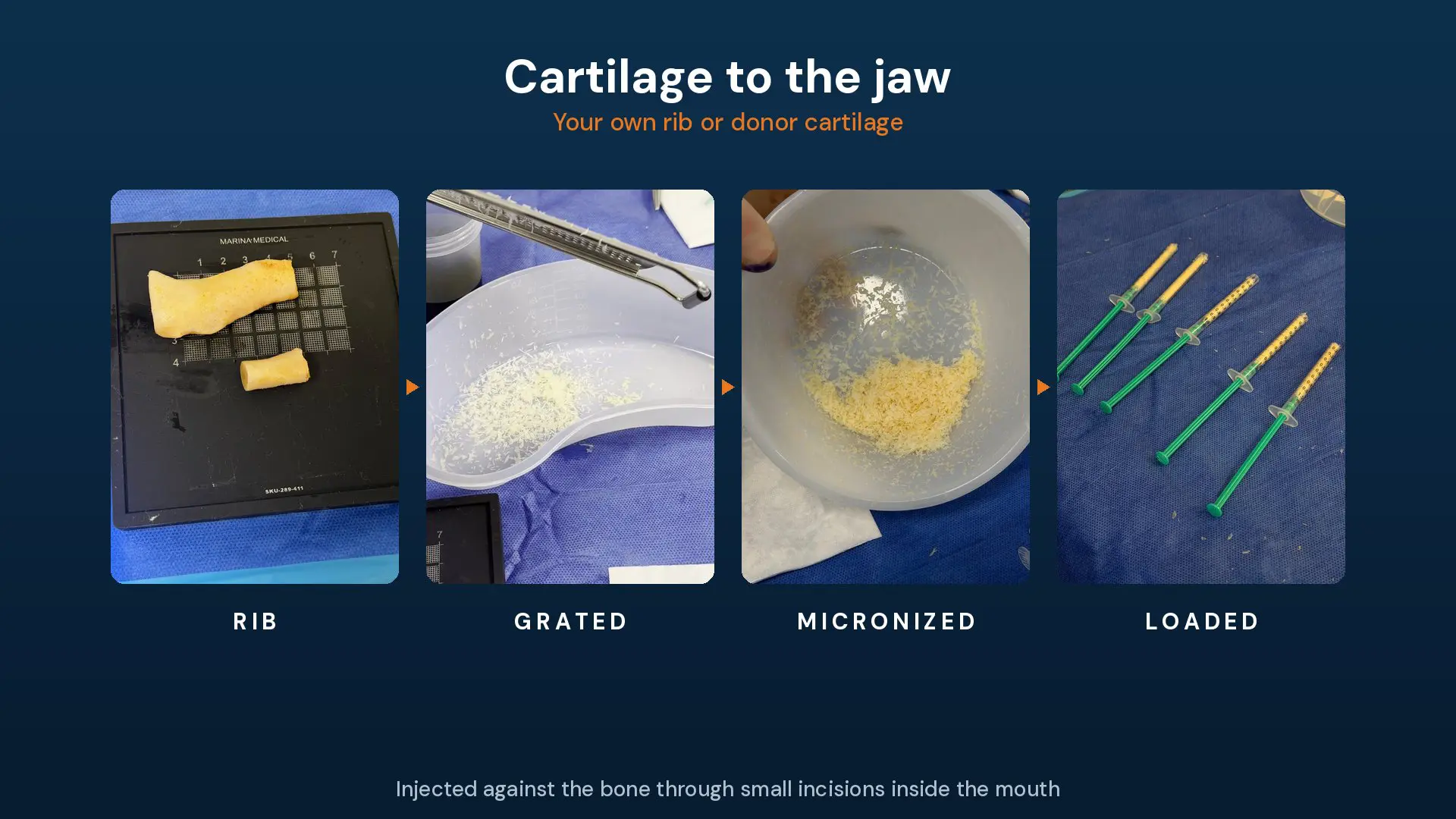
It’s a newer procedure Dr. Weinfeld developed: cartilage, either your own or donor cartilage, is micronized and injected against the surface of the jawbone and chin through small incisions inside the mouth, while you’re awake.
If you want a little bit more, I’ve developed a new procedure that can be really, really effective. It involves using cartilage, whether it be a patient’s own cartilage or donor cartilage, through small incisions in the mouth, and, get this, while the patient is awake. I’m injecting, if you will, that cartilage against the surface of the bone.
How does cartilage on bone work?
You may be thinking: cartilage, bone, how does that work? Let me tell you a little secret. Did you know that cartilage has less resorption against the surface of the bone than actual bone? It’s interesting. It’s more effective.
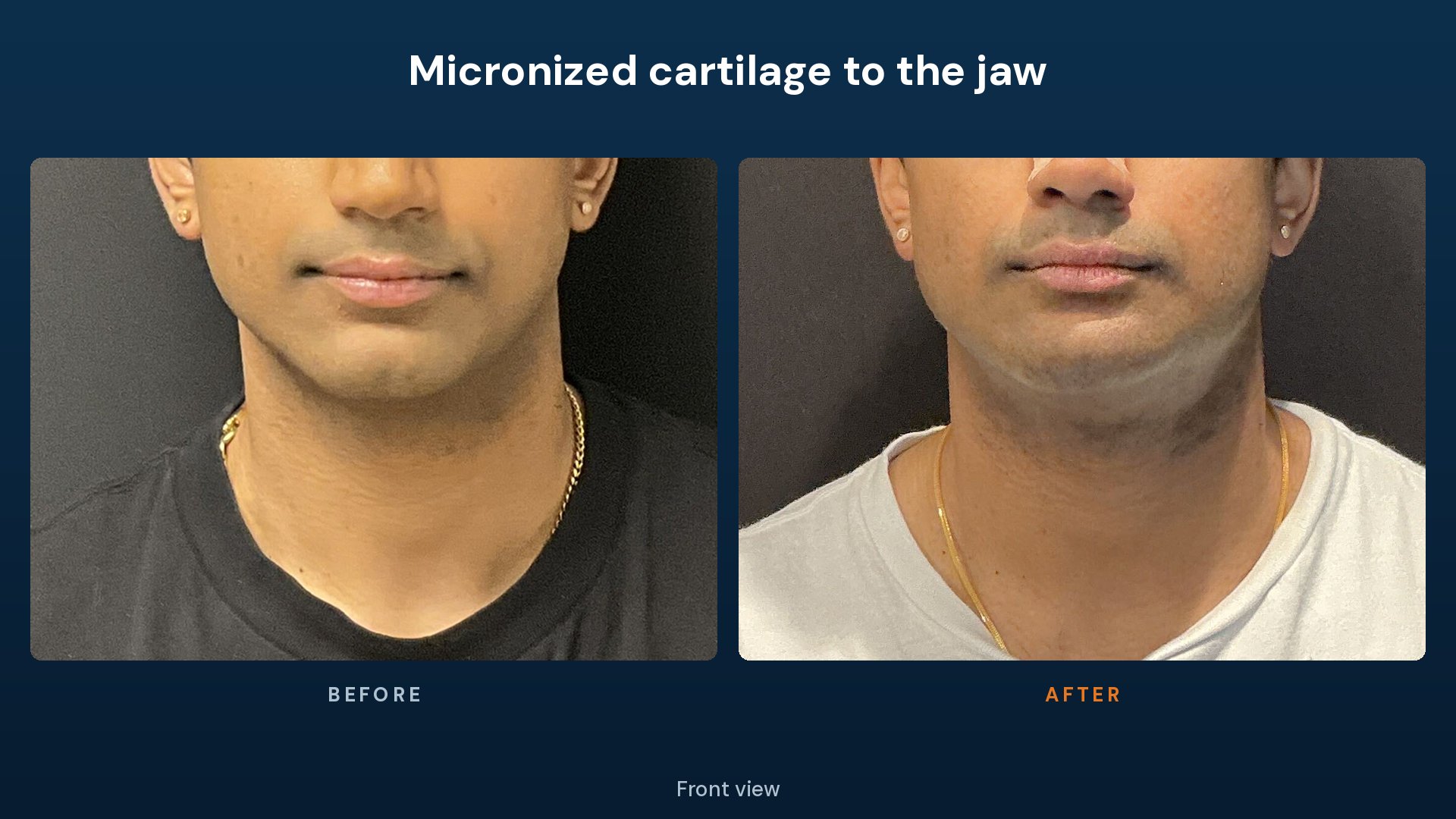
And what happens to that cartilage? The periosteum, the lining on the surface of the bone, can actually turn that cartilage into a bone-like substance. So cartilage grafting along the border of the mandible (the jawbone) and along the chin can give even more of a sharp appearance to a jaw, when that’s what a patient wants.
When do you need a chin or jaw implant?
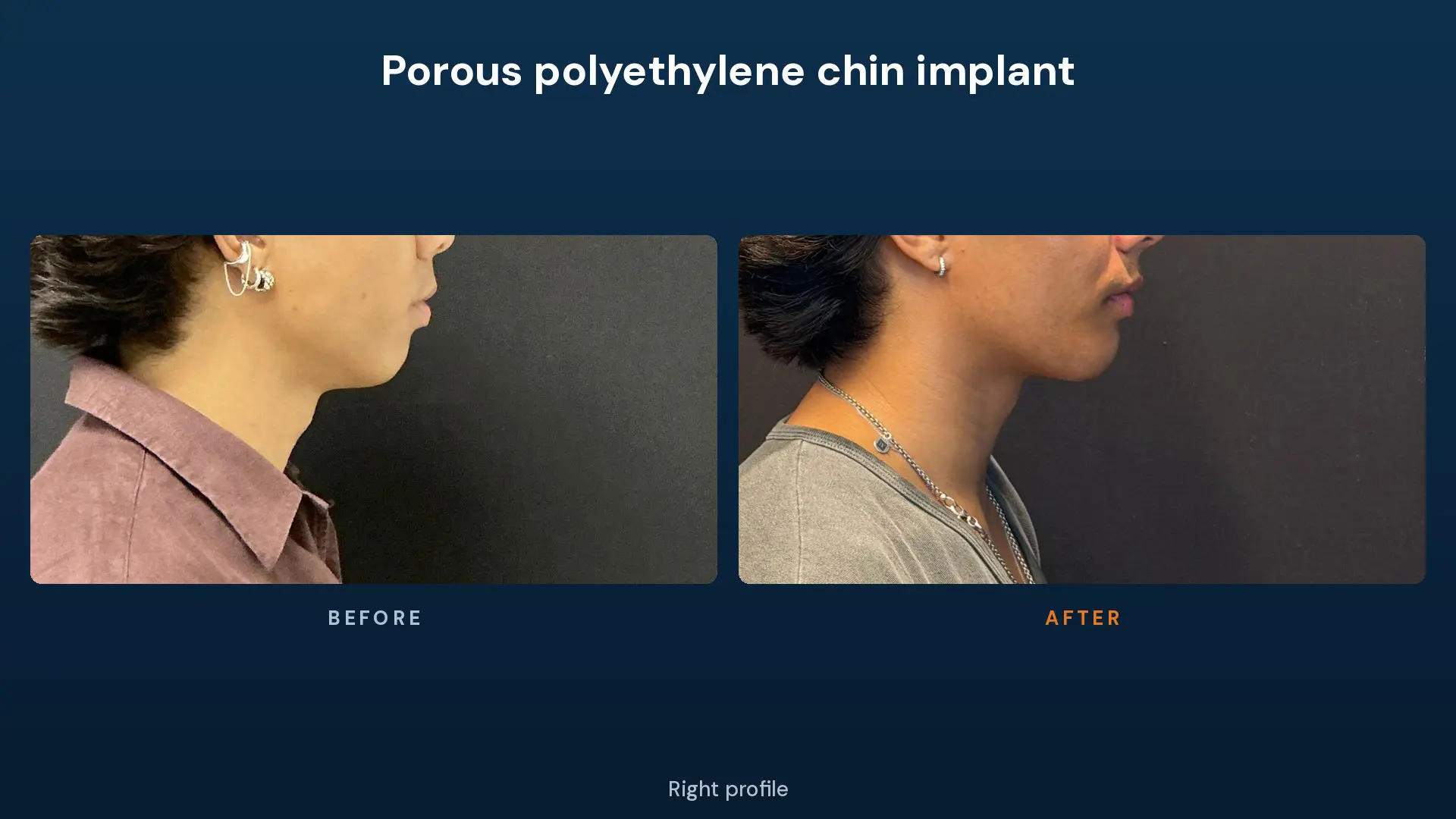
When you need a lot of projection in the chin, more chin height, or real definition at the gonial angle, the back corner of the jaw. That’s where a chin implant or jaw angle implant comes into play.
What if a patient needs a lot of projection in the chin, or even some lengthening, heightwise, of the chin, and maybe even wants to add a significant amount of definition to the gonial angle, to the back of the jaw? That’s where implants come into play.
Why doesn't Dr. Weinfeld use silicone chin implants?
Before you choose to have an implant, I want you to know this: I don’t use silicone implants. A lot of patients have them done, and a lot of good doctors use silicone implants. But let me tell you why I don’t like them.
Part of the reason is that they move. Even if you screw them in place, they still have a tendency to move a little bit. Another reason, and this is well established in the scientific literature, is that they can lead to some bony resorption. I have taken out chin implants where there’s been enough bony resorption that there’s almost a bony shell around the outer edges, because it’s like that implant burrowed down into the bone.
What is a porous polyethylene chin implant?
I like to use porous polyethylene implants. That’s a fancy term for an implant made out of essentially a plastic called polyethylene, but it’s porous. That means it has open structures on the outer surface, little rough patches, and the great thing about those rough patches is that your body can anchor to them.

I have an 18-year history using porous polyethylene implants, in the jaw, the chin and the cheeks.
With a silicone implant, in some ways your soft tissues are supporting the implant. When you’re using a porous polyethylene implant, the implant is actually supporting the overlying tissues. In my opinion, my observation, that shapes the chin and jaw better, with less potential, if any at all, for bone resorption. I’m sure it happens; I’ve not seen it.
Dr. Weinfeld carves each implant to the face and fixes it to bone with screws, two on each side, so it can’t rotate around a single screw.
Is your jawline problem actually your neck?
Sometimes. Extra bulk in the neck can blunt the cervicomental angle, the angle between your neck and your jaw, and rob you of definition in both. Then it’s not about adding an implant at all; sometimes it’s about subtraction.
What if it’s not just the jaw alone? What if there’s extra bulk in the neck and you don’t have a cervicomental angle, and it’s robbing you of the definition of both your jaw and your neck? How do you go about fixing that? That’s where it’s not about implants at all. Sometimes it’s about subtraction.
When is neck liposuction enough?
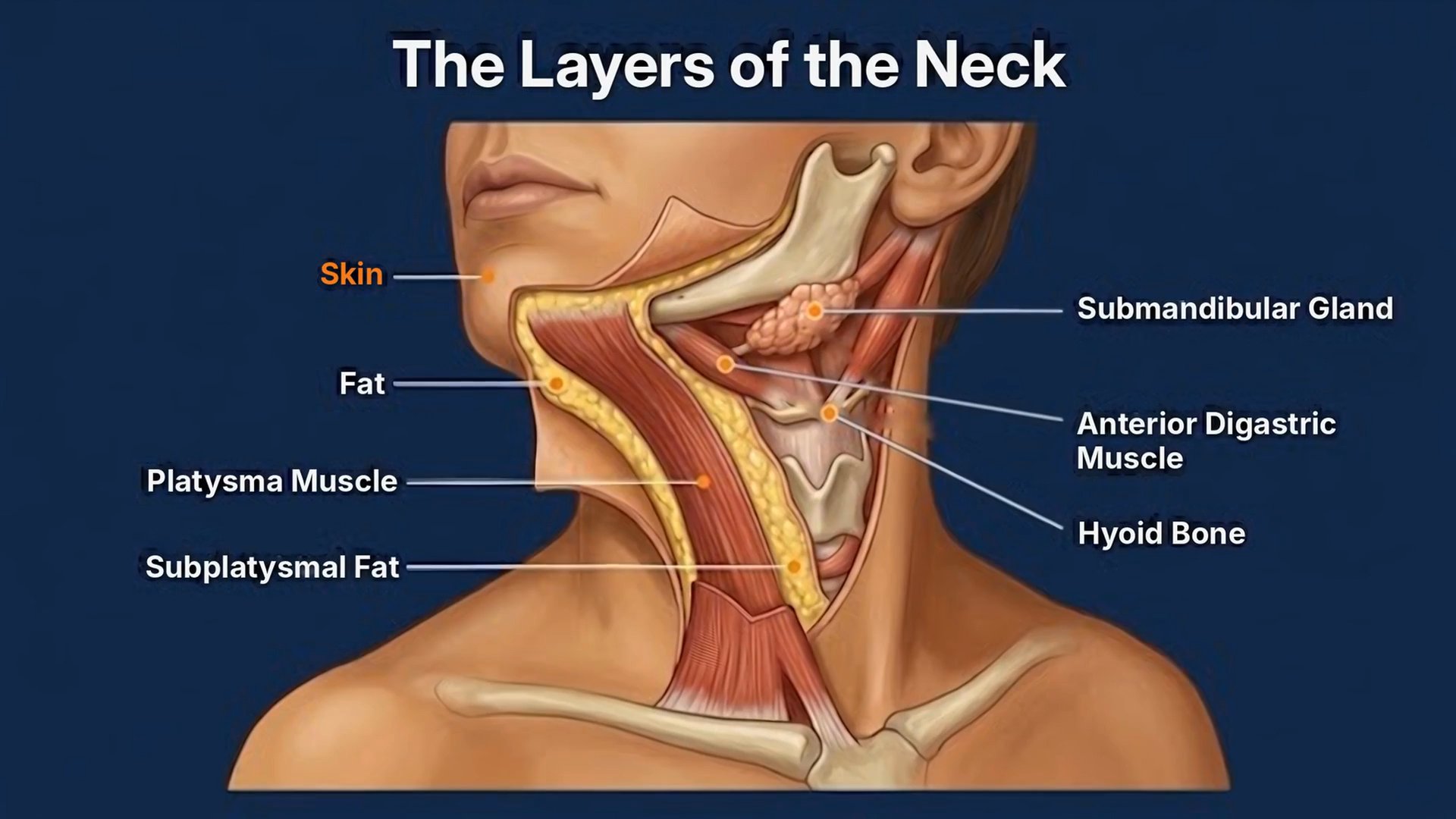
There are two areas that we subtract. One is what we call preplatysmal, or subcutaneous, fat. Sometimes people have a little bit too much fat underneath the skin and above the platysma muscle. The platysma is a thin, broad muscle that goes from the jaw all the way down to the collarbone, if you believe that.
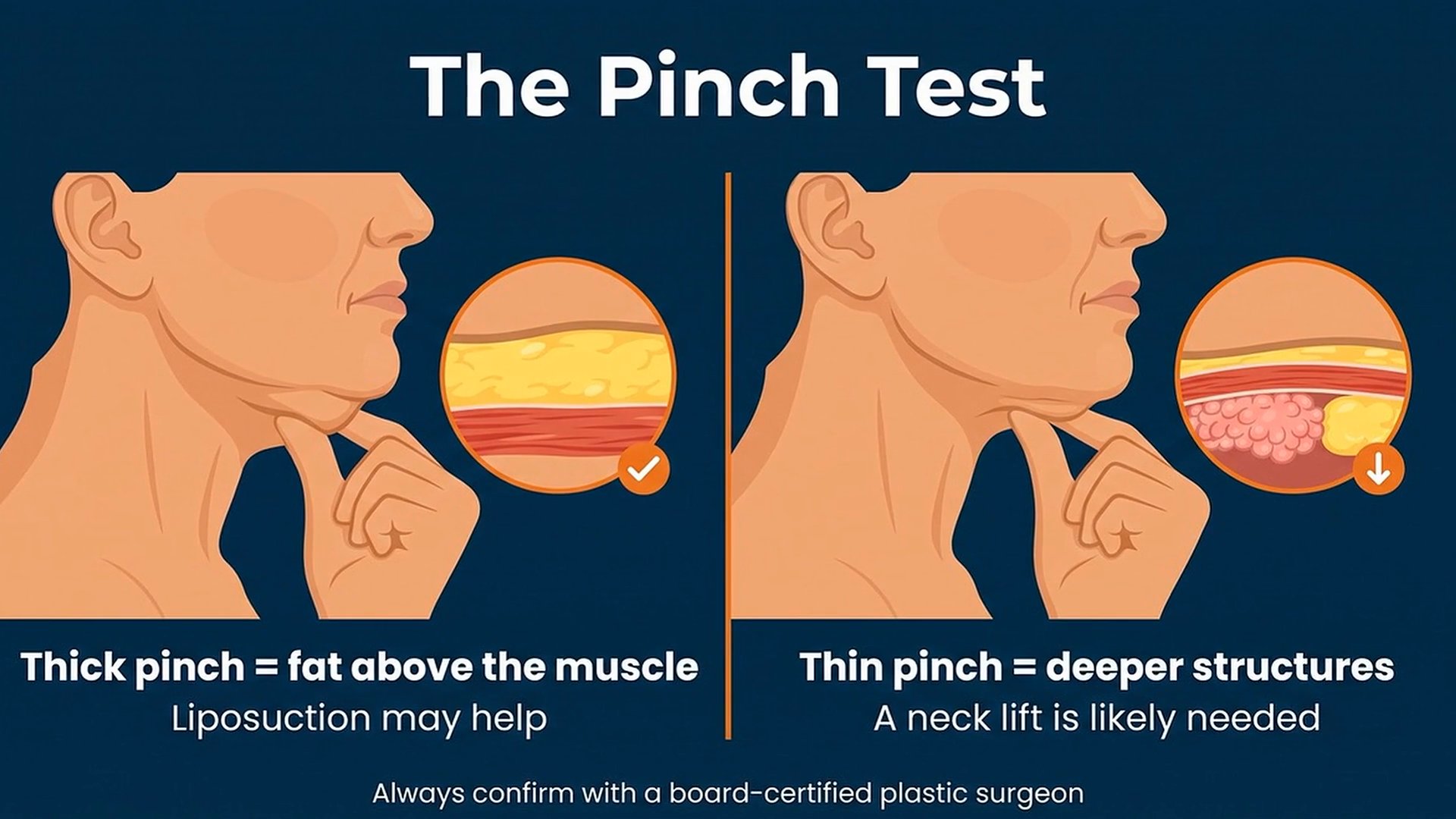
If someone has just a little bit of excess bulk in that area, and a pinch test shows that it’s not deep structures, then what we can do is liposuction: remove a little bit of that fat, enhance the jaw and create more neck definition.
What can't neck liposuction reach?
You want to be really careful before you have liposuction to the neck, before you have chin liposuction. You want to make sure that it is only preplatysmal fat. Often it’s not. Often it’s deep structures: subplatysmal fat, the fat beneath the platysma, a submandibular gland (a salivary gland under the jaw) that’s a little too large, or even a muscle called the anterior belly of the digastric that’s a little bit too large. You can’t get those with liposuction.
What is 3D deep plane neck sculpting?
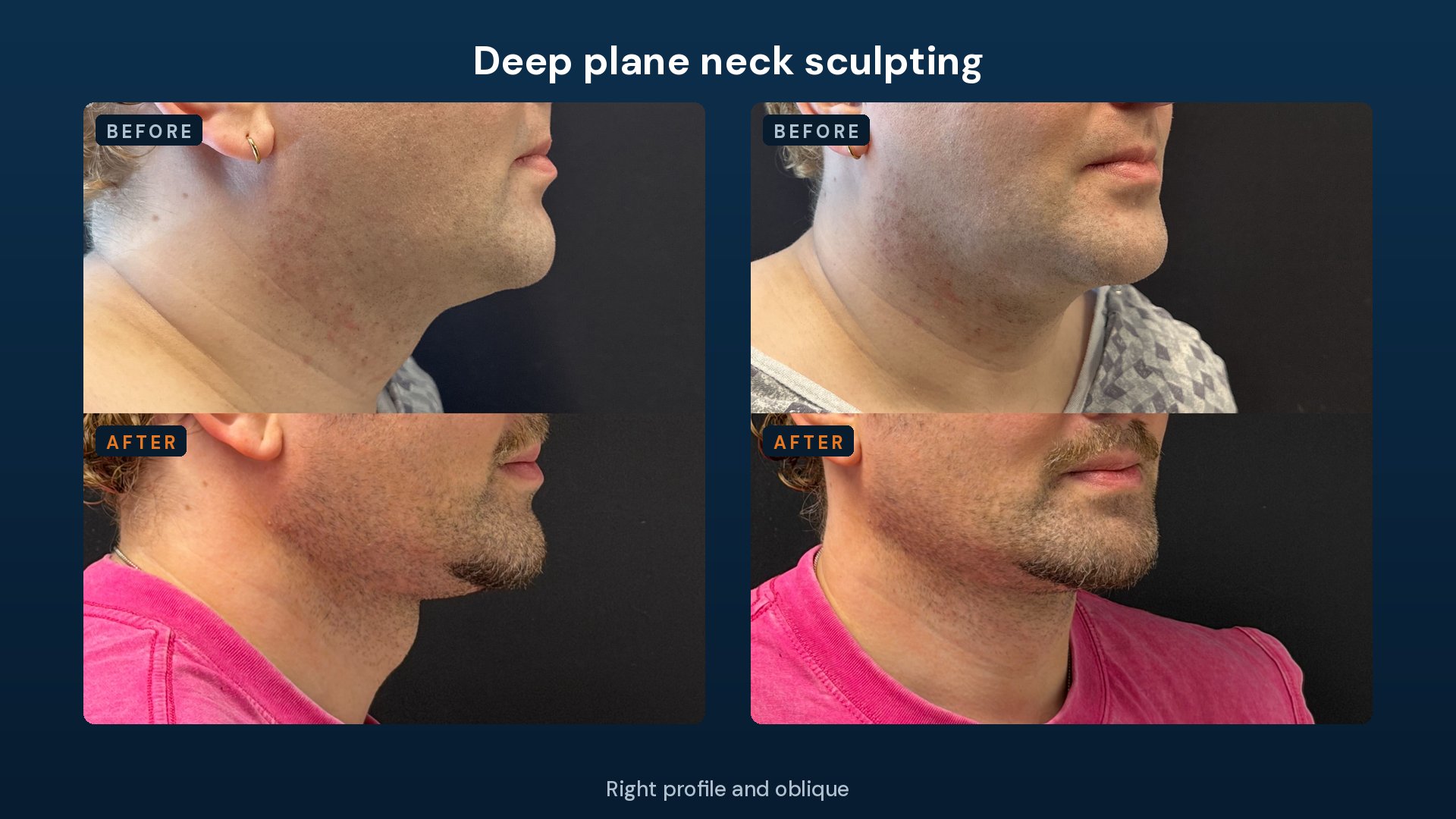
The way we address that is with three-dimensional deep plane neck sculpting: essentially an anterior neck lift, sometimes combined with a posterior neck lift, and sometimes done through just a small, very well hidden incision under the chin, the same incision we place a chin implant through. We can debulk those bulky tissues and further enhance the jaw definition that we got by adding an implant, fat grafting or cartilage grafting.
Dr. Weinfeld is careful not to remove much fat beneath the platysma unless he also reduces the anterior digastric muscles and the submandibular gland, and even thin patients often need those structures addressed. For more on this, see his video Liposuction Can’t Reach This: Neck Lipo vs. Neck Lift.
Who is a candidate for jawline surgery, and what is recovery like?
Most patients are back to work and social engagements in 2 to 3 weeks, sometimes as early as a week. Dr. Weinfeld performs chin implants under general anesthesia, and he says no to anyone who’s still growing or has really poor dental hygiene.
How long is recovery after jawline surgery?
Usually patients are back to social engagements and work in 2 to 3 weeks, but sometimes as early as a week, depending on the patient’s motivation.
Is a chin implant done under general or local anesthesia?
I’ve done chin implants under general anesthesia. I’ve not had a patient ask for one under local anesthesia, but it can be done with the right patient, with the right tolerance for anxiety and discomfort. Micronized cartilage grafting, by contrast, is done while the patient is awake.
Who isn't a good candidate?
I definitely say no to someone who’s still growing, and to someone who has really poor dental hygiene with a lot of cavities, because that can increase infection risk.
Which jawline approach fits your face?
It depends on the look you want and what your anatomy shows, and many patients combine approaches. The plan can range from softer and fuller to crisp, clean and chiseled.
So there you go: there are four different approaches to create a more masculine appearance. You can see why we can find it a little bit cringy when we say looksmaxxing, because it’s so much more complex. And frankly, it’s so much more awesome than that.
We have so many great options to bring about an individualized look: just softer, a little bit more full augmentation of the volume through fat grafting, all the way through a really crisp, clean, masculine, chiseled appearance with porous polyethylene implants, potentially combined with some neck work.
Where do chin and jawline fillers fit?
Fillers can work for people who only want modest changes and are hesitant about a lasting result. But in most instances they rarely are as powerful, and they don’t shape the soft tissues as much.
| What you want or what your anatomy shows | What usually helps | Good to know |
|---|---|---|
| A modest change, and you're hesitant about a lasting result | Fillers | Rarely as powerful; in most instances they don't shape the soft tissues as much |
| A very soft, subtle increase, a couple of millimeters | Fat grafting | Your own fat along the jaw angle, the jawline and the chin; about 70% of it lasts |
| A little more angularity, with nothing synthetic | Micronized cartilage grafting | Your own or donor cartilage, through small incisions inside the mouth, while you're awake |
| A lot of chin projection, chin height or definition at the jaw angle | Porous polyethylene chin or jaw angle implant | Carved to the face and fixed to bone; your tissue anchors to it |
| Fullness under the jaw that's fat above the muscle (a thick pinch) | Neck liposuction | Reaches only the fat under the skin, above the platysma |
| Fullness from deep structures: fat beneath the muscle, a large gland, a bulky digastric | 3D deep plane neck sculpting | Sometimes through one small, well-hidden incision under the chin; pairs with an implant or grafting |
Frequently asked questions
Can a porous polyethylene chin implant be removed?
In Dr. Weinfeld's experience, yes. Porous polyethylene has a slightly rough surface that your body anchors to, which is a big part of why it's so stable, so patients ask whether the tissue integrates so much that it can't be removed. He has removed them on two occasions, to exchange for a slightly different size or shape, had no problems removing those implants, and found it easy to put another one back in.
Are you awake for cartilage grafting to the jaw?
Yes. Dr. Weinfeld injects micronized cartilage against the surface of the jawbone and chin through small incisions inside the mouth while the patient is awake. The cartilage can be your own or donor cartilage. It's a newer procedure he developed for patients who want a little more than fat grafting can give: more of a sharp appearance along the border of the jaw and the chin, without an implant.
How much fat is grafted to the jawline?
Typical volumes per side are about 3 to 5 cc at the gonial angle (the back corner of the jaw), 3 to 5 cc along the body of the jaw and 2 to 3 cc at the chin, and every face is planned individually. Fat grafting suits someone looking for a very soft, very subtle increase in volume, a couple of millimeters in one direction and a couple of millimeters in another.
Can a chin implant and a neck lift be done together?
Yes. Dr. Weinfeld can perform 3D deep plane neck sculpting through the same small, very well hidden incision under the chin that he uses to place a chin implant. Debulking the bulky tissues in the neck further enhances the jaw definition the implant creates. Neck work can also be combined with fat grafting or cartilage grafting, depending on the look you want and what your anatomy shows.
Why doesn't Dr. Weinfeld like the word looksmaxxing?
He finds the word a little bit cringy, and he thinks it underestimates the importance of creating a masculine appearance that is natural or even dramatic. Building a jawline is much more complex than the word suggests: it can mean fat grafting, cartilage grafting, porous polyethylene implants or neck sculpting, alone or combined, planned around your anatomy to bring about an individualized look.
About the author
Adam Bryce Weinfeld, MD, is a board-certified plastic surgeon in Austin, Texas, double fellowship-trained in facial aesthetic surgery and oculoplastic surgery, with 19 years in practice. He is a Clinical Associate Professor at Dell Medical School and has authored 33+ peer-reviewed publications and multiple book chapters. His practice is exclusively aesthetic, with an emphasis on the face, with offices in Westlake and North Austin. Read about his training and publications.
Considering jawline surgery in Austin?
Book a consultation with Dr. Adam Weinfeld, board-certified plastic surgeon in Austin, Texas.
Request a consultation512-559-1376 · drweinfeld.com
This article is for education only and is not medical advice. Individual results vary. Patient photos are shown with permission and are unretouched. Written by Dr. Adam Weinfeld from his video; edited and formatted with AI assistance.
Full video transcript
Why looksmaxxing misses the point. For facemaxxing, don't come to me. Let me tell you why. First of all, that word is a little bit cringy, I think. But looksmaxxing, the reason that I take objection with that word is because I think it underestimates the importance of creating a masculine appearance for someone that is natural or even dramatic.
Fat grafting: soft, subtle volume. Let's talk about the jaw. The jaw is an important area that we can augment when we are trying to achieve an improvement in the masculine appearance. If someone's looking for a very soft, very subtle increase in the volume, perhaps a couple of millimeters this direction, a couple of millimeters that direction, that's where fat grafting is really quite excellent.
Cartilage grafting: your own or donor rib. If you want a little bit more, I've developed a new procedure that can be really, really effective. And that involves using cartilage, whether it be a patient's own cartilage or whether it be donor cartilage, through small incisions in the mouth, get this, while the patient is awake. Injecting, if you will, that cartilage against the surface of the bone. And you may be thinking, cartilage, bone, how does that work? Let me tell you a little secret. Did you know that cartilage has less resorption against the surface of the bone than actual bone. It's interesting, it's more effective. And what happens to that cartilage? The surface of the periosteum actually can turn that cartilage into a bone-like substance.
Cartilage grafting results. So cartilage grafting along the border of the mandible and along the chin can give even more, more of a sharp appearance to a jaw when that's what a patient wants.
Implants, and why I don't use silicone. Now, what if a patient needs a lot of projection in the chin or even some lengthening, heightwise of the chin, and maybe even wants to add a significant amount of definition to the gonial angle, to the back of the jaw, that's where implants come into play. Before you choose to have an implant, I want you to know this. I don't use silicone implants. Now, a lot of patients have them done. A lot of good doctors use silicone implants. But let me tell you why I don't like silicone implants. Part of the reason I don't like silicone implants is that they move. Even if you screw them in place, which people rarely do, they still have a tendency to move a little bit. Another reason I don't like them, and this is well established in the scientific literature, is they can lead to some bony resorption. I want you to hear this. I have taken out chin implants where there's been enough bony resorption where there's almost a bony shell around the outer edges of it because it's like that implant burrowed down into the bone. That's the other reason I don't use them, okay?
Porous polyethylene implants. I like to use porous polyethylene implants. Now that's a fancy term for an implant that's made out of essentially a plastic called polyethylene. But it's porous. That means it has open structures in it on the outer surface of it, little rough patches. And the great thing about those rough patches is that your body can anchor to those, right? So, in contrast to a silicone implant, where really in some ways your soft tissues are supporting the implant. When you're using a porous polyethylene implant, that implant is actually supporting the overlying tissues.
Chin implant results, and can it be removed?. And in my opinion, my observation, shaping it better, and also with less potential, if any at all, for bone resorption. I'm sure it happens. I've not seen it. Now you may be wondering, because you probably have done a little bit of research, porous polyethylene implants, a little bit of a rough surface. Does the tissue integrate in it so much you can't remove it? And the answer to that in my experience is no. I've had two occasions where I've removed them to exchange for a slightly different size or different shape, and I've had no problems removing those implants. And it's easy to put another one back in.
When it's not the jaw alone: the neck. But what if it's not just the jaw alone? What if it's because there's extra bulk in the neck and you don't have a cervicomental angle? And it's robbing you of that definition of both your jaw and of your neck. How do you go about fixing that? That's where it's not about implants at all. Sometimes it's about subtraction. There are two areas that we subtract: one is what we call preplatysmal or subcutaneous fat. Sometimes people have a little bit too much fat underneath the skin.
Neck liposuction and the pinch test. And above the platysma muscle, the platysma muscle is a thin, broad muscle that goes from the jaw all the way down to the collarbone, if you believe that. And if someone has just a little bit of excess bulk in that area, and if they do a pinch test and we know that it's not deep structures, then what we can do is liposuction, remove a little bit of that fat, enhance the jaw, create more neck definition. But you want to be really careful before you have liposuction to the neck, before you have chin liposuction, you wanna make sure that it is only preplatysmal fat.
Deep structures liposuction can't reach. Often it's not, often it's deep structures, often it's subplatysmal fat. You can't get that with liposuction. Often it is a submandibular gland that's a little too large, and even a muscle called the anterior belly of the digastric that's a little bit too large.
3D deep plane neck sculpting. The way we address that is with three-dimensional deep plane neck sculpting, essentially an anterior neck lift, sometimes combined with a posterior neck lift, sometimes just through a small incision here, very well hidden, the same incision we place a chin implant through, we can debulk those bulky tissues and further enhance that jaw definition, the jaw definition that we got potentially by adding an implant, fat grafting or cartilage grafting.
Four approaches, one individualized plan. So there you go. There are four different approaches to create a more masculine appearance. And see why we can find it a little bit cringy when we say looksmaxxing, because it's so much more complex. And frankly, it's so much more awesome than that. We have so many great options to bring about an individualized look. Just softer, a little bit more full augmentation of the volume through fat grafting, all the way through a really crisp, clean, masculine, chiseled appearance with porous polyethylene implants, potentially combined with some neck work. Really incredible procedures for you guys.