
Different, But Better: A 3.5-Month Rhinoplasty Transformation with Ultrasonic Piezosurgery and Structural Grafting
November 07, 2026 | Rhinoplasty
By Adam Bryce Weinfeld, MD · Board-certified plastic surgeon · Austin, Texas · Updated November 7, 2026
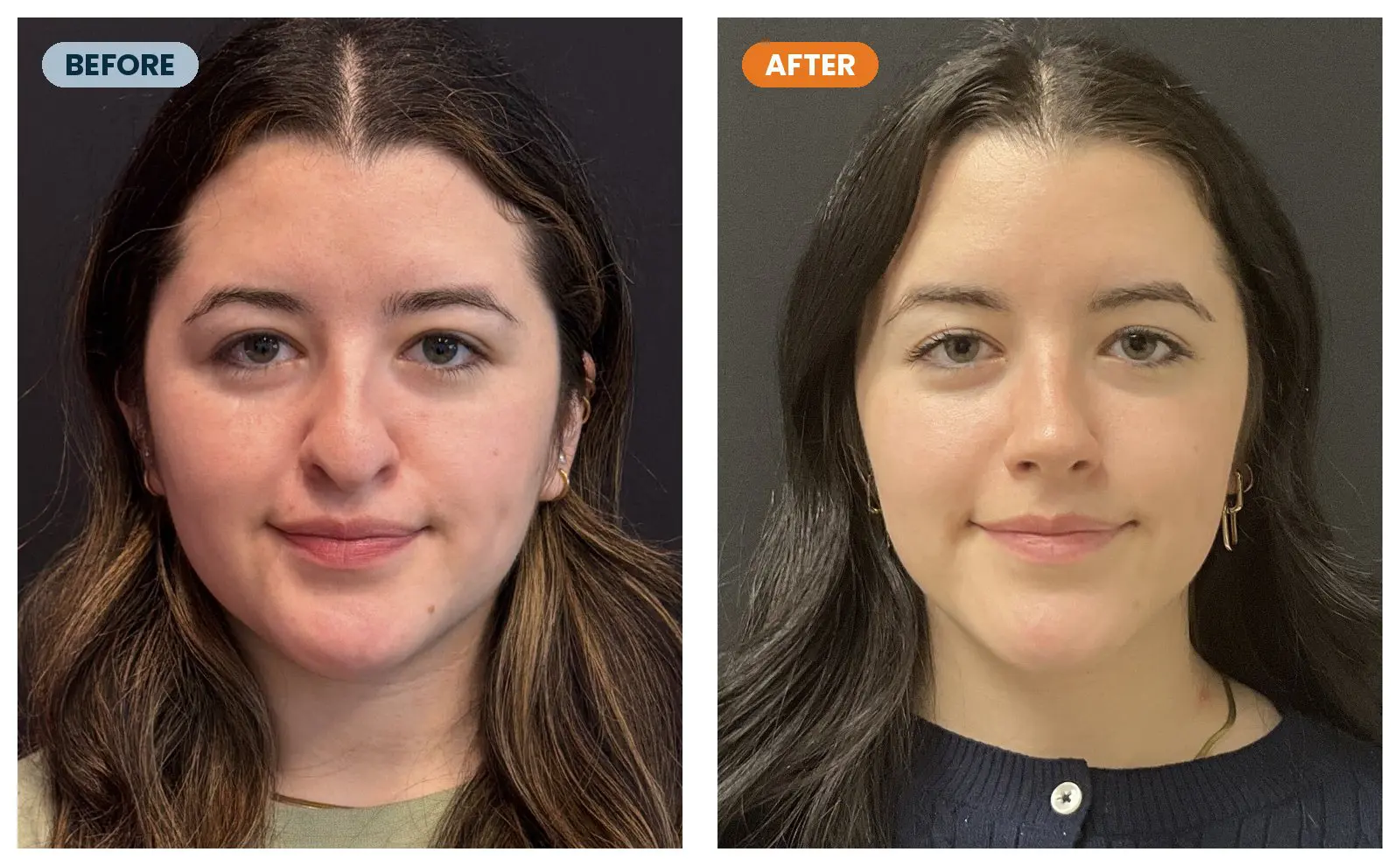
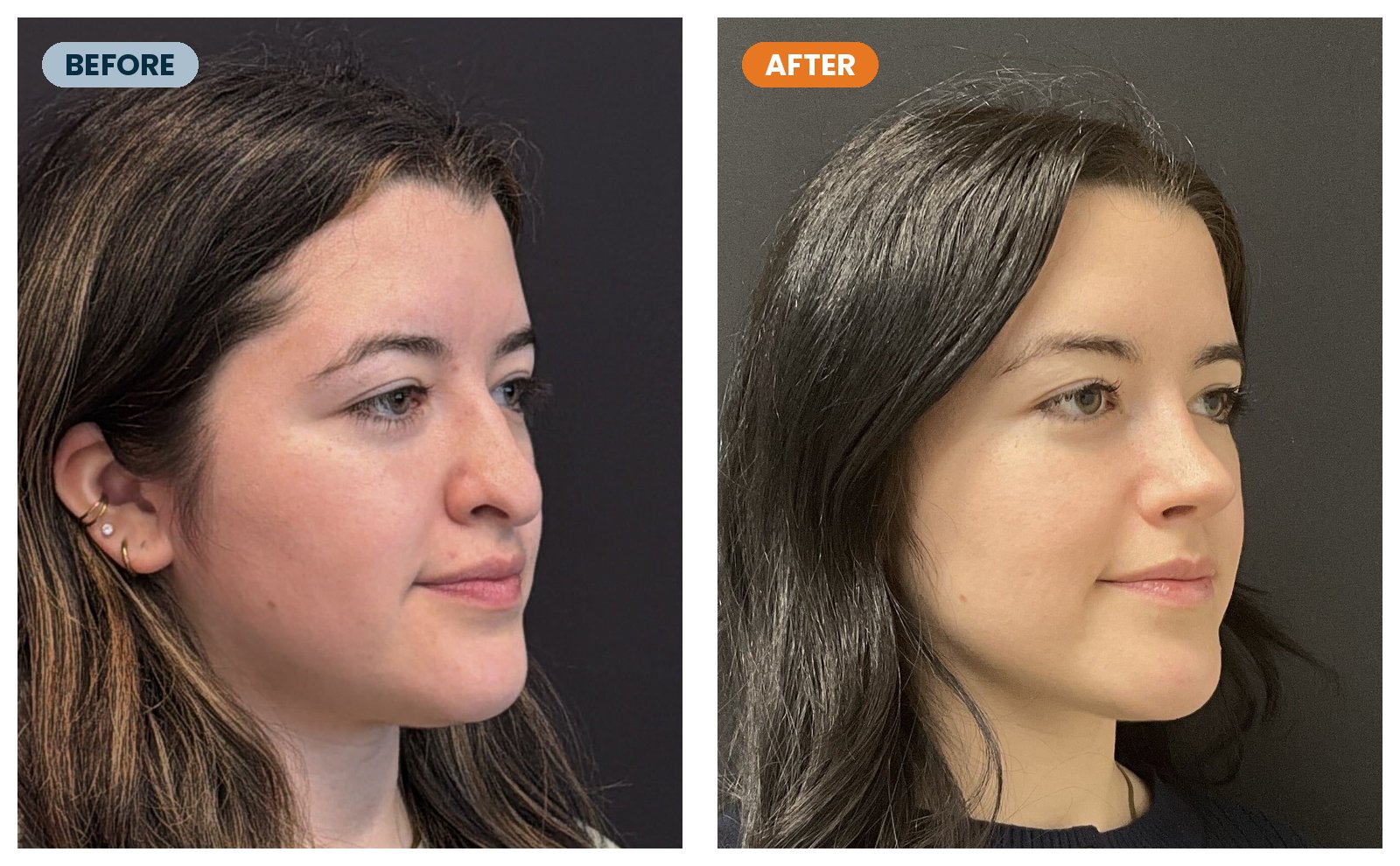
There are two types of rhinoplasties: the same but better, and the different but better. This patient wanted the second. Before surgery, she says, her nose was very bulbous, and from the side it was very flat. She would have been disappointed if she had the same nose. She came to me for a rhinoplasty to make her nose look different, and that’s what she got.
Her anatomy is why a subtle, reduction-only rhinoplasty was never going to be enough. She had extreme tip plunging, significant alar retraction and very thick skin. Getting her there took structure: a septal extension graft for powerful, durable tip rotation, an articulated alar graft to bring the nostril margin down, an alar base reduction, soft tissue work beneath the skin, and precise bone work with the piezotome.
She is about three and a half months out from her rhinoplasty in Austin, Texas. At that point it’s likely that at least 40% of her swelling is still present, so this is an early look. Her one-year results are still to come.
Fast facts
- Procedure: Structural ultrasonic rhinoplasty (piezotome, also called piezosurgery)
- Tip support: Septal extension graft
- Nostril margins: Articulated alar rim graft, leveraging the septal extension graft
- Soft tissue and base: Alar base reduction; sutures beneath the skin to control the empty space that could fill with blood
- Where she is now: About 3½ months after surgery, with at least 40% of the swelling likely still present; it starts to settle at about six months, and her one-year result is still to come
- Breathing: She reports breathing better; her nose was pinching before surgery
Watch the complete 3.5-month post-operative interview with Dr. Adam Weinfeld above (12:06), or use the chapter directory below to jump directly to specific clinical topics and surgical explanations.
Chapters in this video
- [0:00] – Same But Better vs. Different But Better Rhinoplasty
- [0:57] – The Starting Point: Bulbous Tip, Flat Profile and Where to Have Surgery
- [2:16] – Ultrasonic Piezosurgery: Precisely Cutting Bone Instead of Breaking It
- [3:01] – Tip Rotation: On-the-Table Photos vs. the Natural Drop
- [4:22] – Tip Support: Septal Extension Graft vs. Columellar Strut
- [5:31] – Correcting Alar Retraction: Articulated Alar Graft and Base Reduction
- [6:52] – Pain and Bruising: Physiology, Technique and Anesthesia
- [8:37] – What Friends, Family and Coworkers Noticed
- [9:36] – Her Advice for Anyone Considering Rhinoplasty
- [10:09] – The Hardest Part of Recovery: Sleeping Elevated
- [10:42] – Breathing Better: The Pinching She Never Noticed
- [11:06] – The Swelling Timeline: 3.5 Months to 1 Year
What Is the Difference Between a “Same But Better” and a “Different But Better” Rhinoplasty?
▶ Watch this discussion in the video at 0:00
Dr. Weinfeld’s Clinical Take: There are two types of rhinoplasties: the same but better, and the different but better. This patient wanted a different nose, and she would have been disappointed if she had the same nose. Her surgery was transformational, and that transformation truly was to give her a different nose.
Some patients want to keep the nose they have and simply have it look better. Others want a nose that looks clearly different. This patient was in the second group. She was very displeased with the appearance of her nose before surgery, and in the pre and postoperative photographs you can see that her nose is now quite different.
“Before, my nose was very bulbous, and I felt like from the side it was very, like, flat, and I was just, like, not happy with that. I’ve heard things about it my whole life.” — the patient
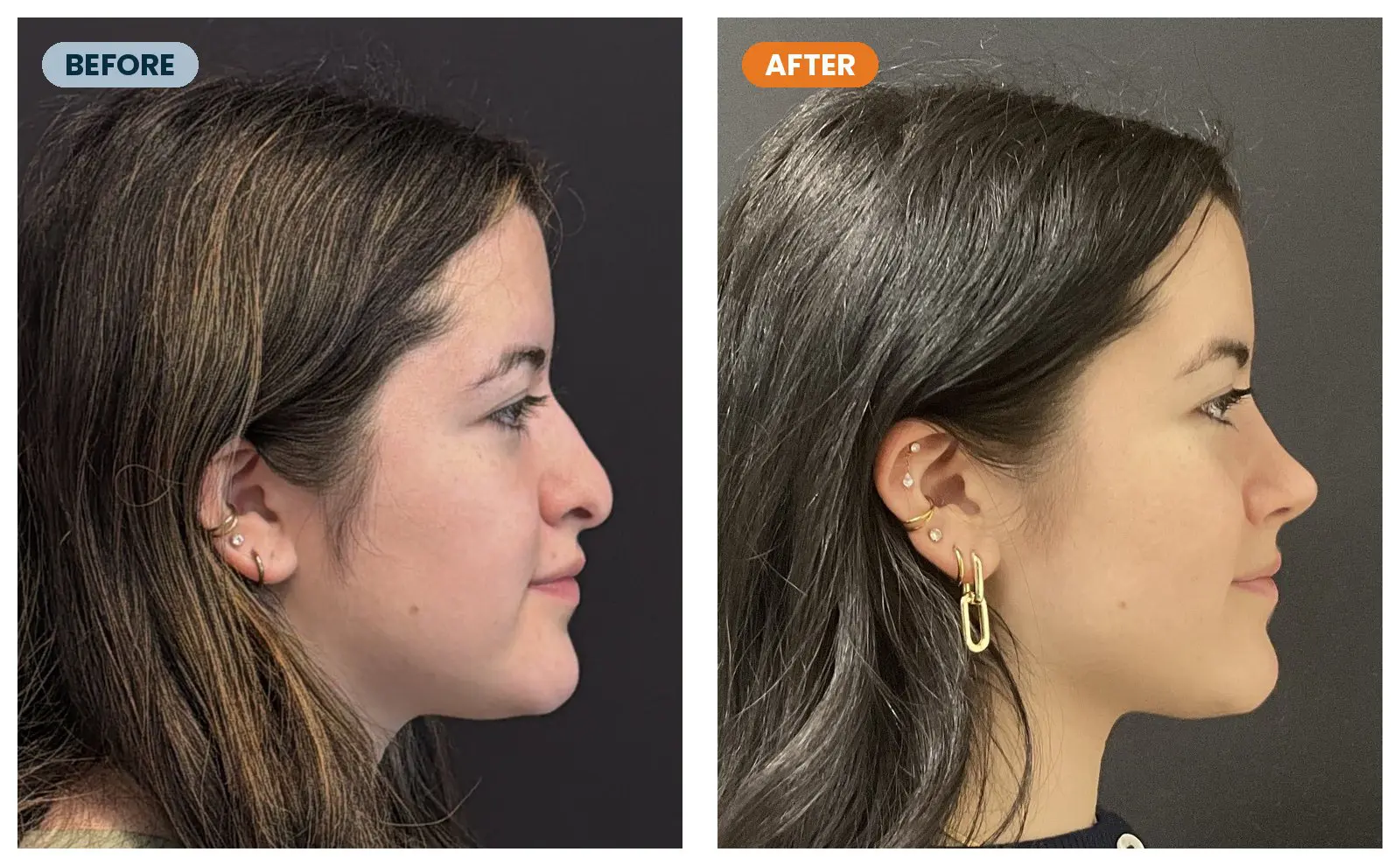
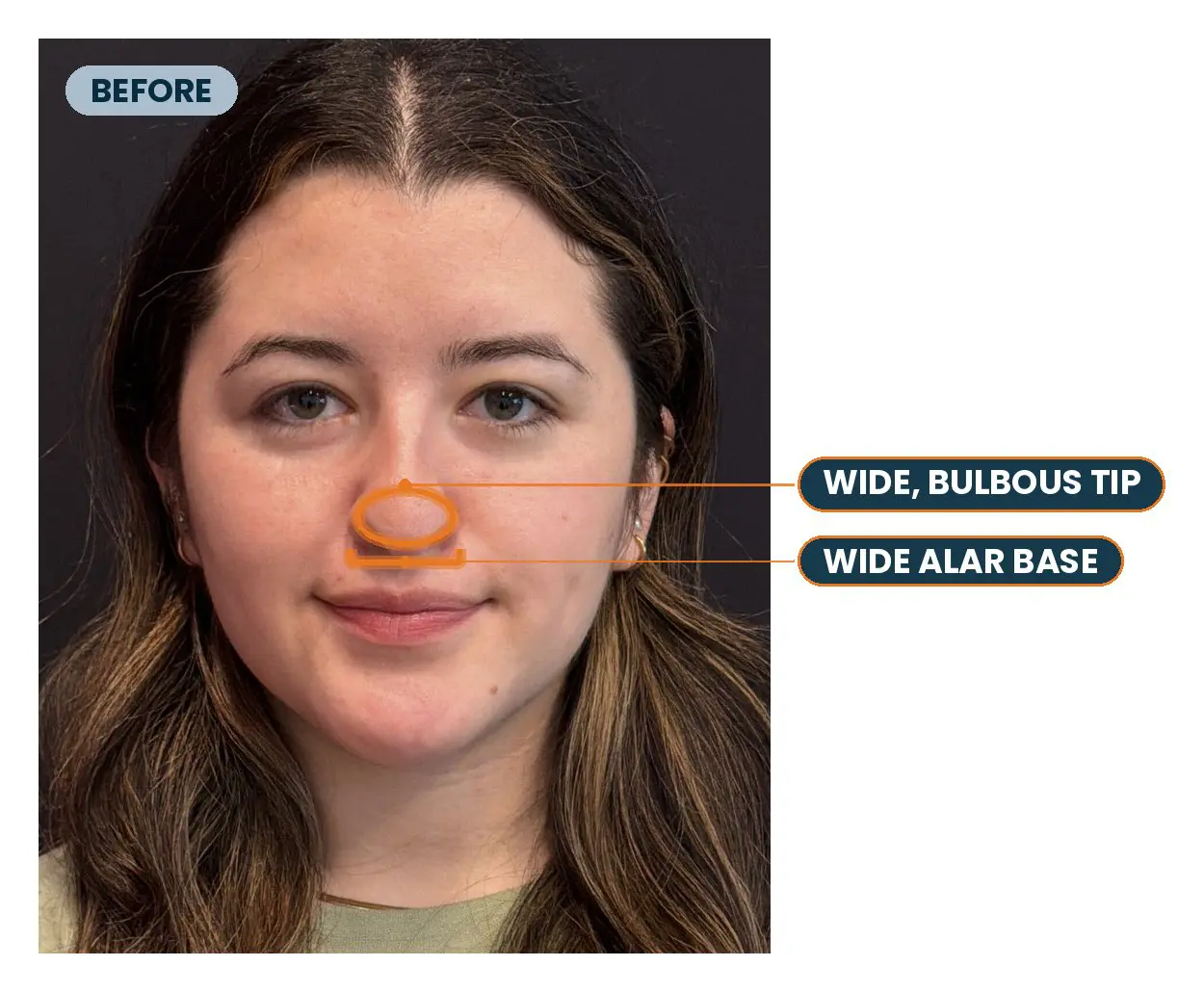
Her anatomy is the reason a small change was never going to be enough. She had extreme tip plunging, significant alar retraction and very thick skin. She also wanted a “swoop” to her profile, something patients ask for a lot. Each of those needed its own strategy, which the sections below walk through.
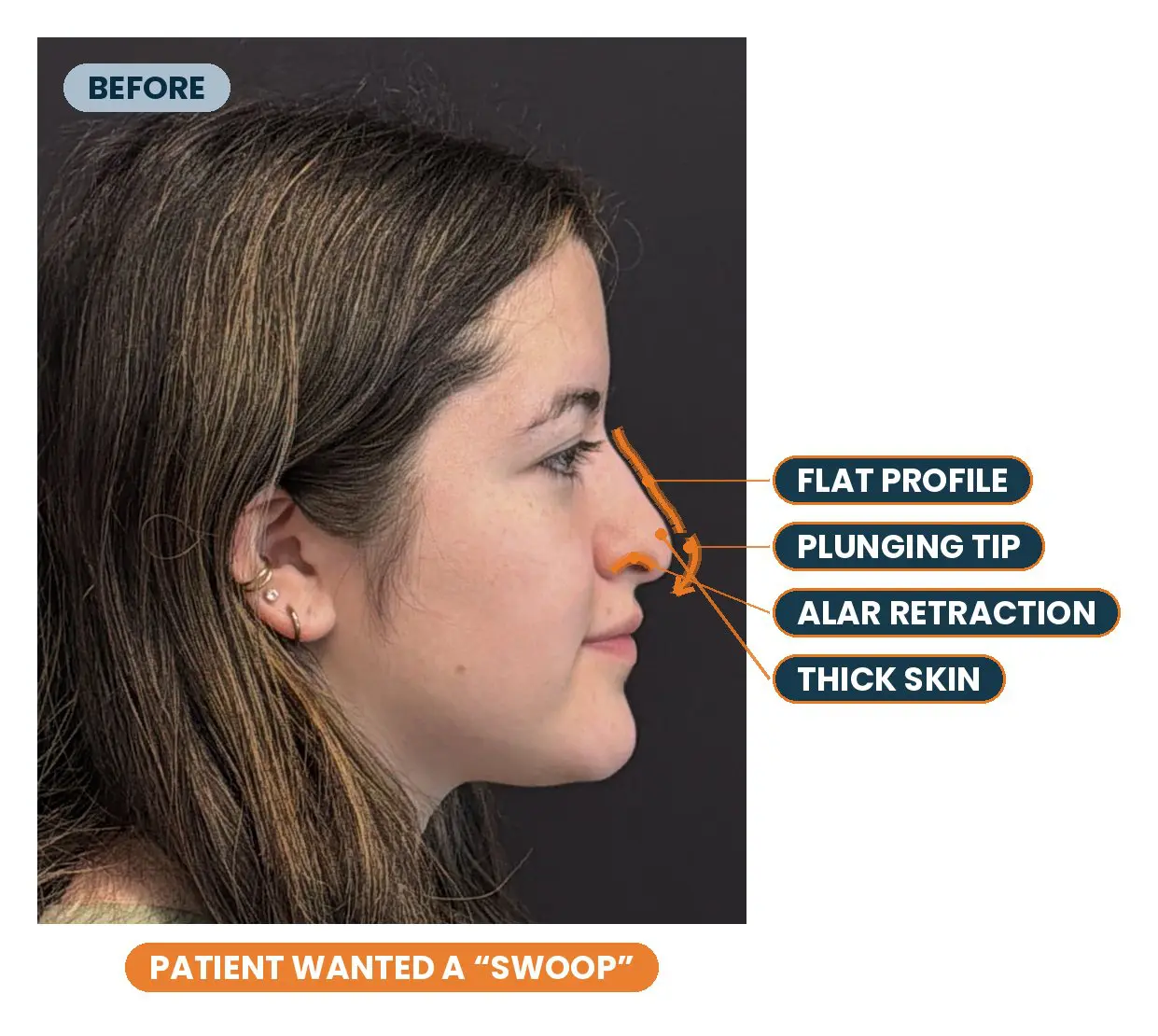
At one point in the interview I suggested she hadn’t asked for a radically different nose. She corrected me: “But I feel like I did.” That is the heart of a different but better rhinoplasty. The goal is set by what the patient wants, and in her case that was a nose that looks different.
What did friends and coworkers notice?
▶ Watch this part of the interview at 8:37
With a change this big, people noticed, and she wasn’t shy about it. “It was definitely all that I could talk about,” she says. Family and friends love it, and her side profile still surprises them.
“Whenever they see my side profile, they’re really like, ‘Whoa, like, I forgot that you got that done.’” — the patient
At work, she says, people were staring “right at my nose” at first, and coworkers made jokes about her being a new employee. As I told her, that’s probably why people were asking, “Who’s the new girl?”
Why Choose Rhinoplasty Close to Home in Austin Instead of Traveling Abroad?
▶ Watch this discussion in the video at 0:57
Dr. Weinfeld’s Clinical Take: There are great surgeons in Mexico, and I know many of them. For this patient, the deciding factor was home: if anything were to happen, she wanted to be where she lives. Swelling takes months to settle, and I see my patients frequently after surgery.
She researched rhinoplasty for a long time before she chose a surgeon, and at first she looked everywhere around the world. When I asked whether she was going to go to Turkey, she told me she had actually been thinking about Mexico.
“If anything were to happen, like, it would be great to just be where I live and be home. I started looking around the Austin area.” — the patient
From there, she looked at videos and vlogs from people who had had rhinoplasty in the area, liked my results, and booked a consultation. One technique in particular drew her in: ultrasonic rhinoplasty.
What Is Ultrasonic Piezosurgery, and Why Use It in Rhinoplasty?
▶ Watch this discussion in the video at 2:16
Dr. Weinfeld’s Clinical Take: In a rhinoplasty, almost always, we do have to cut or break bones and reposition them. The piezotome, also known as piezosurgery or ultrasonic rhinoplasty, allows me to precisely cut the bone instead of breaking it. That gives more control of the cut and more control over the bones.
She remembered it as “hypersonic technique.” The instrument is the piezotome, and the approach goes by several names: piezosurgery, piezo rhinoplasty or ultrasonic rhinoplasty. “That’s what I was really looking for,” she says, and it is part of why she reached out.
The piezotome is wonderful because it lets you make a precise cut rather than a break. I still use both rasps and the piezotome, sometimes alternating back and forth. Technique is also one of the three factors behind bruising and swelling, which I explain in the bruising section below.
Septal Extension Graft vs. Columellar Strut: Which Supports a Plunging Tip?
▶ Watch this discussion in the video at 4:22
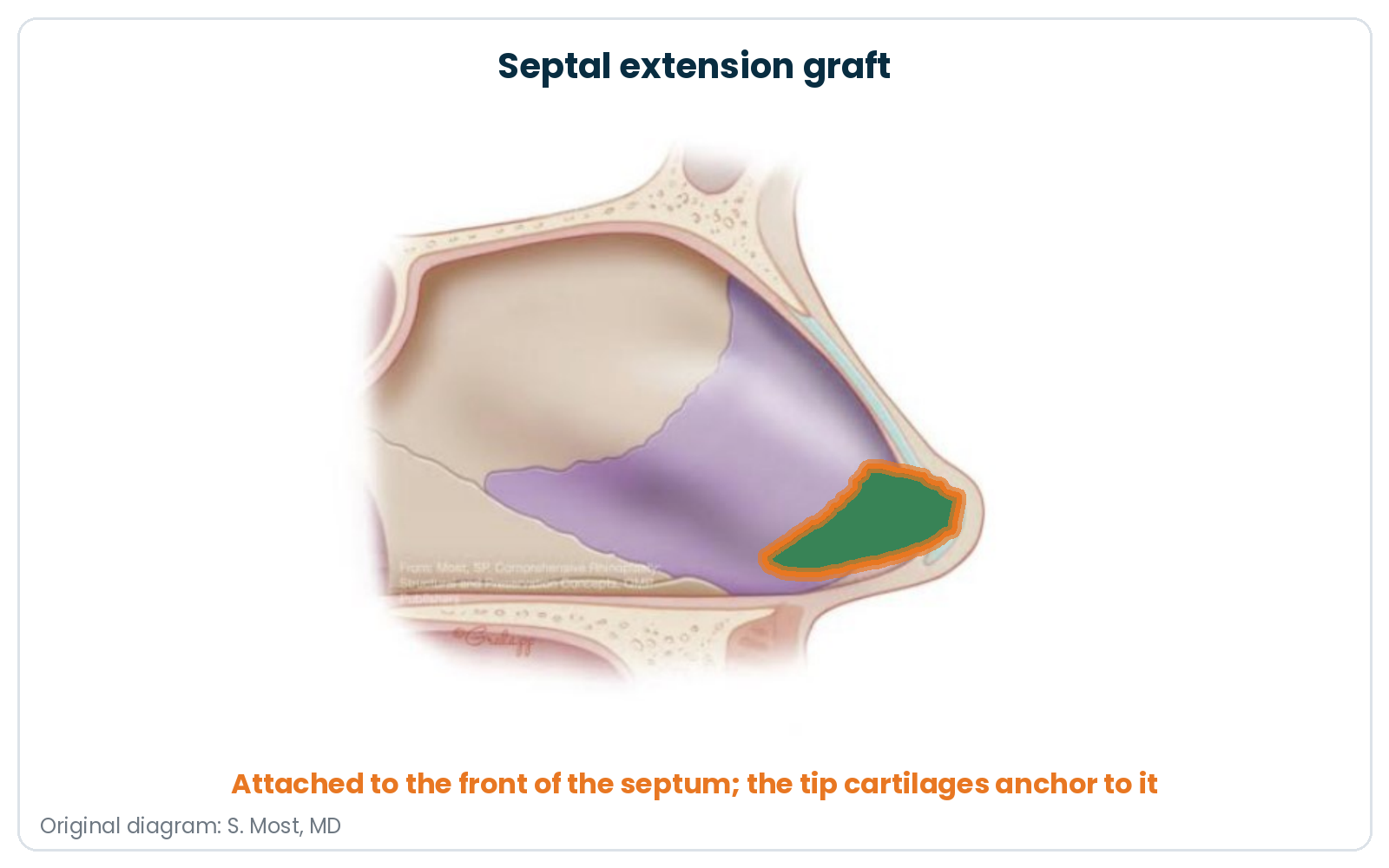
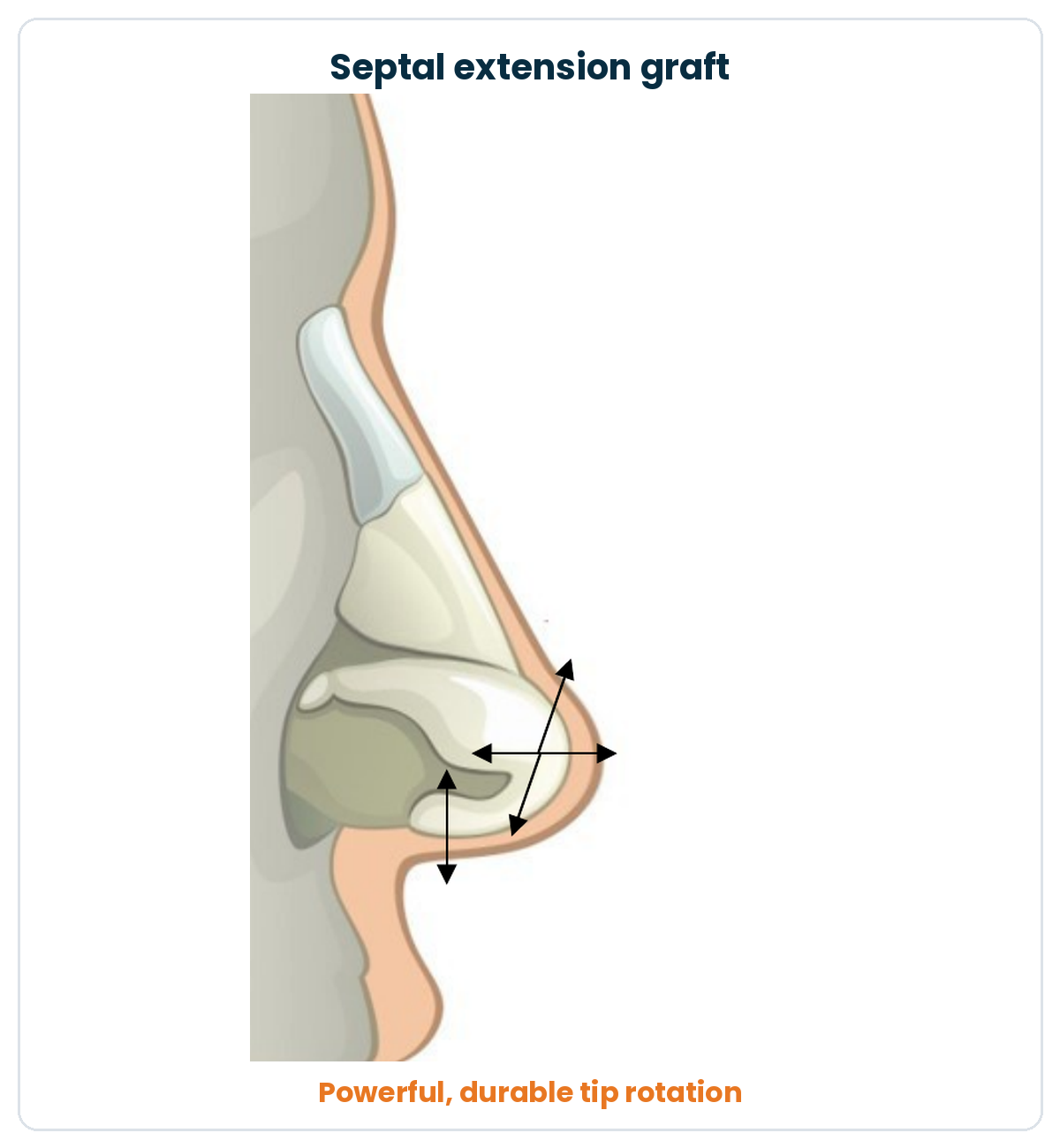
Dr. Weinfeld’s Clinical Take: There are two ways we create tip support: a columellar strut or a septal extension graft. A columellar strut is a smaller piece, somewhat mobile and flexible. A septal extension graft is attached to the front part of the septum, with the tip cartilages anchored to it, for powerful, durable rotation.
The one thing that provided the most power over her tip position and shape was a septal extension graft. Both options involve placing cartilage between the lower parts of the cartilage that create the tip, called the lower lateral cartilages. The difference is how much support and rotation each can provide.
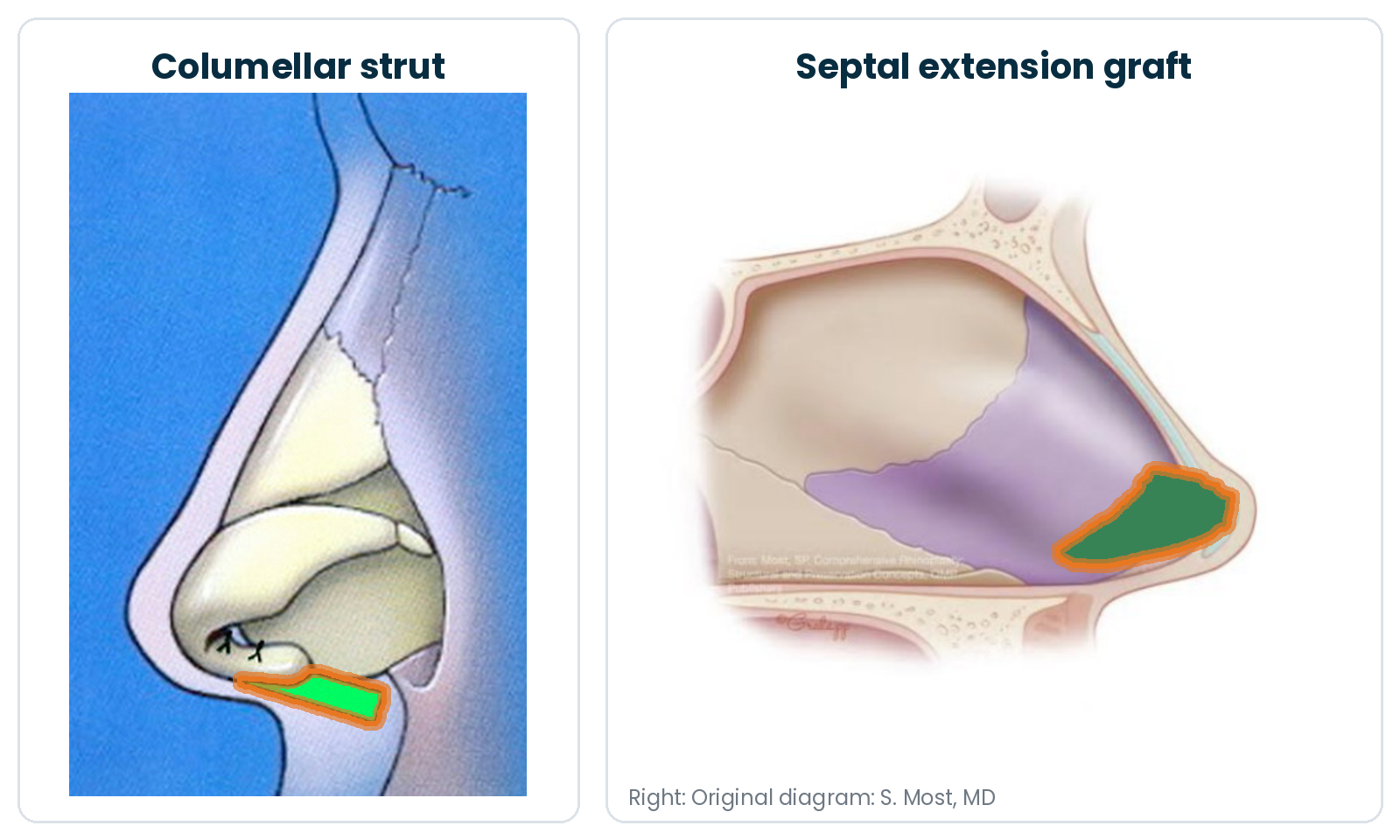
The columellar strut
A columellar strut is a smaller piece of cartilage that’s somewhat mobile and flexible. It is not as helpful for someone who needs a significant amount of rotation, like this patient did. For her, a columellar strut would have been insufficient to bring the tip of her nose to where it needed to be.
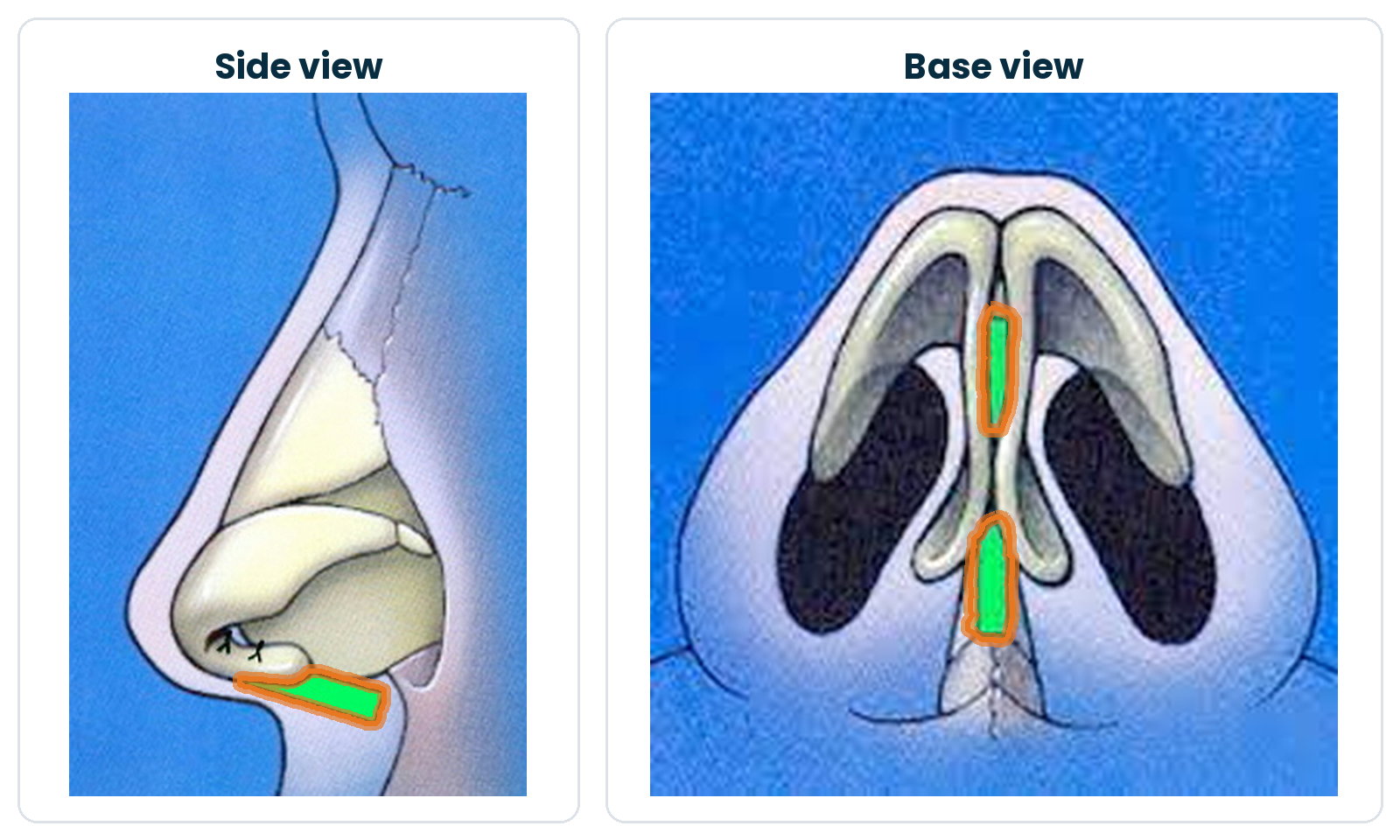
The septal extension graft
A septal extension graft is a graft of cartilage taken from further back in the septum and attached to the front part of the septum. You then anchor the tip cartilages to it. That is what allowed such powerful and durable tip rotation in this patient, something she asked for.
| Columellar strut | Septal extension graft (SEG) | |
|---|---|---|
| Where it sits | Between the lower cartilages that create the tip | Attached to the front part of the septum; the tip cartilages are anchored to it |
| Stiffness | A smaller piece, somewhat mobile and flexible | Nice and rigid |
| Tip rotation | Not as helpful when a significant amount of rotation is needed | Powerful, durable tip rotation |
| Nostril margin (alar retraction) | Not discussed in this case | Lets the lateral crura and an articulated alar graft pull the nostril margin down |
| In her case | Would have been insufficient | Extreme tip plunging, significant alar retraction and very thick skin |
How Much Does the Nasal Tip Drop After Surgery, and What Is the “Table Angle”?
▶ Watch this discussion in the video at 3:01
Dr. Weinfeld’s Clinical Take: She showed me images of a really turned-up nose, and I resisted a little: “Are you sure?” Patients often hear that the tip drops a little after surgery. She has seen a slight drop, but because I used a septal extension graft, I don’t think she’ll see a radical change.
Before surgery, she had modeled out a nose that was really turned up. I asked her to think it over, and she is glad I did. The images she had been looking at were photos taken on the operating table, and they can be misleading.
“When you look at those on-the-table pictures, it kind of looks like the nose is straight up. But you don’t really think about, like, oh, the face is kind of angled one way or another.” — the patient
“I did follow your lead, though. I think your judgment was correct,” she says. She also knew the tip can drop a little after surgery, so she wanted it upturned even after that drop. At three and a half months she has seen “just slightly” of a drop, and she wouldn’t be upset if it dropped more, “because the change was so drastic, I’m so happy.”
How Is Alar Retraction Corrected in Rhinoplasty?
▶ Watch this discussion in the video at 5:31
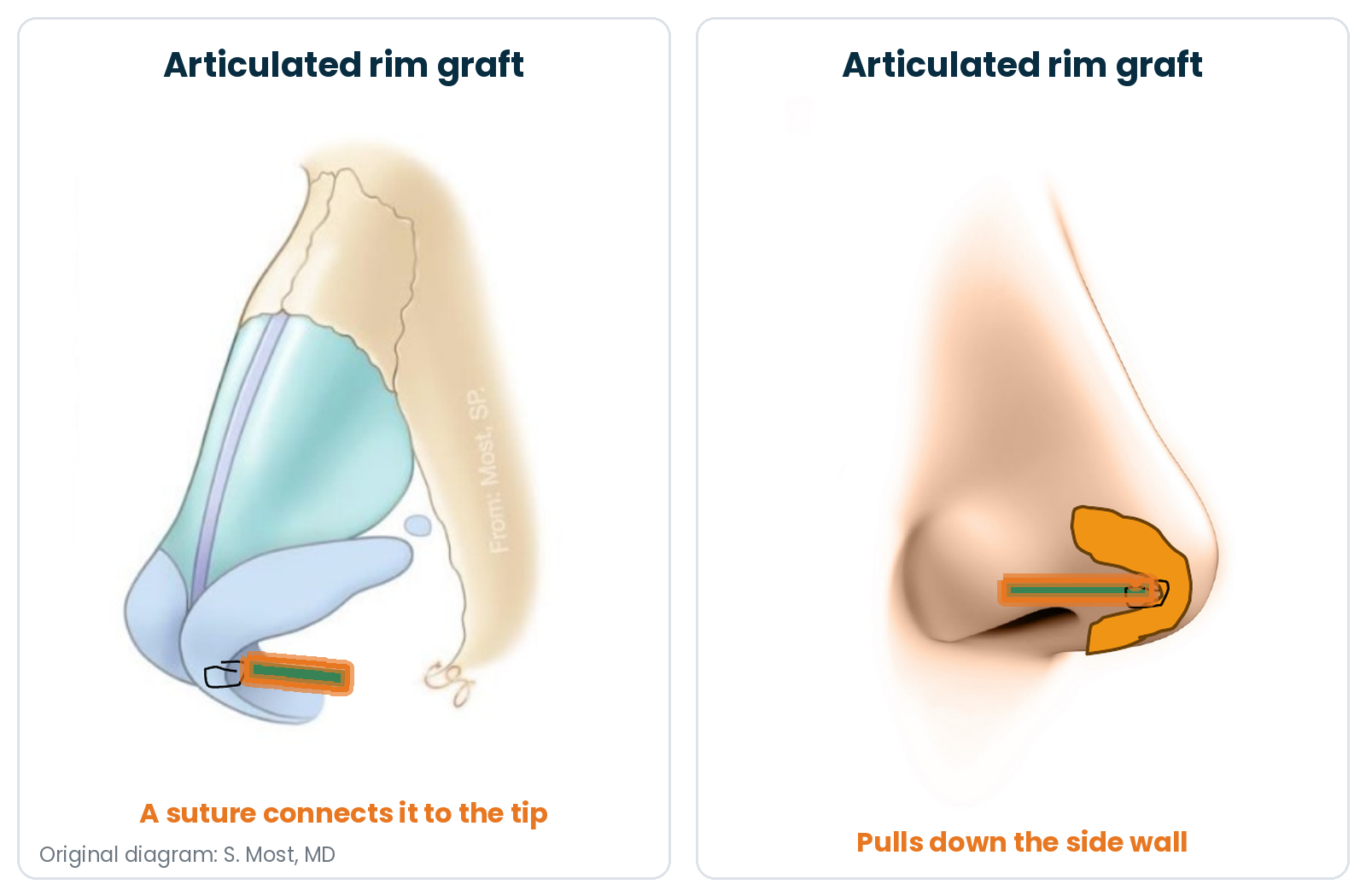
Dr. Weinfeld’s Clinical Take: The septal extension graft, believe it or not, helped a lot with her alar retraction: it lets the lateral crura pull down on the nostril margins. I also used an articulated alar graft, cartilage at the rim sutured to the tip, so the rigid tip support pulls the side wall down.
Alar retraction means the rim of the nostril, the alar margin, sits too high, so more of the nostril shows from the side. She had significant alar retraction, and correcting it took three steps working together.
Leveraging the septal extension graft
The septal extension graft primarily controls tip rotation. But it also lets us use the cartilage in the lower lateral portion of the nose, called the lateral crura, and leverage the power of the septal extension graft to pull down on the nostril margins.

The alar rim graft
An alar graft is a small piece of cartilage placed underneath the skin at the alar rim, the margin of the side wall of the nostril. That piece of cartilage makes the rim a little more rigid.

The articulated alar graft
When we need to really bring that alar margin down, we use an articulated alar graft. A suture connects the middle portion of the alar graft to the tip itself. The tip and its support through the septal extension graft, which is nice and rigid, then help pull down the side wall of the nostril.
Managing the soft tissues
I also reduced her alar base, which was quite wide, and did important soft tissue work with sutures beneath the skin. Those sutures help control the empty space that could fill with blood and make the tip look even thicker, which matters in thick skin like hers.
What Actually Controls Bruising and Discomfort After Rhinoplasty?
▶ Watch this discussion in the video at 6:52
Dr. Weinfeld’s Clinical Take: Three factors contribute to bruising and swelling. First, your physiology: alcohol or refined sugars in the first two weeks are inflammatory, and genetics play a part. Second, technique, including the piezotome. Third, anesthesia: a team of anesthesia providers, handpicked by me for facial procedures, who can have a significant impact.
She describes her pain as very well managed with the medications she was given, and better than she expected, “for sure.” One of them was Journavx, a medication we have that’s been a game changer for pain after surgery. Never stop a prescribed medication without your prescribing doctor.
“I really didn’t feel like I had a lot of bruising. I mean, I’ve seen people that they come out super swollen, super bruised, and I was really, really happy that I didn’t have…” — the patient
The three pillars
Physiology. Your own internal physiology can be affected by what you take in. If you drink a lot of alcohol within the first two weeks, or eat a lot of refined sugars, those are inflammatory and make you swell more. Alcohol can also affect the way your liver makes the proteins that help blood clot. Genetics matter too. She was probably fortunate: she followed our instructions and probably has good genetics.
Technique. There are certain ways I go about things that can help, and the piezotome is one of them.
Anesthesia. We have a really amazing team of anesthesia providers, and for facial procedures they’re handpicked by me, so that I have someone who is familiar with the ways they can have a significant impact.
In my practice, bruising usually peaks at about four to seven days, and patients feel comfortable socially at about seven to eight days after rhinoplasty. More on what that first stretch feels like is in my post on rhinoplasty recovery, pressure and getting back to social life, and on medications in pain, nausea and swelling medications after facelift and rhinoplasty.
How Long Do You Sleep Elevated After Rhinoplasty?
▶ Watch this discussion in the video at 10:09
Dr. Weinfeld’s Clinical Take: When I asked her for one bad thing, she said sleeping up. She’s a stomach sleeper, and sleeping elevated on her back was unavoidable. She used the pillow everyone suggests, made sure not to turn, and went back to stomach sleeping after about three weeks.
Every recovery has a hard part, and I asked her to name one. Her answer came right away: “Sleeping up.”
“I got the pillow, like everyone suggested. Definitely helped. But it’s just different. I mean, I’m a stomach sleeper. So I was dreading that, but, you know, I did it. It felt like it went by pretty quick.” — the patient
Head elevation is good for bruising and swelling. She stayed on her back, made sure not to turn, and was back to stomach sleeping after about three weeks. I have never used nasal packing; I use soft internal splints, and patients use saline through the splints from day one.
How Much Swelling Remains at 3.5 Months, and How Does Breathing Improve?
▶ Watch this discussion in the video at 10:42 and 11:06
Dr. Weinfeld’s Clinical Take: At three and a half months, it’s likely that at least 40% of the swelling is still present. It bounces from side to side like a ping pong game, starts to settle at about six months, and brings more definition and symmetry. Swelling inside means breathing can keep improving too.
If you love it at three and a half months, you’ll be infatuated with it as more of the swelling goes away. We get more definition, and potentially even more symmetry, because swelling sometimes moves from one side to the other. We can see that at three, four, even five months, and it starts to settle out at about six months. Primary rhinoplasty swelling is traditionally down to 40% at three months and nearly zero at one year.
Breathing she didn’t know she was missing
She says she definitely breathes better now. Before surgery, she couldn’t really tell that she wasn’t breathing well, which is so common.
“Whenever you said that, ‘Oh, you can kind of see your nose pinching before,’ I was like, oh, yeah, you can, but I never even thought about that.” — the patient
Swelling on the outside also means there’s swelling on the inside. So if her breathing is already better than it was before surgery, she’s likely to keep seeing improvements she wasn’t even expecting. I can’t wait to show you her results at one year.
Her Advice for Anyone Considering Rhinoplasty
▶ Watch this discussion in the video at 9:36
Asked what she would tell anyone considering a rhinoplasty, she says she would come here again. She also found it reassuring to watch my videos on Instagram before surgery: “I really loved being able to watch your videos, being able to see you explain everything. It made me feel a lot better.”
That’s why I appreciate patients like her sharing their experience. I’m glad we’re in an era where people feel more comfortable talking about procedures they’ve had. If you’re researching rhinoplasty, my rhinoplasty page and rhinoplasty FAQs are good next reads, and how long a rhinoplasty lasts covers the long view.
About the author
Adam Bryce Weinfeld, MD, is a board-certified plastic surgeon in Austin, Texas, double fellowship-trained in facial aesthetic surgery and oculoplastic surgery, and Past President of The Rhinoplasty Society. In 19 years of practice he has authored 33+ peer-reviewed publications and multiple book chapters, and he is a Clinical Associate Professor at Dell Medical School. His practice is exclusively aesthetic, with an emphasis on the face.
Considering a rhinoplasty in Austin?
Book a consultation with Dr. Adam Weinfeld, board-certified plastic surgeon in Austin, Texas.
Request a consultation512-559-1376 · drweinfeld.com
Patient shown: rhinoplasty, about 3½ months after surgery. This article is for education only and is not medical advice. Individual results vary. Patient photos are shown with permission and are unretouched. The patient was not paid for this interview; her comments are her own, given spontaneously and without prompting, and she is not a medical professional. Written by Dr. Adam Weinfeld from his video; edited and formatted with AI assistance.
Full video transcript
0:00 · Same But Better, Or Different?
Dr. Weinfeld: So there are two types of rhinoplasties. There’s the same but better, and there’s the different but better.
Patient: Well, before, my nose was very bulbous, and I felt like from the side it was very, like, flat. … Sometimes they’re just, whenever they see my side profile, they’re really like, "Whoa, like, I forgot that you got that done." … Because the change was so drastic, I’m so happy.
Dr. Weinfeld: You are going to be able to watch an interview I do with a patient of mine who’s about three and a half months out from a different but better rhinoplasty. You can see in the pre and postoperative photographs that her nose is quite different, and she was very displeased with the appearance of her nose before surgery. This surgery was transformational for her, and that transformation truly was to give her a different nose. She would have been disappointed if she had the same nose. She came to me for a rhinoplasty to make that nose look different, and that’s what she got. And she is extremely happy with the results. And you’re going to be able to see that in this video.
0:57 · Why She Chose Rhinoplasty
Dr. Weinfeld: So you are about three and a half months out from your rhinoplasty. Can you tell me, so, what are your sort of initial impressions of the whole experience? Why you had rhinoplasty, and what do you feel like this has done for you?
Patient: Well, before, my nose was very bulbous, and I felt like from the side it was very, like, flat, and I was just, like, not happy with that. Like, I’ve heard things about it my whole life, and I’ve just really got into researching rhinoplasties, and I just thought this might be the perfect, like, answer for me. And so did my research. I found you.
Dr. Weinfeld: How’d you find me, out of curiosity?
Patient: Well, first I was looking kind of, like, everywhere. Like, everywhere around the world.
Dr. Weinfeld: Oh, wow.
Patient: Yeah.
Dr. Weinfeld: Are you gonna go to Turkey?
Patient: I was actually thinking about going to Mexico.
Dr. Weinfeld: Okay, they’re great surgeons there.
Patient: Yeah.
Dr. Weinfeld: Yeah, I know many of them, actually.
Patient: So I was looking there, but then I was just like, well, if anything were to happen, like, it would be great to just be where I live and be home. I started looking around the Austin area. I tried to, like, look at videos, like vlogs of people who have had them around here, and I just really liked your work when I came across it.
2:16 · Ultrasonic Rhinoplasty
Patient: Like, I really liked that, I think it’s called, like, hypersonic technique, or like the…
Dr. Weinfeld: Piezotome. Also known as piezosurgery, or ultrasonic rhinoplasty.
Patient: Ultrasonic, yes. Yeah, that’s what I was really looking for, and, you know, I saw that you did that. I really liked your results. So, yeah, that made me reach out and book the consultation.
Dr. Weinfeld: Yeah, I’m glad you mentioned that. So the piezotome is wonderful because whenever we’re doing a rhinoplasty, or almost always, we do have to sort of cut or break bones and reposition them. The wonderful thing about the piezotome is that it allows you to actually precisely cut it instead of breaking it. And therefore you have more control of the break, the cut, and you have more control over the bones.
3:01 · How Turned-Up Should The Tip Be?
Dr. Weinfeld: You know, one thing I remember is, if I’m not mistaken, you had shown me some images, and you kind of modeled out, like, you really wanted the nose, like, really turned up. And I kind of resisted a little bit. Like, not resisted, but I was like, "Are you sure?" Tell me a little bit about that interaction.
Patient: I am really glad that you did mention something, because I think when I was looking at the pictures, I didn’t realize, like, when you look at those on-the-table pictures, it kind of looks like the nose is straight up. But you don’t really think about, like, oh, the face is kind of angled one way or another. So you do kind of notice that it is more of an upturned nose that you don’t really get in the picture. I did follow your lead, though. I think your judgment was correct, yeah. And I knew that, you know, everyone says that the tip drops just a little bit after, so I wanted to make sure that it was upturned even after that drop. So that’s why I was happy with it.
Dr. Weinfeld: Do you feel like you’ve seen a little bit of a drop?
Patient: Just slightly.
Dr. Weinfeld: Would you be upset if it dropped more?
Patient: No. I don’t think I would be upset if it dropped more.
Dr. Weinfeld: If it stayed exactly the same, would you be upset?
Patient: I think that where it is now, or even if it goes lower, like, because the change was so drastic, I’m so happy.
Dr. Weinfeld: I don’t think you’ll see a radical change in it, because I used a septal extension graft with you.
4:22 · Septal Extension Graft Vs. Columellar Strut
Dr. Weinfeld: I want to talk to you a little bit more about her surgery, though, because there are some important things about her surgery. This patient had extreme tip plunging, significant alar retraction and very thick skin. I use some important strategies to achieve what we achieved for her, and the result, once again, is quite transformational. The one thing that provided the most power over that tip position and shape was a septal extension graft. There are two ways that we create tip support. One was the columellar strut, one is with a septal extension graft. They both involve placing cartilage between the lower parts of the cartilage that create the tip. But a columellar strut is a smaller piece that’s somewhat mobile and flexible. Not as helpful at all for someone who needs a significant amount of rotation, like this woman did. That’s where a septal extension graft comes into play. A septal extension graft is a graft of cartilage taken from behind, further back in the septum, and attached to the front part of the septum. And you anchor the tip cartilages to it. That’s what allowed such powerful and durable tip rotation in this particular patient, something she asked for, and something we discussed in this video.
Dr. Weinfeld (to her): But for you, I think a columellar strut would have been insufficient in bringing the tip of your nose to where we need the tip of your nose to be. Okay, so we kind of did the right thing there.
5:31 · Fixing Alar Retraction
Dr. Weinfeld: Another thing that I want to point out is that she had alar retraction. The septal extension graft, believe it or not, helped a lot with her alar retraction. Now, that septal extension graft primarily controls tip rotation, but what it allows us to do is use the cartilage in the lower lateral portion of the nose, called the lateral crura, and leverage that power of the septal extension graft to pull down on the nostril margins, the alar margin. But what’s more is I use what we call an alar graft, and in her particular case, it was an articulated alar graft. An alar graft is a small piece of cartilage we place underneath the skin at the alar rim, at the margin of the ala, of the side wall of the nostril. That piece of cartilage makes it a little bit more rigid. But when we need to really bring that alar margin down, we do what’s called an articulated alar graft. And articulated alar grafts help connect. It’s a piece of suture that connects the middle portion of that alar graft to the tip itself. So the tip, and its support through the septal extension graft, which is nice and rigid, is helping pull down the side wall of the nostril. So those are some of the special techniques I employed with her to create this really impressive result. Another thing that I did was manage the soft tissues. I reduced the alar base, which in her was quite wide. In addition to that, I did some important soft tissue work with sutures beneath the skin to help control the empty space that could fill with blood and make the tip look even thicker.
6:52 · Pain And Bruising
Dr. Weinfeld: How about pain? What did you feel like, pain was a lot, a little?
Patient: Honestly, just taking all of the different medications that, you know, I needed to take, I felt like it was very well managed.
Dr. Weinfeld: Yeah. Did you take the Journavx that we have?
Patient: I did.
Dr. Weinfeld: Yeah, that one’s been a game changer. Pain, the same as you thought it would be? Better or worse?
Patient: Better, for sure.
Dr. Weinfeld: And how about, did you feel like you had a lot of bruising, not a lot of bruising?
Patient: I really didn’t feel like I had a lot of bruising. I mean, I’ve seen people that they come out super swollen, super bruised, and I was really, really happy that I didn’t have…
Dr. Weinfeld: There’s three factors that contribute to bruising and swelling. One is, like, your own internal physiology, which can be impacted by medications you take. For example, if you drank a lot of alcohol within the first two weeks, or maybe ate a bunch of refined sugars, those things are inflammatory, so that’s gonna make you swell more. Alcohol can impact the way your liver makes the proteins that help blood clot, that you need, like, beneficial clotting. Another thing that can impact your physiology, though, was just your physiology, like genetics, you know. You’re probably fortunate, because you probably followed our instructions and you probably have good genetics, and that’s what led to less bruising, less swelling. Other thing that leads to better bruising and swelling than people expect is technique. You know, and so there are certain ways I go about things that can help. One of them is, as you already mentioned, the piezotome. Really helpful. And then the final thing is anesthesia. We have a really amazing team of anesthesia providers, really, and for the facial procedures, like, handpicked by me, to make sure that I have someone who’s familiar with the ways that they can have a significant impact. So essentially it’s three pillars of factors that contribute to the fantastic result that you’ve had.
8:37 · What Friends And Coworkers Noticed
Dr. Weinfeld: How about this? Has any of your family or friends noticed that you had surgery?
Patient: Oh, yeah.
Dr. Weinfeld: How could they not, right? ‘Cause we had such a big change.
Patient: Yeah, it was definitely all that I could talk about.
Dr. Weinfeld: Oh, okay. Yeah, you weren’t shy about it, huh?
Patient: Oh, yeah. I was ready.
Dr. Weinfeld: Any comments they made at all?
Patient: Yeah, I mean, they love it. Everyone loves it. Sometimes they’re just, whenever they see my side profile, they’re really like, "Whoa, like, I forgot that you got that done." Like, it is definitely a change, but yeah.
Dr. Weinfeld: How about people, like, at work, that aren’t, like, close to you? Have they mentioned anything?
Patient: Yeah, at first I could definitely tell people were staring, like, boom, right at my nose.
Dr. Weinfeld: Did they think you were, like, a new employee or something? No, no, I’m just saying.
Patient: They definitely made those jokes.
Dr. Weinfeld: Because there are two different kinds of rhinoplasty. There’s, like, the better rhinoplasty, and there’s the different rhinoplasty. And then the different is like, "I want a radically different nose." You didn’t ask for a radically different nose, I don’t think.
Patient: But I feel like I did.
Dr. Weinfeld: Yeah, okay, so there you go. And I guess that’s probably why people are like, "Who’s the new girl?" Right?
9:36 · Her Advice To Future Patients
Dr. Weinfeld: Anything else you’d like to share with anyone considering a rhinoplasty?
Patient: [Comment praising Dr. Weinfeld omitted from this transcript.]
Dr. Weinfeld: That’s very kind of you. Yeah. She’s not getting paid to say that.
Patient: No, I’m not. I would come here again. And, like, even just on your Instagram…
Dr. Weinfeld: Yeah.
Patient: That’s another thing. I really loved being able to watch your videos, being able to see you explain everything. It made me feel a lot better.
Dr. Weinfeld: That’s why I appreciate you doing this, by the way. So helpful. I’m glad we’re in an era where people feel more comfortable talking about procedures they’ve had.
10:09 · The Hardest Part Of Recovery
Dr. Weinfeld: How about this? Like, you have to tell me one thing that was bad. What was one bad thing?
Patient: Sleeping up.
Dr. Weinfeld: Okay, yeah, tell me about that.
Patient: I got the pillow, like everyone suggested. Definitely helped. But it’s just different. I mean, I’m a stomach sleeper.
Dr. Weinfeld: Well, no matter what, we wouldn’t have been able to…
Patient: Yeah, exactly. So I was dreading that, but, you know, I did it. It felt like it went by pretty quick.
Dr. Weinfeld: When could you go back to stomach sleeping?
Patient: I would say after, like, three weeks. I just was on my back, and I made sure not to turn.
10:42 · Breathing Better After Rhinoplasty
Dr. Weinfeld: Do you sleep better? Sometimes people breathe better through their nose, and therefore sleep better.
Patient: I would say I definitely feel like I breathe better. And before, I couldn’t really tell that I, you know, didn’t breathe…
Dr. Weinfeld: Oh, that’s so common, yeah.
Patient: Like, whenever you said that, "Oh, you can kind of see your nose pinching before," I was like, oh, yeah, you can, but I never even thought about that. Or this is just, you know, how I’ve always known it to be.
11:06 · What Happens As Swelling Fades
Dr. Weinfeld: So, three and a half months, if you love it now, you’ll be infatuated with it as more of the swelling goes away. We get more definition. You’ll even see potentially even more symmetry, because sometimes the swelling goes one side to the other side. It bounces back and forth like a ping pong game for a little while. We can see that certainly at three months, four months, even five months. It starts to settle out at about six months. And then the breathing: if your breathing’s, like, better than it was before surgery, swelling on the outside also means there’s swelling on the inside. So you’re likely to continue to have improvements of breathing that you weren’t even expecting. Thank you for doing this.
Patient: Of course.
Dr. Weinfeld: Now you’re seeing her at three and a half months, and we know that at three and a half months it’s likely that she has at least 40% of the swelling still present. I can’t wait to show you her results at one year. So anyway, I hope you enjoy the video. If you’re looking for more content like this, let me know in the comments. And also, if you’re interested in a consultation, go to drweinfeld.com. Use the contact form. It goes directly to my office, but also I get to see it. And if you ask interesting questions, I’ll be sure to answer them for you.