
1 Year After Cosmetic and Functional Rhinoplasty: Resolving a Dorsal Hump, Plunging Tip, and Unsuspected Airway Obstruction
November 07, 2026 | Rhinoplasty
By Adam Bryce Weinfeld, MD · Board-certified plastic surgeon · Austin, Texas · Updated November 7, 2026
We are here one year from her rhinoplasty. How have things been going in this last year? “I’m so happy. I love the way my nose looks. It’s a completely different nose in my opinion, what I was aiming for.”
Her goals, in a couple of words: “Honestly, smaller nose. I didn’t like my bridge. It was a hump. I felt like my tip just drooped down.” She did liquid rhinos in the past to help slim down the bridge and mask it, and contouring with makeup the best that she could. She wanted a different nose, and she got a different nose. In an open cosmetic and functional rhinoplasty, we addressed the tip that was plunging and the dorsal hump, with a septoplasty, spreader grafts and a septal extension graft.
One benefit she didn’t even know she could benefit from: when she woke up from surgery, she was able to breathe better. She’s been told she doesn’t snore anymore. And because people gotta hear something that’s not perfect, she tells us that too: one nostril kind of flares out wider than the other, and her tip, after being a year post-op, is still kinda on the bigger side.
Fast facts
- Patient: 32 years old, one year from her rhinoplasty
- Procedure: Open cosmetic and functional rhinoplasty
- Her goals: Smaller nose; she didn’t like her bridge (a hump), and her tip just drooped down
- Before surgery: Liquid rhinos and contouring with makeup to mask it
- What we did: Addressed the dorsal hump and the tip that was plunging, with a septal extension graft, spreader grafts, a septoplasty, and the turbinates gently pushed out of the way
- Splints: No nasal packing; the splint was in for the first week
- Taping: Two weeks taping full time, two weeks nighttime only
- Breathing: Able to breathe better from the moment she woke up from surgery, and it never went back; she’s been told she doesn’t snore anymore
- Next steps: A very careful steroid injection just above the tip, and a small procedure for the asymmetric nostril flare if we need to address it later
Watch the complete one-year post-operative interview with Dr. Adam Weinfeld above (9:05), or use the chapter directory below to jump directly to specific clinical topics and surgical explanations.
Chapter directory
- [0:00] – How Is She Doing One Year After Rhinoplasty?
- [0:43] – What Were Her Rhinoplasty Goals?
- [1:09] – Can Rhinoplasty Help You Breathe Better?
- [1:59] – Why Does Breathing Improve After Rhinoplasty?
- [2:49] – Did Rhinoplasty Help Her Snoring and Running?
- [3:23] – What Is Rhinoplasty Recovery Really Like?
- [3:56] – How Long Should You Tape After Rhinoplasty?
- [4:32] – Why Does Your Nose Drip After Rhinoplasty?
- [5:41] – What’s Not Perfect One Year After Rhinoplasty?
- [6:17] – Can Steroid Injections Help Above the Tip?
- [7:03] – How Is an Asymmetric Nostril Flare Treated?
- [8:00] – Her Advice If You’re Considering Rhinoplasty
What Can Rhinoplasty Do for a Dorsal Hump and a Plunging Tip?
▶ Watch this discussion in the video at [0:43]
Dr. Weinfeld’s Clinical Take: You want a different nose, you got a different nose. She didn’t like her bridge; it was a hump, and she felt like her tip just drooped down. She did liquid rhinos to kind of mask it. In surgery, we addressed the tip that was plunging and the dorsal hump.
“So I did liquid rhinos in the past to just help slim down this area here from the bridge to kind of mask it, and then contouring with makeup the best that I could.”
The patient
Her rhinoplasty was open. I do the dorsal reduction and dorsal reassembly before the tip assembly. She did get spreader grafts, and to support the tip that was plunging, I used a septal extension graft, made with cartilage from the further back parts of the nose brought forward to support the new architecture. I compare the septal extension graft with a columellar strut in another case study, Different, But Better.
“So you want a different nose. You got a different nose. We addressed the tip that was plunging and the dorsal hump.”
Dr. Weinfeld
Can a Cosmetic Rhinoplasty Help You Breathe Better?
▶ Watch this discussion in the video at [1:09]
Dr. Weinfeld’s Clinical Take: A lot of people who have difficulty breathing, but they didn’t realize it, get better from a rhinoplasty. When we take out the splint, a lot of people can breathe really well, and then they lose a little bit of the benefit and then it comes back. Hers never went back.
“One benefit that I didn’t even know I could benefit from is when I woke up from surgery, I was able to breathe better.”
The patient
“I didn’t know in the past that I couldn’t breathe through my nose the way I can now. Immediately when I woke up, that was the first thing that my parents said that I said, was ‘I can breathe.’ And even when having the splint in, even though it was uncomfortable for that first week, I was still able to breathe through my nose.”
The patient
Now, when we take out the splint, a lot of people can breathe really well, and then they lose a little bit of the benefit, and then it comes back. Was she like that, or was it something different? Something different:
“I don’t think it ever went back to the base. I think I can breathe all the way through from when the splint got removed until this day.”
The patient
Why Do People Breathe Better After Rhinoplasty?
▶ Watch this discussion in the video at [1:59]
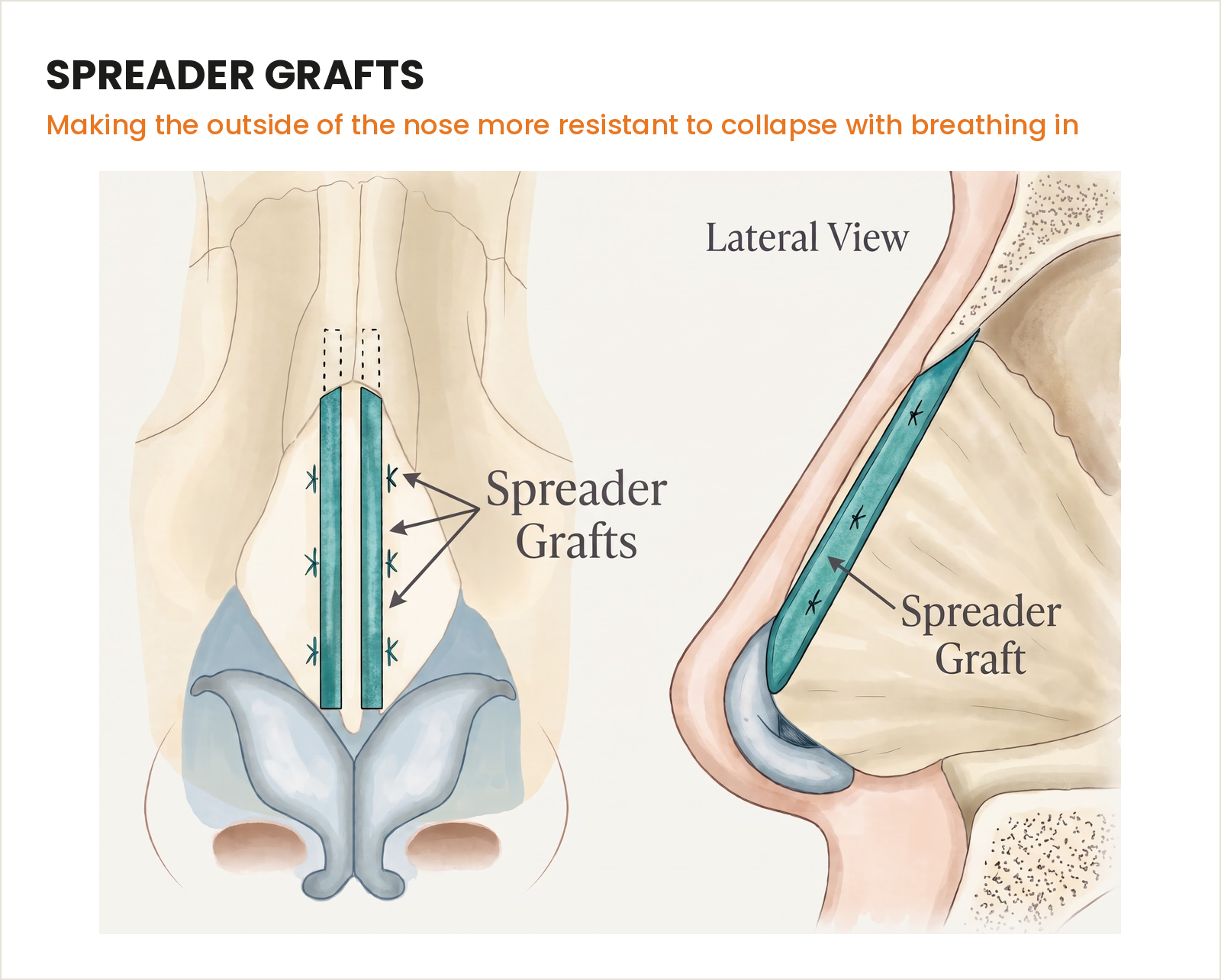
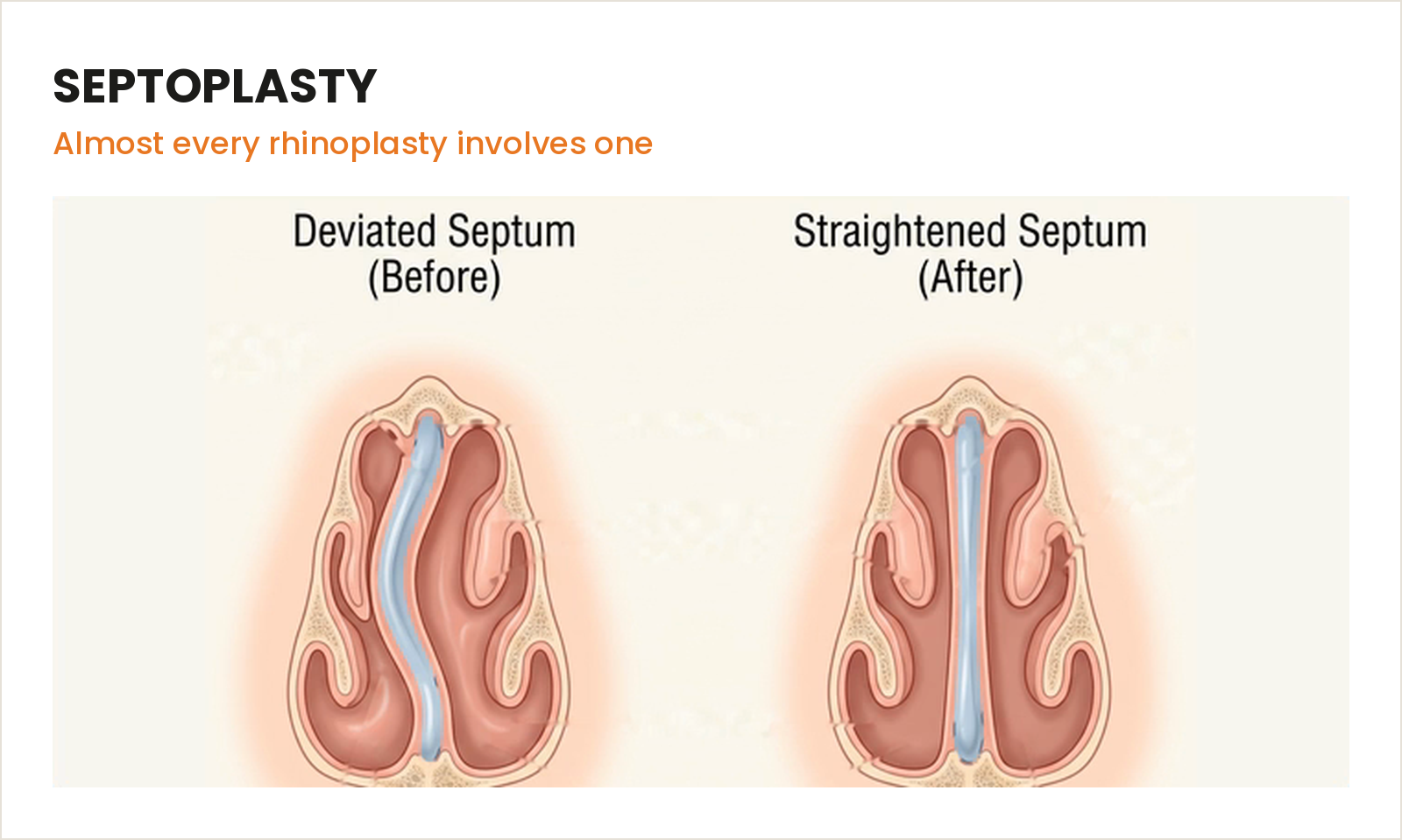
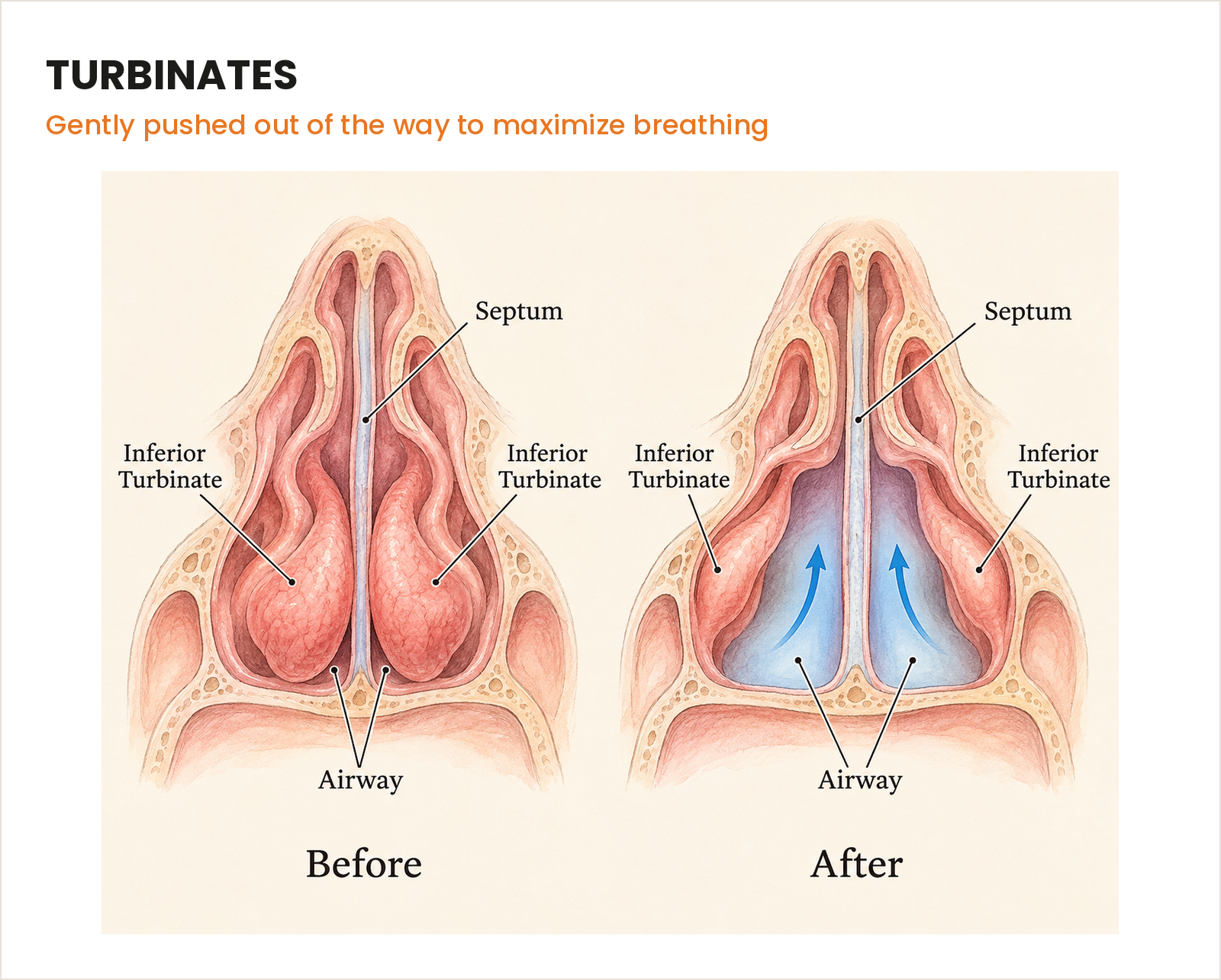
Dr. Weinfeld’s Clinical Take: We’re often changing the structures of the outside of the nose to make them more resistant to collapse with breathing in. Almost everybody has a little bit of a deviation to the septum, and almost every rhinoplasty involves a septoplasty. I gently push the turbinates out of the way to maximize breathing.
A lot of people who have difficulty breathing, but they didn’t realize it, get better from a rhinoplasty. They want to know why. In her case, all three of these things were part of the surgery.
1. The outside of the nose
Often we’re changing the structures of the outside of the nose to make them more resistant to collapse with breathing in. She did get spreader grafts.
2. The septum
Almost everybody has a little bit of a deviation to the septum, and almost every rhinoplasty involves a septoplasty, in order to get some of the cartilage from the further back parts of the nose and bring it forward to support the new architecture that we’re creating, that shapes the skin on the outside that we see as the appearance of the nose.
3. The turbinates
Not to mention, I often gently push out these filters that we have in our nose called turbinates. I gently push them out of the way to maximize the breathing also. And also, you need to do that to get the splints in, so that they’re more comfortable than they would otherwise be.
| What we did | Why |
|---|---|
| Spreader grafts | Changing the structures of the outside of the nose to make them more resistant to collapse with breathing in |
| Septoplasty | Almost everybody has a little bit of a deviation to the septum; it also gets cartilage from the further back parts of the nose to support the new architecture |
| Turbinates gently pushed out of the way | To maximize the breathing, and so the splints are more comfortable than they would otherwise be |
Can Rhinoplasty Help With Snoring and Exercise?
▶ Watch this discussion in the video at [2:49]
Dr. Weinfeld’s Clinical Take: A lot of people talk about exercise and sleep. She’s been told she doesn’t snore anymore, and she’s a big runner who’s breathing great through her nose and lasting longer in her runs. If that happened after surgery and you say you’re breathing better, we have to assume that that contributed.
So how has the improvement in her breathing impacted her life? A lot of people talk about exercise and sleep.
“I don’t know if this has anything to do with it, but I’ve been told I don’t snore anymore.”
The patient
“I mean, if that happened after surgery and you say you’re breathing better, we have to assume that that contributed.”
Dr. Weinfeld
“Yeah, tremendously. And I’m a big runner, and I’ve noticed during my runs I’m breathing great through my nose and just lasting longer in my runs and in my workouts.”
The patient
What Is Rhinoplasty Recovery Really Like?
▶ Watch this discussion in the video at [3:23]
Dr. Weinfeld’s Clinical Take: I’ve never used nasal packing. The first week having the splint in was uncomfortable for her, just because you have something up your nose for that amount of time. After the splint was removed, it was great. She had some drippage for about two months, and taping was a security blanket.
“I will say the first week having the splint in was uncomfortable, just because you have something up your nose for that amount of time. And then after the splint was removed, I feel like it was great.”
The patient
I’ve never used nasal packing. I use soft silicone Doyle splints secured with a small suture through the septum, or the sutureless Bstent, developed by my mentor Bahman Guyuron, in about a third of patients; the choice is mine, based on anatomy and healing. Patients keep Afrin at home and use saline through the splints from day one. More in Nasal Splints vs. Packing After Rhinoplasty.
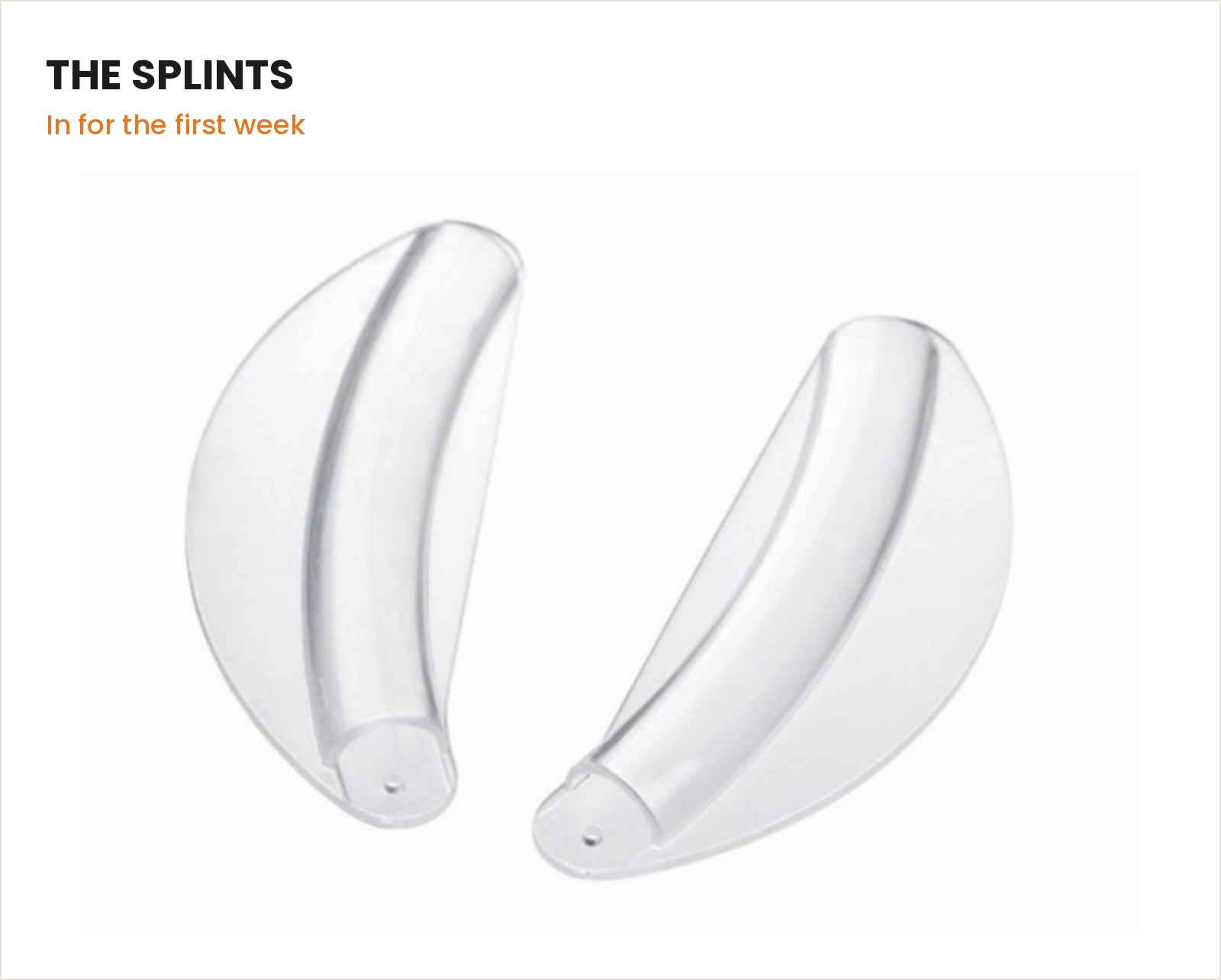
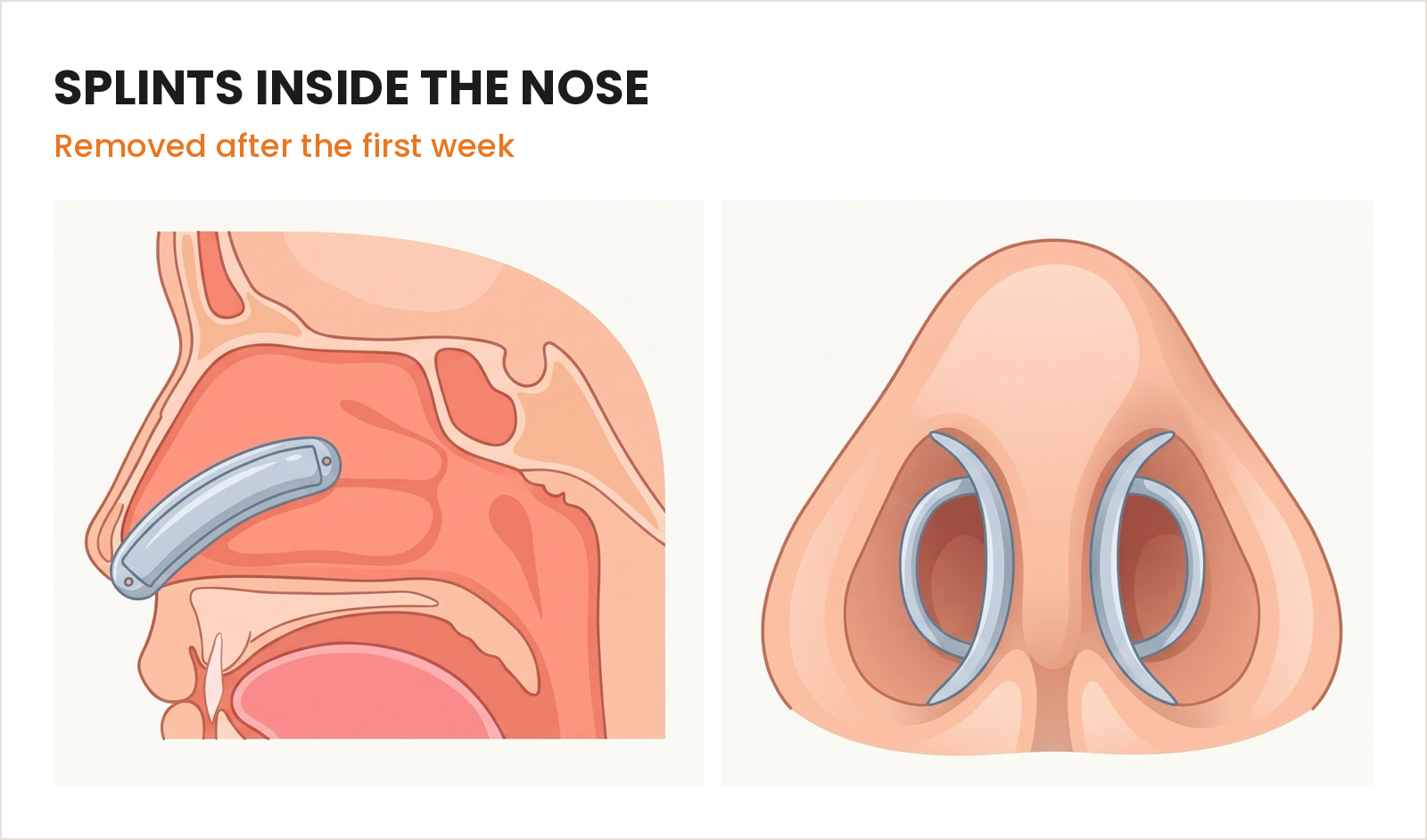
“I did suffer occasionally from some drippage that lasted for about two months after my surgery. And then just taping the nose, I felt like that was like a security blanket for like the first four weeks, and then I stopped.”
The patient
Bruising usually peaks at about four to seven days, and patients feel comfortable socially and back to work at about seven to eight days after rhinoplasty. More in Bruising After a Facelift or Rhinoplasty.
| When | What happens |
|---|---|
| First week | The splint is in; uncomfortable, just because you have something up your nose, but she was still able to breathe through her nose |
| About 4 to 7 days | Bruising usually peaks |
| About 7 to 8 days | Comfortable socially and back to work |
| Taping | Two weeks taping full time, two weeks nighttime only |
| Up to three months | Dripping; a month, two months, very typical (hers lasted about two months) |
| Three months | Swelling traditionally down to 40% |
| Up to a year | We do still have swelling up to a year, especially with slightly thicker skin; traditionally nearly zero at one year |
How Long Should You Tape Your Nose After Rhinoplasty?
▶ Watch this discussion in the video at [3:56]
Dr. Weinfeld’s Clinical Take: I like two weeks taping full time, two weeks nighttime only. A lot of people choose to do it longer and they think that it helps, and I think they’re probably right. But it definitely doesn’t change where you end up at six months or 12 months, in my experience.
“You did what I kind of consider the minimum, which I think is great. Like, the minimum to me also could very well be the maximum. And you did what we asked.”
Dr. Weinfeld
I like two weeks taping full time, two weeks nighttime only. A lot of people choose to do it longer and they think that it helps, and I think they’re probably right. But the kind of help is that maybe it prevents the intermittent fluctuation and swelling that people have. Or maybe it makes months two and three slightly less swollen, but it definitely doesn’t change where you end up at six months. It doesn’t change where you end up in 12 months, in my experience.
Why Does Your Nose Drip After Rhinoplasty?
▶ Watch this discussion in the video at [4:32]
Dr. Weinfeld’s Clinical Take: A lot of people notice dripping up to three months. All of a sudden you have more air coming through your nose than you ever did, and it’s going to take some adjustment in the cells that create the mucus. Surgery can make them hyper-responsive. A month, two months, very typical.
I love that she mentioned the dripping. A lot of people notice it, even up to three months. Very rarely people have it even further out, and I suspect those people probably had bad allergies before. They just didn’t realize it or think about it, and they’re just more aware of their nose after surgery, very frequently the case. But she’s different than that. She had a very short period: two months.
Correction: In the video I say “three weeks” here. I meant three months.
“The fact that you had this really impressive increase in your airflow, your nose had a whole different reality. And our nose reacts to the environment on the outside, and then that creates an environment on the inside of our nose.”
Dr. Weinfeld
All of a sudden you have more air coming through your nose than you ever did in the past, and so it’s going to take some adjustment in the cells that create the mucus: the fine mucus, the thick mucus, and even the sinus cells. It’s going to take a little bit of time for those to adjust and to acclimatize to that new reality.

Another thing is that just surgery in itself can aggravate those cells in a little way. It makes them hyper-responsive, and then it takes a little while to settle down. So a month, two months, very typical.
What’s Not Perfect One Year After Rhinoplasty?
▶ Watch this discussion in the video at [5:41]
Dr. Weinfeld’s Clinical Take: As surgeons, we always put forth a perfect effort. But the results of our labors sometimes have imperfection here or there, and people gotta hear something that’s not perfect. For her, one nostril kind of flares out wider than the other, and her tip is still kinda on the bigger side.
“To be honest, people gotta hear something that’s not perfect, because I want them to know there’s, like, a real thing that we’re talking about.”
Dr. Weinfeld
“I will say, I’ve noticed maybe this nostril here kind of flares out wider than this one. And I just feel like my tip, still kinda up here, after being a year post-op, it’s still kinda on the bigger side.”
The patient
Let’s tackle those backwards.
| Just above the tip | Asymmetric nostril flare | |
|---|---|---|
| What it is | Not really the true tip, it’s just above it | This nostril kind of flares out wider than this one, more noticeable on the right-hand side |
| Why | We do still have swelling up to a year, especially with slightly thicker skin, and the nose heals by scarring | A muscle from the orbit down to the ala and the lip pulls that nostril out, like the reins of a horse |
| What helps | A very careful steroid injection; sometimes we would do more than one | A small incision where the ala meets the cheek and the lip, and a partial release of that muscle |
| When | First: typically three months, six months, and very effective at a year | If we need to address it later, we certainly will |
Can Steroid Injections Help the Area Above the Tip at One Year?
▶ Watch this discussion in the video at [6:17]
Dr. Weinfeld’s Clinical Take: That area is not really the true tip, it’s just above it, and it responds very well to steroids. While we typically use steroids at three months, six months, I have seen it be very effective at a year, because we still have swelling up to a year, especially with thicker skin.
That area that’s kind of, it’s not really the true tip, it’s just above it. That area is an area that responds very well to steroids.
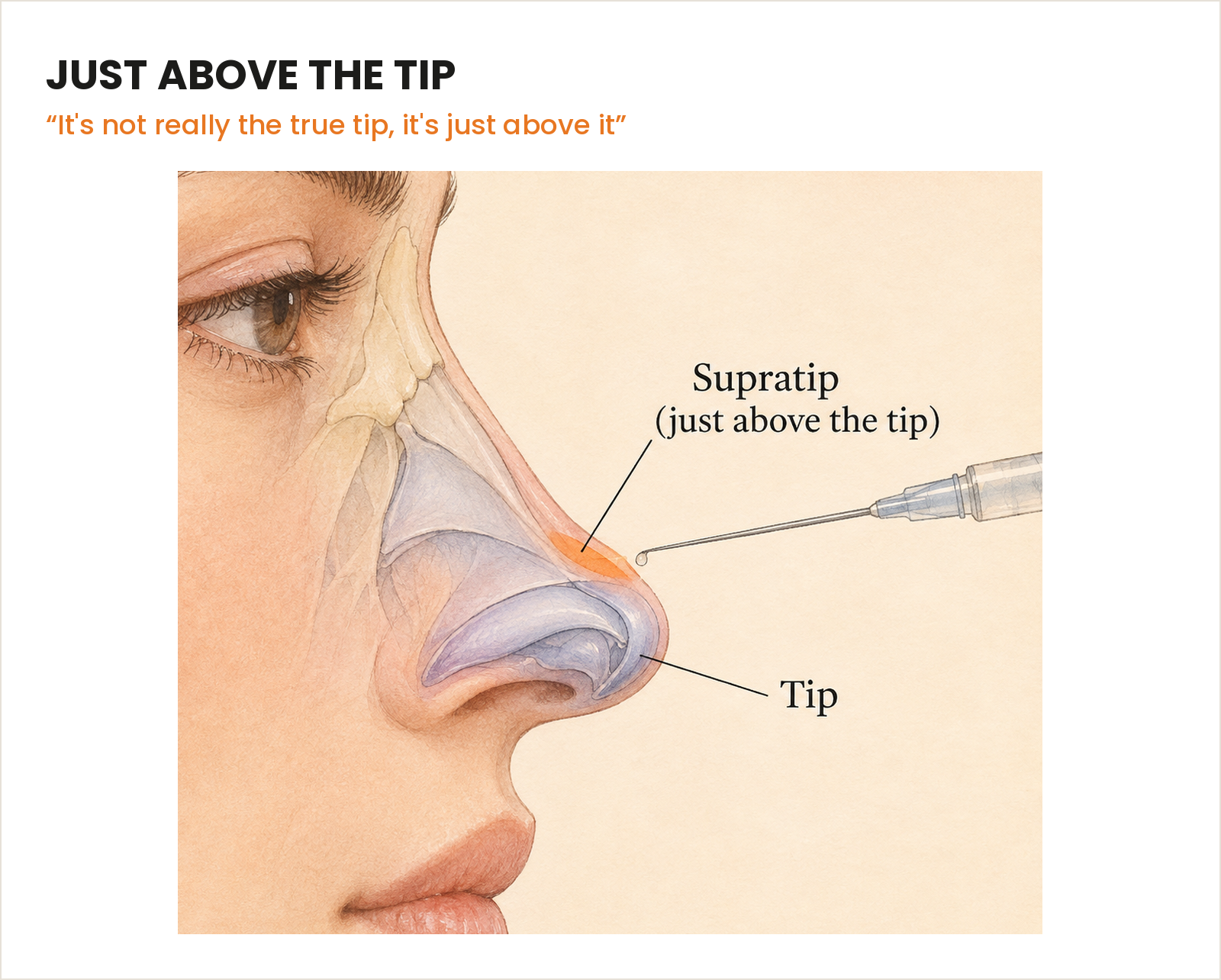
While we typically use steroids at kind of three months, six months, time frames like that, I have seen it be very effective at a year. And the reason for that is that we do still have swelling that exists in our nose up to a year, especially someone who has slightly thicker skin, such as her. Primary rhinoplasty swelling is traditionally down to 40% at three months and nearly zero at one year.
And then also, the steroid itself can kind of shrink some of the natural scar tissue that exists in that area anyway. I mean, the nose heals by scarring. There’s no way around that. And maybe there’s just a little bit more there than would be advantageous.
“So I suggest we do a very careful steroid injection there. Sometimes we would do more than one, but I think you’re going to see an impressive improvement.”
Dr. Weinfeld
She has not had the steroid injection yet.
How Is an Asymmetric Nostril Flare Treated?
▶ Watch this discussion in the video at [7:03]
Dr. Weinfeld’s Clinical Take: There’s a muscle that goes from the orbit down to the ala and down to the lip, and when we smile, it pulls that nostril out. We make a small incision where the ala meets the cheek and lip and partially release that muscle. I would recommend we do the steroids first.
With smiling, we all know that there’s going to be some asymmetry, and the nose is going to widen. Now, for someone like her who’s noticing it, there’s a small procedure we can use to address that nostril flare that’s asymmetric, more noticeable on the right-hand side.
There’s a muscle that goes from the inner aspect of the eye bone, the orbit, down to the ala and then down to the lip. And when we smile, it pulls, like pulling the reins of a horse, it pulls that nostril out.

What we do is we make a small incision where that ala meets the cheek and the lip. If we just release that little bit of muscle, just partially, it can weaken that response enough to create more symmetry.
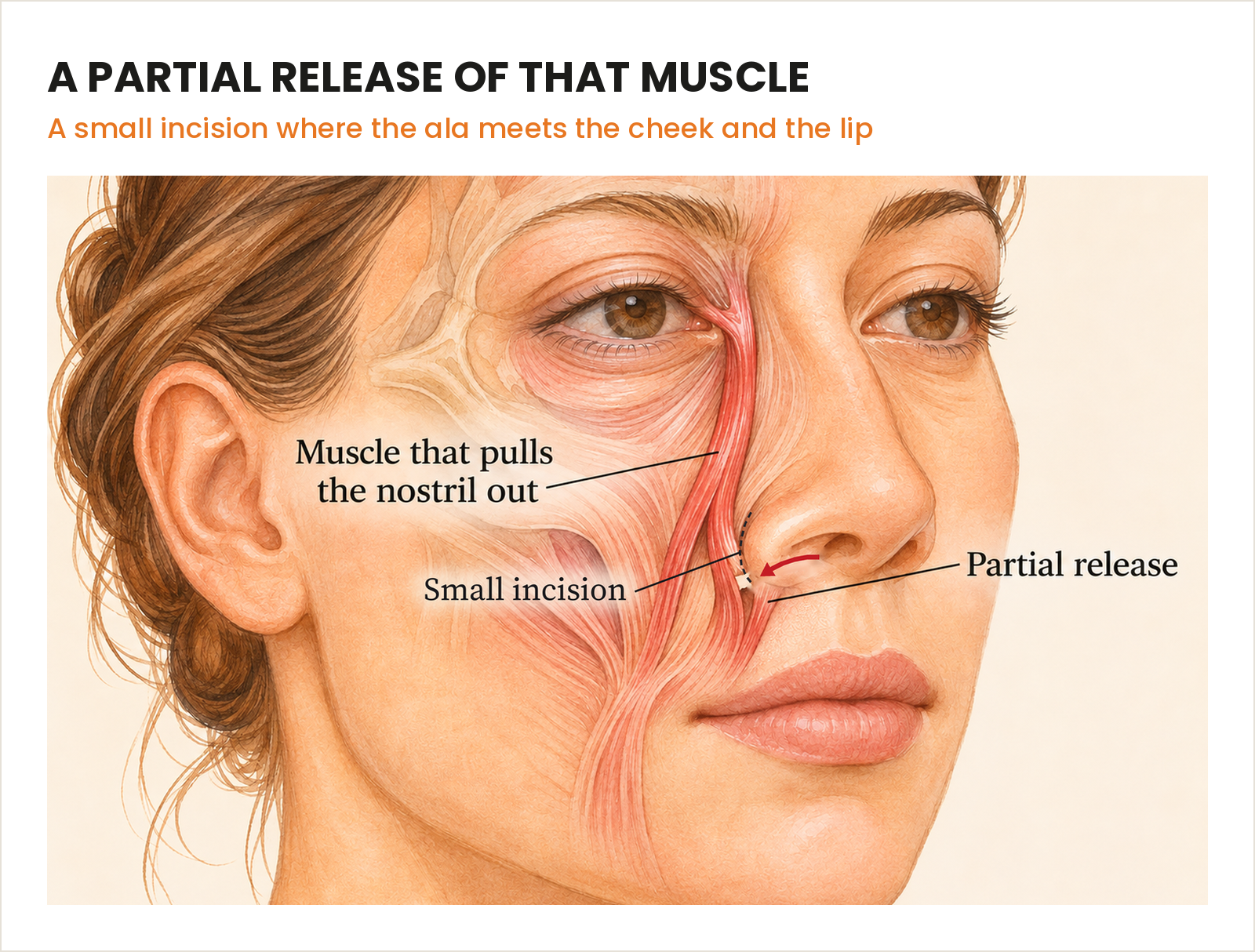
I would recommend we do the steroids first, because sometimes when there’s two little things that bother someone, you address one, the other one’s no longer bothersome.
“But I’m not going anywhere, you’re not going anywhere. If we need to address it later, we certainly will. That’s part of our commitment to making sure that patients are happy.”
Dr. Weinfeld
What Advice Does She Have for Anyone Considering Rhinoplasty?
▶ Watch this discussion in the video at [8:00]
Dr. Weinfeld’s Clinical Take: Her advice: you should do it. It’s your face, and you need to do your research and make sure you’re picking the right surgeon for that. She documented her journey on social media, like TikTok and Instagram. And I’m not going anywhere. If we need to address something later, we certainly will.
“Yeah, I think you should do it. I documented my journey on social media, like TikTok and Instagram, and just kind of took people along with me. And I got really good feedback from that, questions regarding the whole process I was able to answer for people.”
The patient
“I think at first it was a little scary. I was a little hesitant, because it’s your face, and you know, you need to do your research and make sure you’re picking the right surgeon for that. And I felt like you gave me the results that I wanted. And I’m very happy. I have, you know, what I want.”
The patient
If you’re doing that research now, start with How to Prepare for Your Rhinoplasty or Facelift Consultation, my rhinoplasty FAQs and my rhinoplasty page.
About the author
Adam Bryce Weinfeld, MD, is a board-certified plastic surgeon in Austin, Texas, double fellowship-trained in facial aesthetic surgery and oculoplastic surgery, and Past President of The Rhinoplasty Society. His practice of 19 years is exclusively aesthetic, with an emphasis on the face. He is a Clinical Associate Professor at Dell Medical School and has authored 33+ peer-reviewed publications and multiple book chapters.
Considering a rhinoplasty in Austin?
Book a consultation with Dr. Adam Weinfeld, board-certified plastic surgeon in Austin, Texas.
Request a consultation512-559-1376 · drweinfeld.com
This article is for education only and is not medical advice. Individual results vary. Patient photos are shown with permission and are unretouched. Written by Dr. Adam Weinfeld from his video; edited and formatted with AI assistance.
Full video transcript
Cold Open
Patient: It's a completely different nose in my opinion — what I was aiming for.
Patient: When I woke up from surgery, I was able to breathe better.
Patient: I don't know if this has anything to do with it, but I've been told I don't snore anymore.
Dr. Weinfeld: To be honest, people gotta hear something that's not perfect.
One Year Later
Dr. Weinfeld: First of all, thank you for doing this.
Patient: Thank you.
Dr. Weinfeld: We are here one year from your rhinoplasty. How have things been going in this last year?
Patient: Great.
Dr. Weinfeld: We need more detail. What else?
Patient: I'm so happy. I love the way my nose looks. It's a completely different nose in my opinion — what I was aiming for.
Dr. Weinfeld: Yes, okay. So tell me about that. What were your goals, like, in a couple of words?
Her Goals
Patient: Honestly, smaller nose. I didn't like my bridge. It was a hump. I felt like my tip just drooped down.
Patient: So I did liquid rhinos in the past to just help slim down this area here from the bridge to kind of mask it, and then contouring with makeup the best that I could.
Dr. Weinfeld: So you want a different nose. You got a different nose. We addressed the tip that was plunging and the dorsal hump.
The Breathing Surprise
Dr. Weinfeld: Was there any other benefit of surgery other than that?
Patient: One benefit that I didn't even know I could benefit from is when I woke up from surgery, I was able to breathe better.
Dr. Weinfeld: Tell me a little bit more about that.
Patient: I didn't know in the past that I couldn't breathe through my nose the way I can now. Immediately when I woke up, that was the first thing that my parents said that I said, was "I can breathe." And even when having the splint in, even though it was uncomfortable for that first week, I was still able to breathe through my nose.
Dr. Weinfeld: Now, when we take out the splint, a lot of people can breathe really well, and then they lose a little bit of the benefit and then it comes back. Were you like that, or was it something different than that?
Patient: Something different.
Dr. Weinfeld: And what was it like?
Patient: I don't think it ever went back to the base. I think I can breathe all the way through from when the splint got removed until this day.
Why Breathing Improves
Dr. Weinfeld: A lot of people who have difficulty breathing, but they didn't realize it, get better from a rhinoplasty. They want to know why. And the reason for that is, often we're changing the structures of the outside of the nose to make them more resistant to collapse with breathing in. And then also, almost everybody has a little bit of a deviation to the septum, and almost every rhinoplasty involves a septoplasty, in order to get some of the cartilage from the further back parts of the nose and bring it forward to support the new architecture that we're creating, that shapes the skin on the outside that we see as the appearance of the nose. So those are the things that explain why you breathe better. Not to mention, I often usually gently push out these filters that we have in our nose called turbinates. I gently push them out of the way to maximize the breathing also. And also, you need to do that to get the splints in, so that they're more comfortable than they would otherwise be.
Snoring and Running
Dr. Weinfeld: So how has the improvement in your breathing impacted your life? Like — a lot of people talk about, like, exercise and sleep. Did you notice anything in those realms of your life?
Patient: I don't know if this has anything to do with it, but I've been told I don't snore anymore.
Dr. Weinfeld: I mean, if that happened after surgery and you say you're breathing better, we have to assume that that contributed.
Patient: Yeah, tremendously. And I'm a big runner, and I've noticed during my runs I'm breathing great through my nose and just lasting longer in my runs and in my workouts.
Dr. Weinfeld: That's fantastic.
Her Recovery
Dr. Weinfeld: So, side benefit: you didn't know it was going to happen. You got your nose looking the way you wanted it to, and you're breathing better. What was your recovery like?
Patient: I will say the first week having the splint in was uncomfortable, just because you have something up your nose for that amount of time. And then after the splint was removed, I feel like it was great. I did suffer occasionally from some drippage that lasted for about two months after my surgery. And then just taping the nose — I felt like that was like a security blanket for like the first four weeks, and then I stopped.
Taping and Dripping
Dr. Weinfeld: Yeah. I like that. You made a couple of really interesting and important points. One is that you did what I kind of consider the minimum, which I think is great. Like, the minimum to me also could very well be the maximum. And you did what we asked. I like two weeks taping full time, two weeks nighttime only. A lot of people choose to do it longer and they think that it helps, and I think they're probably right. But the kind of help is that maybe it prevents the intermittent fluctuation and swelling that people have. Or maybe it makes, like, week — or rather months two and three slightly less swollen, but it definitely doesn't change where you end up at six months. It doesn't change where you end up in 12 months, in my experience. That's one important thing.
Dr. Weinfeld: Another important thing you said, about the dripping. I love that you said that, because that's good. A lot of people notice that even up to three weeks. [Correction: three months] Very rarely people have it even further out, and I suspect those people probably had bad allergies before dripping. They just didn't realize it or think about it, and they're just more aware of their nose after surgery — very frequently the case. But you're different than that. You had a very short period — two weeks, excuse me, two months.
Dr. Weinfeld: And there's two reasons for that. I would suspect with you, the fact that you had this really impressive increase in your airflow, your nose had a whole different reality. And our nose reacts to the environment on the outside, and then that creates an environment on the inside of our nose. All of a sudden you have more air coming through your nose than you ever did in the past, and so it's going to take some adjustment in the cells that create the mucus. And like the fine mucus, the thick mucus, and even the sinus cells — it's going to take a little bit of time for those to adjust and to acclimatize to that new reality. That's probably what was going on. Another thing is that just surgery in itself can just aggravate those cells in a little way. It makes them hyper-responsive, and then it takes a little while to settle down. So a month, two months, very typical. I'm glad you mentioned that.
The Honest Part
Dr. Weinfeld: All right, so as surgeons, we always put forth a perfect effort. But the results of our labors sometimes have imperfection here or there.
Dr. Weinfeld: Is there anything — you love it, I know. But is there just, like — to be honest, people gotta hear something that's not perfect, because I want them to know there's, like, a real thing that we're talking about.
Patient: Yeah.
Dr. Weinfeld: Well, is there — tell me about something. There has to be something you don't like. Tell me about that.
Patient: I will say, I've noticed maybe this nostril here kind of flares out wider than this one. And I just feel like my tip — still kinda up here — after being a year post-op, it's still kinda on the bigger side.
Just Above The Tip
Dr. Weinfeld: Let's tackle those backwards, okay? So that area that's kind of — it's not really the true tip, it's just above it. That area is an area that responds very well to steroids. And while we typically use steroids at kind of three months, six months, time frames like that, I have seen it be very effective at a year. And the reason for that is that we do still have swelling that exists in our nose up to a year, especially someone who has slightly thicker skin, such as yourself. So that's one reason. And then also, the steroid itself can kind of shrink some of the natural scar tissue that exists in that area anyway. I mean, the nose heals by scarring. There's no way around that, you know. And maybe there's just a little bit more there than would be advantageous. So I suggest we do a very careful steroid injection there. Sometimes we would do more than one, but I think you're going to see it, an impressive improvement.
The Nostril Flare
Dr. Weinfeld: The smiling — we all know that there's going to be some asymmetry, and the nose is going to widen. Now, for someone like you who's noticing it, there's a small procedure we can use to address that nostril flare that's asymmetric, more noticeable on the right-hand side. What we do is we make a small incision where that ala meets the cheek and the lip. And we can make a small incision there. And there's a muscle that goes from the inner aspect of, like, the eye bone — the orbit here, orbital floor — down to the ala and then down to the lip. And when we smile, it pulls like, you know — pulling like the reins of a horse, it pulls that nostril out. If we just release that little bit of muscle, just partially, it can weaken that response enough to create more symmetry. So I think that's something we should consider also. I would recommend we do the steroids first, because sometimes when there's two little things that bother someone, you address one, the other one's no longer bothersome. But I'm not going anywhere, you're not going anywhere. If we need to address it later, we certainly will. That's part of our commitment to making sure that patients are happy.
Her Advice
Dr. Weinfeld: Final thoughts for patients that may be considering having a rhinoplasty?
Patient: Yeah, I think you should do it. I documented my journey on social media, like TikTok and Instagram, and just kind of took people along with me. And I got really good feedback from that — questions regarding the whole process I was able to answer for people. I think at first it was a little scary. I was a little hesitant, because it's your face, and, you know, you need to do your research and make sure you're picking the right surgeon for that. And I felt like you gave me the results that I wanted. And I'm very happy. I have, you know, what I want.
Dr. Weinfeld: Fantastic. Well, thank you. Thank you for doing this.
Patient: Thank you.
Dr. Weinfeld: You're welcome.