
How to Prepare for Your Rhinoplasty or Facelift Consultation
November 01, 2026 | Facelift, Rhinoplasty
By Adam Bryce Weinfeld, MD · Board-certified plastic surgeon · Austin, Texas · Updated November 1, 2026
To prepare for a rhinoplasty (nose surgery) or facelift consultation, answer your basic questions ahead of time with Dr. Weinfeld’s online resources, know your top priorities, plan your time off and bring anyone whose opinion matters. Then come ready for a two-way conversation about your goals and your limitations, so the visit can end in a decision you’re happy with.
In this video
- 0:00 Why might a surgeon turn you down?
- 0:17 Why does a plastic surgeon interview you?
- 1:22 Why do surgeons ask screening questions?
- 2:06 What should you focus on in a consultation?
- 2:52 What is the 85/15 rule in rhinoplasty?
- 3:31 Are rhinoplasty simulations (morphs) helpful?
- 4:49 Why can front-view simulations mislead?
- 6:36 Where is the real result of surgery?
- 6:48 How do I prepare for my consultation?
- 7:55 Should I bring my partner to my consult?
- 9:05 Do I need to understand everything first?
- 10:00 What happens after the consultation?
Key takeaways
- A consultation is a two-way conversation: you’re getting to know your surgeon, and your surgeon is making sure surgery can truly make you happy.
- Plan on really loving about 85% of your result, with maybe 15% you’re a little less than satisfied with. That’s the reality of how the body heals.
- Morph photos are a great basis for conversation, but don’t use them to decide whether to have surgery or who should do it.
- Prepare ahead: use the online resources, plan your time off (about 7 to 8 days for rhinoplasty, closer to 2 weeks for a facelift) and bring your decision-makers.
- You’ll never understand every detail in advance. Go in knowing you make one great decision.
What happens at a rhinoplasty or facelift consultation?
A consultation with Dr. Weinfeld has three parts: photos and a detailed exam, a planning meeting with him, and a meeting with a patient care coordinator. Along the way, you’ll talk about your goals and also your limitations.
The first 30 minutes are photos and a detailed exam. Then you meet with Dr. Weinfeld for an intensive discussion of your goals, desires and priorities. Early on, he asks a few screening questions about your motivations for surgery. Once he has described a plan, it goes to the patient care coordinator, who meets with you to schedule and discuss finances.
"Patients should really understand from me the things that we’re not going to be able to achieve," he says. "And they should be slightly disappointed with that. And that is just fine." Then the focus turns to what can actually be accomplished, led by what he calls the three big things: what needs to be addressed for you to be happy.
What should be certain is an open channel of communication. It’s a relationship, and there are uncertainties, so the consultation is where you and your surgeon talk about goals and desires, but also about limitations. Learn more about rhinoplasty and the deep plane facelift.

Why is a consultation a two-way conversation?
Because both of you are deciding. Patients often say they’re interviewing a variety of doctors, and Dr. Weinfeld agrees: it is an interview. What some patients don’t recognize is that he’s interviewing them as well, and not to be exclusive.
"The reason I’m interviewing them is really for their benefit," he says. "It doesn’t have to do with me. I’m a doctor. I’m here for you guys. It’s my responsibility to see this through." Part of doing that well is making sure there’s a high probability you’ll be happy with surgery.
That’s why the consultation starts with a few screening questions. If someone wants a rhinoplasty because they were made fun of about their nose growing up, it’s not that he won’t do surgery; that’s actually common. He just wants to make sure you’re in the right emotional space to benefit from it.
When might Dr. Weinfeld recommend against surgery?
Most consultations are about alignment, not exclusion. The times he may say no are when expectations can’t be met, when there’s a medical problem, or when the procedure someone wants isn’t indicated for their anatomy. Even then, the goal is honesty: "I would much rather you not have surgery because I can’t give you what you want than have surgery expecting to get something that just can’t be delivered."
He also limits the number of surgeries he does, up to 125 facelifts and 175 rhinoplasties a year, to keep the experience boutique and bespoke for every patient.
What is the 85/15 rule?
The 85/15 rule means planning on really loving about 85% of your result, with maybe a 15% element you’re a little less than satisfied with. Dr. Weinfeld wants patients to decide on a rhinoplasty with that concept in mind.
"I tell patients, I’ll probably be less than satisfied with those parts too," he says. "That is the reality of dealing with human tissues in surgery." Surgeons have a lot of control in the operating room; it’s how the body heals afterward that can have a big impact on the final result. When patients understand and have made peace with the 85/15 rule, they end up being very happy.
He has taught the same idea to other rhinoplasty surgeons, presenting on patient expectations and the 85/15 rule at the International Meeting of Rhinoplasty Societies (IMRhiS) in Miami Beach.
In his words, the real result isn’t only in the post-op photograph: "It’s in the heart and in the mind. It’s that happiness." For what healing feels like day to day, see rhinoplasty recovery: pressure, discomfort and getting social again.
Are rhinoplasty morph photos accurate?
Simulations (morph photos) can be very helpful, but they have limitations, especially front views. Dr. Weinfeld uses them as a basis for conversation, never as a way to decide whether to have a rhinoplasty or whether he’s the right surgeon to do it.
He uses basic Photoshop rather than an algorithm. Working through it himself forces him to see things he might not have seen, and the whole time he’s asking: am I actually representing something I can do? Front views of simulations are notoriously problematic. If you decide based on the front views, you may not have the rhinoplasty with the surgeon you should have chosen, or not have a surgery you might have really benefited from.
A simulation that can’t show what you want is still useful. "If I can’t show you that with a simulation, it doesn’t mean that it’s a failure in the simulation or that it’s a failure in me," he says. You may be asking for something that can’t physically be done, and that’s important to know before surgery.
Simulations are imperfect in themselves, too. If you like the simulation, you’re probably going to like the final result better, because it’s real, physical and three-dimensional. When a patient gets too focused on the morph, he suggests taking it home, studying it and coming back with what they learned. If the comments can be reworked in a way that’s realistic, he’ll do that.

How do I prepare for my rhinoplasty or facelift consultation?
Come in prepared, in the right framework and with the people who will help you decide. The better prepared you are for your rhinoplasty consultation, or your facelift consultation for that matter, the more it’s in your favor.
| Before your consultation | Why it helps |
|---|---|
| Start answering your questions with Dr. Weinfeld’s online resources | It saves time for the more important conceptual issues: the evaluation and discussion of a plan. |
| Know your three big things | Your plan is built around what needs to be addressed for you to be happy. |
| Find out how much time you can take off work | Many people return to work about 7 to 8 days after rhinoplasty, and closer to 2 weeks after a facelift. |
| Bring the people whose opinion matters | A partner, parent or friend who will help decide or care for you can join in person, by FaceTime, by video through the practice’s app or by phone. |
| Live out of state? | Start with a virtual education session. The in-person consultation before surgery can be the day before. |
| Expect to have some questions left | No one understands every detail in advance, and there’s a post-consultation process to fill the gaps. |
Should I bring my partner to my consultation?
Yes, if their opinion is important to you. A common hang-up is needing to run the idea past a loved one afterward. "Do that heavy lifting in advance," Dr. Weinfeld says. If your partner, spouse, roommate or best friend will be part of your decision making, and even your recovery, they should be at the consultation: physically if possible, virtually if not. That helps you translate the initial momentum and excitement of the visit into a decision you’re going to be happy with, and you could be saving thousands of dollars.
Do I need to understand everything before I decide?
No. You’re never going to be able to understand everything about the decision making, the recovery, or the ins and outs and complications of a rhinoplasty or a facelift in advance, at the consultation or even afterward. If you’re waiting for an aha moment, "it ain’t gonna happen," and waiting for it can stand in your way. Go in with this mindset: you make one great decision, which is to do the surgery you’re going to benefit from.
How much does a rhinoplasty or facelift cost?
At Dr. Weinfeld’s practice, rhinoplasty starts at $18,000, and a deep plane face and neck lift ranges from $32,000 to $48,000, depending on what other procedures are done with it. Your personalized quote comes at your consultation.
The consultation fee is $200, and it goes toward your surgery. The practice also offers a same-day booking incentive of 5% of the surgeon’s fees, which can amount to thousands in savings. The reason is simple: a well-prepared consultation that ends in a decision entails less work, and Dr. Weinfeld wants to pass that efficiency on to the patient. Compare procedures on the revision rhinoplasty and neck lift pages.
What happens after the consultation?
Your questions don’t end when you leave. Dr. Weinfeld’s practice has an extensive post-consultation process that addresses your questions, further educates you and gets you additional materials.
That includes a PDF he created called Facelift and Rhinoplasty University, which goes over key concepts. You get it in advance, and afterward you can study it to make sure it’s filling in the gaps. If medications are on your mind, his post on medications for pain, nausea and swelling is a good next read.
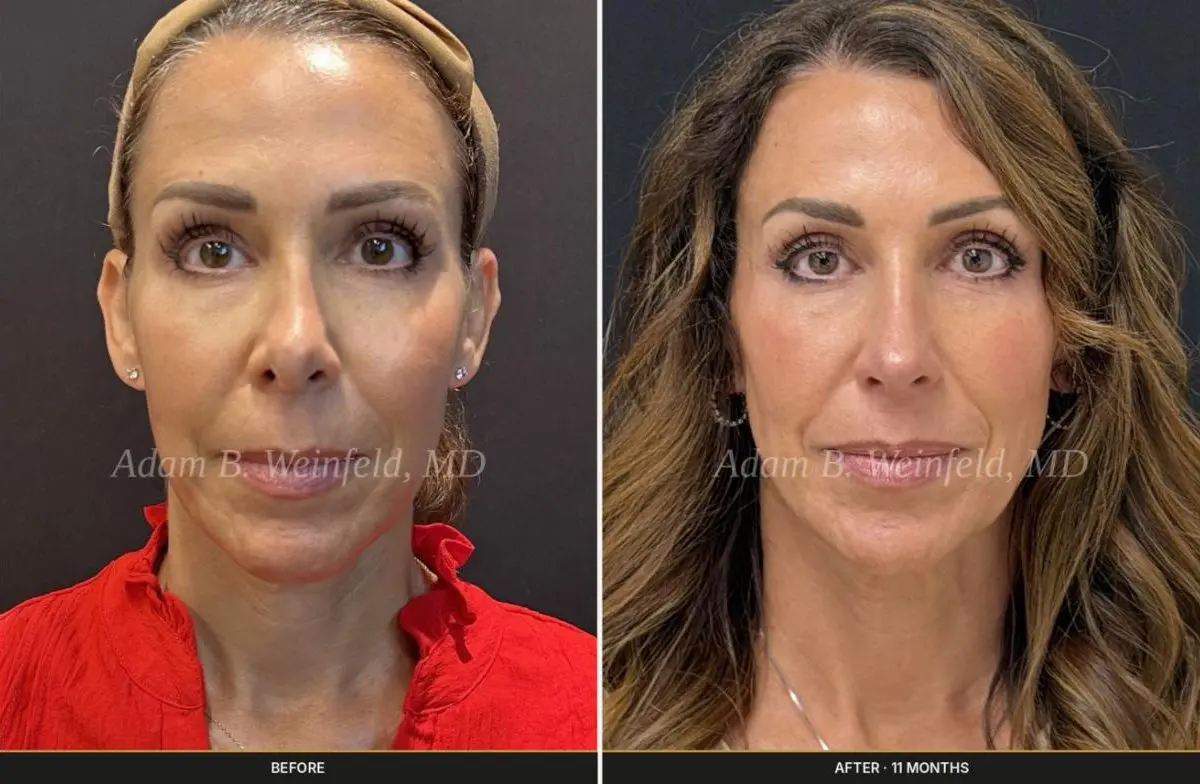
What can results look like?
These are two of Dr. Weinfeld’s patients from the video. As he puts it, the result isn’t exclusively in the eye and the post-op photograph; it’s whether you’re ultimately satisfied with the result.

Frequently asked questions
Can I do a virtual consultation if I live out of state?
You can start virtually. Dr. Weinfeld offers virtual education sessions for patients who live out of state, so you can learn about your options and get your basic questions answered from home. The actual consultation before surgery has to be in person, but it can be scheduled the day before your surgery, which keeps travel to Austin simpler.
Does the consultation fee go toward surgery?
Yes. The consultation fee at Dr. Weinfeld’s practice is $200, and it goes toward your surgery. If you book on the same day as your consultation, the practice also offers a same-day booking incentive of 5% of the surgeon’s fees, which can amount to thousands in savings, because a well-prepared consultation that ends in a decision takes less work.
How much time off work do I need after rhinoplasty or a facelift?
A lot of people return to work about seven to eight days after rhinoplasty. After a facelift, plan on closer to two weeks. Find out when you can get off from work before your consultation, so the visit can focus on your evaluation and plan instead of scheduling questions, and so you’re ready to make a decision when you leave.
Will a morph photo show exactly what my nose will look like?
No. Simulations are imperfect, and front views are notoriously problematic. Dr. Weinfeld uses morph photos as a basis for conversation, not as a promise. If you like the simulation, you’re probably going to like the final result better, because it’s real and three-dimensional. If he can’t show something in a simulation, it may be something that can’t physically be done.
What if I'm still unsure after my consultation?
That’s normal. You’re never going to understand every detail of the decision making, recovery and complications in advance, at the consultation or even afterward. Dr. Weinfeld’s practice has a post-consultation process that answers your questions and sends additional materials, including his Facelift and Rhinoplasty University PDF. Go in knowing you make one great decision: the surgery you’ll benefit from.
References
Weinfeld A. Presentation on patient expectations and the 85/15 rule. International Meeting of Rhinoplasty Societies (IMRhiS), Miami Beach, Florida, June 2025. Faculty listing: rhinoplastysociety.org/imrhis-faculty
About the author
Adam Bryce Weinfeld, MD, is a board-certified plastic surgeon in Austin, Texas, double fellowship-trained in facial aesthetic surgery and oculoplastic surgery, with 19 years in practice. He is a Clinical Associate Professor at Dell Medical School, a Past President of The Rhinoplasty Society and the author of 33+ peer-reviewed publications. His practice is exclusively aesthetic, with an emphasis on the face, with offices in Westlake and North Austin. Training and credentials.
Considering a rhinoplasty or facelift in Austin?
Book a consultation with Dr. Adam Weinfeld, board-certified plastic surgeon in Austin, Texas.
Request a consultation512-559-1376 · drweinfeld.com
This article is for education only and is not medical advice. Individual results vary. Patient photos are shown with permission. Written by Dr. Adam Weinfeld from his video; edited and formatted with AI assistance.
Full video transcript
Opening I would much rather you not have surgery because I can’t give you what you want than have surgery expecting to get something that just can’t be delivered. Where’s the result? It’s in the heart and in the mind. It’s that happiness. We’re also actually interviewing patients as well.
Why does a plastic surgeon interview you? So, you know that movie, The Interview, with Seth Rogen and James Franco? It’s a pretty cool movie where they go to interview the dictator of North Korea. I’m not really here to talk about the movie so much as the idea of an interview. I think it’s kind of interesting when a patient comes in to have a consultation and they say, you know, I’m interviewing a variety of doctors. And I kind of agree with it. That’s fine. You know, it is an interview. But what I think some patients don’t recognize is that we’re also actually interviewing patients as well. And we’re not interviewing patients to try to, like, I don’t know, be exclusive or to be exclusionary or what have you. And the reason I’m interviewing them, once again, is really for their benefit. It doesn’t have to do with me. I’m a doctor. I’m here for you guys. It’s my responsibility to see this through. And part of doing that well is kind of selecting the right patients, patients that we know there’s a high probability, a high probability of them being happy with surgery, right?
Why do surgeons ask screening questions? We want to make sure, for the patient’s own benefit, that we’re screening for patients who are going to be happy with surgery. So when we detect motivations for surgery that might be outside of what surgery can actually achieve, like if there’s childhood trauma that might have, let’s say, for a rhinoplasty may have centered around their nose like they were made fun of incessantly, or worse so, their family members kind of picked on them. It’s not that we won’t do surgery; it’s actually a common thing, unfortunately. But we want to make sure that they’re in the right emotional space to benefit from a surgery. So that’s a really important thing, and that’s why we actually asked some screening questions at the beginning of our consultation that tap into that.
What should you focus on in a consultation? Another thing is, we want to make sure that they’re focusing on the right thing in the consultation. The right thing is: do they recognize that this is a relationship, that there’s uncertainties? But what should be certain is that we have an open channel of communication and that we have the ability to talk to one another and that we’ve talked about goals and desires, but also that we’ve talked about limitations. Patients should really understand from me the things that we’re not going to be able to achieve. And they should be slightly disappointed with that. And that is just fine. But then lean into focus on the things that we can actually accomplish that’s so very important. And they gotta lead with that. Those things, and we usually call them the three big things. What are the three big things that we need to address in order to be happy?
What is the 85/15 rule in rhinoplasty? And I kind of call it the 85/15% rule. I want patients to make a decision to have a rhinoplasty based on the concept that they’re going to really love 85% of their result, and there may be a 15% element of it that they’re a little bit less than satisfied. I tell patients, I’ll probably be less than satisfied with those parts too. That is the reality of dealing with human tissues in surgery. We actually have a lot of control intraoperatively. It’s how the body heals afterwards that can have a big impact on the way we get our final result. When patients understand and have made peace with that 85%, 15% rule, they end up being very happy.
Are rhinoplasty simulations (morphs) helpful? Another thing that I think is important during a consultation is to not overly rely on morphs or simulations. Simulations can be very, very helpful, but they also have limitations. I tell patients that you should use this as a basis for conversation, but absolutely do not use the simulations as a way to make your decision to or not to have a rhinoplasty. And don’t use the simulations as a way to decide whether I’m the right one to do it. Okay? And that’s a really important thing. I tell patients that simulation-morphed photographs are extremely useful if they don’t actually show you what you like. Like if I can’t show you that with a simulation, it doesn’t mean that it’s a failure in the simulation or that it’s a failure in me or the process and that you’re not going to be happy with rhinoplasty. What it means is that we, that one, you may be asking me for something that I can’t physically do. And so if I’m like failing to show you what you want, then it’s for good reason. It can’t be done. And that’s important to know. I would much rather you not have surgery because I can’t give you what you want than have surgery expecting to get something that just can’t be delivered. That’s an important thing.
Why can front-view simulations mislead? Another important thing is that simulations in and of themselves are imperfect. And so sometimes, and I tell this to patients all the time, is that actually if you kind of like this, you’re probably going to like the final result better because it’s real, it’s physical, it’s three-dimensional in front of your face. So don’t overly rely on simulations, especially the front view. Front views of simulations are notoriously problematic. Now, I use basic Photoshop because I like actually going through it without an algorithm one, it forces me to see things I might not have seen in three dimensions with the patient. But also, as I’m doing that, I’m asking myself: am I actually representing something that I can do? That’s really important, right? So, I like doing it, but Photoshop has some notorious limitations on the front views. So, if you’re trying to make a decision about whether to have a rhinoplasty based on the front views, you’re either gonna not have the rhinoplasty with the person you probably should have had it with, or you’re just not gonna have it at all, maybe be disappointed because you didn’t have a surgery that you might have really benefited from. So that’s really important, okay? Honestly, sometimes I’ll tell patients we’re focusing too much on the simulation. I think you should take the simulations I’ve given you, go home and kind of study them, think about them a little bit, and tell me what you learned from them. And if I feel like, based on your comments, we can rework them in a way that’s realistic, then we’ll do that. But if not, you need to make peace with the fact that I’m trying to show you what can and can’t be done. That’s so important. I never want to take someone’s money based on a false premise. I want to make them understand in advance what they actually should be expecting. And that in and of itself is a little bit of an imperfect process, but when we spend time on it and when patients really dig into it, they really have very positive results afterwards.
Where is the real result of surgery? Where’s the result? It’s in the heart and in the mind. It’s that happiness. It’s not exclusively in the eye and the post-op photograph. That’s not exactly where the result is. It’s: are you ultimately satisfied with the result?
How do I prepare for my consultation? So, there you go. Those are the things that we, as plastic surgeons, some of the things we look for when we’re doing a consultation for rhinoplasty. And what I think is important about me telling you this is this is a great way for you to prepare for a rhinoplasty consultation, I want you to be in the right framework to benefit from a surgery that you really should benefit from, to benefit from a consultation leading to that. And there are some financial motivations here. We actually do same-day booking incentives, and the reason we do that is that it actually entails kind of less work, you know, and so we want to pass that efficiency on to the patient. So the better you’re prepared for that rhinoplasty consultation or for facelift consultation for that matter, it’s really in your best favor. While we’re on that topic, a couple of other things that you can do to prepare is find out when you can get off from work. Do some research. I have so many resources out there. How much time you may need to take off. A lot of people return to work after rhinoplasty at about seven to eight days, so that’s an important thing to know. Facelifts, a little bit more like two weeks, also Another important thing to know.
Should I bring my partner to my consult? Another thing I see hanging people up frequently is the idea of, well, I need to run this idea past a loved one, my parents, my partner, the person who’s going to help take care of me. Do that heavy lifting in advance. If your partner, your husband, your wife, your roommate, your best friend, if they’re going to be part of your decision making and even your recovery and their opinion is important, they should be there at the consultation, right? You could be saving thousands of dollars. So, what I ask of you guys is: bring them physically to the consultation. And if they can’t be there, have them be present virtually. We can do FaceTime, we can do video through our own app, we can even do a phone call on your phone. All of those can be very helpful to help you really kind of take the initial momentum and the excitement and translate it at the end of the visit to a decision that you’re going to be happy with. Another really important thing for the consultation, once again, is prepare as much in advance as you can. Start to answer your questions with the resources that I have online. That’ll save time for the more important conceptual issues, the evaluation and discussion of a plan. That’s super important.
Do I need to understand everything first? But another thing is go into the consultation with this particular thing in mind. You are never going to be able to understand everything about you know, the decision making or the recovery, the ins and outs complications of a rhinoplasty or a facelift, let’s say, for example, in advance of a consultation, even at a consultation or afterwards. So, if you’re waiting for like an aha moment, you’re like, oh, I totally get everything, it ain’t gonna happen. So, if you’re waiting for that moment, you might stand in the way of yourself. Taking advantage of the momentum and taking advantage of the opportunity to proceed with the surgery you’re going to benefit from, and then also do so in a way that actually is advantageous to you financially. So you got to go in with that mindset, knowing that you make one great decision that is to do the surgery you’re going to benefit from, and then
What happens after the consultation? We have an extensive post-consultation process where we make sure that we’re addressing all your questions, we’re further educating you, we’re getting you additional materials. That’s all part of the whole process. And I’ve created a PDF to help you with this called Facelift and Rhinoplasty University, where I go over some of the key concepts, I get it to you in advance, and then you can, after the fact, kind of study it and make sure that it’s filling in the gaps. So anyhow, that’s a super important thing to understand about consultations. And I really hope you learn from it. Follow my YouTube channel. Follow me on Instagram. Comment if there’s other topics that you would like to learn about. See you later. I got to get to a facelift and neck lift.