
Bruising After a Facelift or Rhinoplasty: How to Bruise Less
November 01, 2026 | Facelift, Rhinoplasty
By Adam Bryce Weinfeld, MD · Board-certified plastic surgeon · Austin, Texas · Updated November 1, 2026
Yes. Oozing causes bruising after a facelift or rhinoplasty. A bruise is blood that collects under the skin during and after surgery. It isn’t life-threatening bleeding, but it is recovery-threatening: a couple of extra drops of blood can mean more bruising, swelling and discomfort. Three pillars control it: the patient, anesthesia and surgical technique.
In this video
- 0:00 Does oozing cause bruising after surgery?
- 0:22 Why bruising slows facial surgery recovery
- 1:49 The 3 pillars that control bruising
- 2:14 Does alcohol cause more bruising?
- 2:43 Supplements to stop: turmeric & fish oil
- 4:05 Aspirin, SSRIs and bruising before surgery
- 5:44 Why some people bruise more: screening
- 6:44 Anesthesia, anxiety & the clonidine patch
- 7:57 Why steady blood pressure matters in surgery
- 9:10 A smooth wake-up from anesthesia
- 9:55 How to prevent nausea after surgery
- 11:02 Rhinoplasty technique: the right plane
- 11:52 Does piezo rhinoplasty mean less bruising?
- 12:29 Epinephrine and IV TXA to limit oozing
- 13:05 What is dead space after rhinoplasty?
- 14:39 Reduce oozing, reduce bruising: 3 pillars
Key takeaways
- A bruise is blood that collects under the skin from surgery. It also adds swelling and pain, and a few drops matter more in the tight, small spaces of the face and nose.
- Three pillars control oozing: the patient, anesthesia and surgical technique.
- Tell your surgeon every supplement and medication you take. Turmeric, fish oil, aspirin, ibuprofen and SSRIs can all affect clotting.
- Steady blood pressure, a smooth wake-up and nausea prevention keep pressure spikes from forcing blood under freshly operated skin.
- Bruising usually peaks at about 4 to 7 days. Most patients feel comfortable back at work or socially at about 7 or 8 days after a rhinoplasty and 10 to 14 days after a facelift.
Does oozing cause bruising after a facelift or rhinoplasty?
Yes. Oozing leads to bruising. When there is bruising underneath the skin, that’s blood that has collected underneath the skin from the process of surgery.
There’s going to be bleeding during surgery; we know that. That bleeding, and a little bit collected under the skin, leads to bruising. It can also lead to swelling, because blood underneath the skin, outside of the blood vessels, is actually inflammatory. And because it’s inflammatory and inflames nerves, it can also increase pain.
We’re not talking about life-threatening bleeding, but we are talking about recovery-threatening bleeding. Just a couple of extra drops of blood underneath the surface of the skin can mean a little more bruising than would be desirable, and a longer recovery.

Why bruising matters after facial surgery
Patients are concerned about a lot of things when it comes to recovery, especially recovery in the face: rhinoplasties, comprehensive cervicofacial rejuvenation (surgery of the face and neck, such as facelifts and neck lifts) and other procedures around the eyes. Bruising can delay the healing process, the recovery process and especially the process of social reintegration.
People want to get back to work and back to social engagements without evidence of surgery as soon as possible. Bruising is one of the telltale marks of having had surgery, in addition to swelling. So the name of the game is to reduce the amount of blood that collects underneath the skin, during surgery and also after surgery, during the recovery.
Why does a little blood matter more in the face and nose?
It’s particularly important in surgery of the face. Noses and faces, because a small amount of blood has a bigger impact. It’s a tighter space, a smaller space.

What controls bruising after facial surgery?
Three factors, or pillars, control it: the patient, anesthesia and surgical technique. To control bruising, we have to know the contributing factors that lead to bleeding.
All surgeries have bleeding. We want to control it and minimize it as much as possible, so you’ve got to understand those factors. There are patient factors, there are technique factors, and there are anesthesia factors.
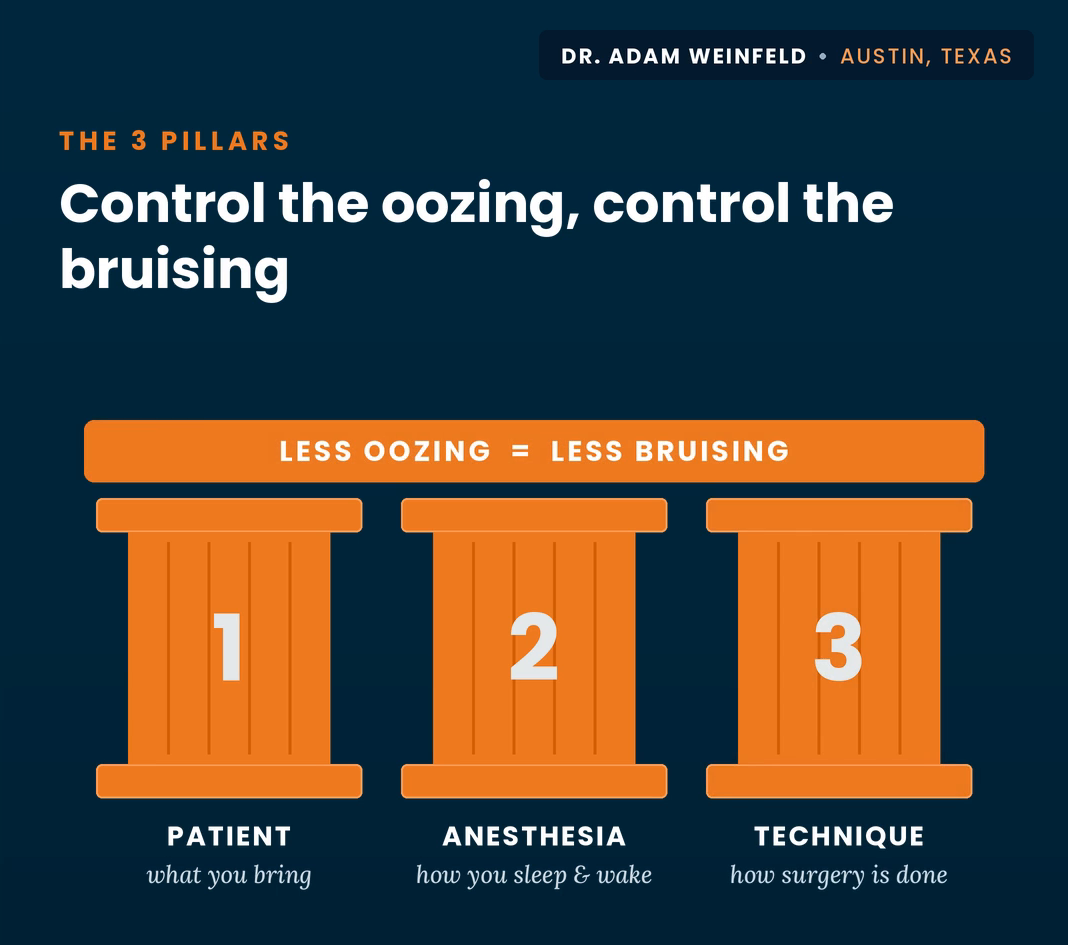
| Pillar | What it includes | Who acts on it, and when |
|---|---|---|
| Patient | Alcohol, supplements (turmeric, fish oil), medications (aspirin, SSRIs) and genetic differences in clotting | You and your surgeon, starting about two weeks before surgery |
| Anesthesia | Clonidine for anxious patients, a low-normal and steady blood pressure, a smooth wake-up and nausea prevention | The anesthesia team and surgeon, from the day before surgery through recovery |
| Technique | Rhinoplasty: the right dissection plane, piezo osteotomies, epinephrine and IV TXA, and controlling dead space. Facelift: dissection under magnification, bipolar cautery and IV or topical TXA | The surgeon, during surgery and through the first week |
What can you do before surgery to bruise less?
Tell your surgeon about alcohol, every supplement and every medication you take. Some patient factors are things we can modify.
Alcohol
Drinking alcohol, especially excessive amounts, within two weeks of surgery can potentially affect the ability of the liver to make the proteins that help create useful clotting during surgery. Those proteins help minimize bleeding and minimize the oozing that leads to bruising.
Supplements: turmeric and fish oil
Supplements that people take can have a big impact. So you need to tell your doctor what supplements you’re taking before surgery. We generally ask patients to stop at least two weeks before.
There are two supplements a lot of people take because they think they’re good for health. They may very well be good for their health, but they’re not good for it if what they want is a great facial plastic surgery recovery.
- Turmeric is very well understood to cause a little bit of a decrease in our body’s ability to create clots, and therefore it can lead to oozing.
- Fish oils are good for the heart for a variety of different reasons. Fish oils also affect the formation of normal, healthy, important clotting during surgery, at a microscopic, microvascular level, that’s important to decrease oozing.
There’s a whole host of them, and it is important to be aware of them. The most common ones are listed below.
Medications: aspirin and SSRIs
Some medications we can ask a patient to stop if we have medical clearance to do so, like aspirin. Some people take it for heart health, but many people who take it don’t have to. We like patients to stop it two weeks before surgery.
Another common one is SSRIs: mood-regulating medications like Prozac and others in that family. Those medications are well established to affect platelet function. Platelets are the tiny blood cells that help form the important clots that prevent bleeding, and therefore bruising, with surgery.
So I talk to my patients: we know this can cause a little extra bruising and may affect your recovery, but we need to have an honest conversation about whether it’s advisable for you to stop. If you stop this, is it going to really wreck your life? Is it going to make you depressed, or change your motivation level or your enjoyment of life?
If it’s not advisable, we acknowledge that some medications people have to continue to take, and we have other ways of controlling bruising and bleeding. But if someone says, “I only take it because it helps me sleep, I have mild anxiety, and I’ve gone off of it before,” then it ain’t an issue, and we have them stop. That’s about two weeks, and sometimes a month, beforehand, for patient-specific reasons. For more on the medications around surgery, see facelift and rhinoplasty medications for pain, nausea and swelling.
Common supplements and over-the-counter medications to stop before surgery
These are the most common ones we ask patients not to use, generally for at least two weeks before surgery. It’s not a complete list, so tell your surgeon everything you take.
Supplements
- Fish oil and other omega-3 supplements
- Turmeric (curcumin)
- Vitamin E
- Ginkgo biloba
- Garlic supplements
- Ginger supplements
- Ginseng
- Feverfew
- Dong quai
- St. John’s wort
- Green tea extract
- Saw palmetto
Over-the-counter medications
- Aspirin and products that contain it, such as Bayer, Bufferin, Ecotrin, Excedrin and Alka-Seltzer
- Ibuprofen (Advil, Motrin)
- Naproxen (Aleve)
- Bismuth subsalicylate (Pepto-Bismol), which contains a salicylate related to aspirin
- Cold, flu and nighttime pain products that contain aspirin, ibuprofen or naproxen, such as Advil PM. Check the label.

Never stop a prescribed medication, including a prescription blood thinner, without your prescribing doctor.
Why do some people bruise more than others?
Genetic variation. Some patients just ooze a little bit more, and some a little bit less.
There’s a range of how our platelets and our coagulation cascade proteins (the proteins that make blood clot) function. There are microscopic differences that have to do with genetic variations, and those are things we can’t necessarily control. But it is important to know if someone has a disorder like hemophilia, or even a hemophilia trait, or has a relative with hemophilia or von Willebrand disease.
This is basic screening, done with some very simple questions:
- Do you bleed a lot when you’ve lost teeth? What’s dental work like?
- When you nick yourself shaving your underarms, your legs or your beard, does it stop bleeding in a normal period of time? Or does it take half an hour, an hour, to stop oozing?
These are important indicators that tell us we may need to order some labs, to get more information about how your blood functions when it needs to clot.
How does anesthesia affect bruising?
Through blood pressure. A low-normal, steady blood pressure during surgery, a smooth wake-up and nausea prevention all help limit oozing. Anesthesia factors cover the perioperative experience (the time around surgery) and how we can regulate it.
Clonidine for anxious patients
Some patients undergoing facial surgery tend to be very anxious, and their blood pressure pops when they get anxious, which we know will happen around surgery. We give them clonidine, a blood pressure medication that has a really wonderful effect on the way people’s blood pressure responds to stress. It can also make people feel less anxious, so it affects blood pressure in two different ways. It also helps with pain control afterward.
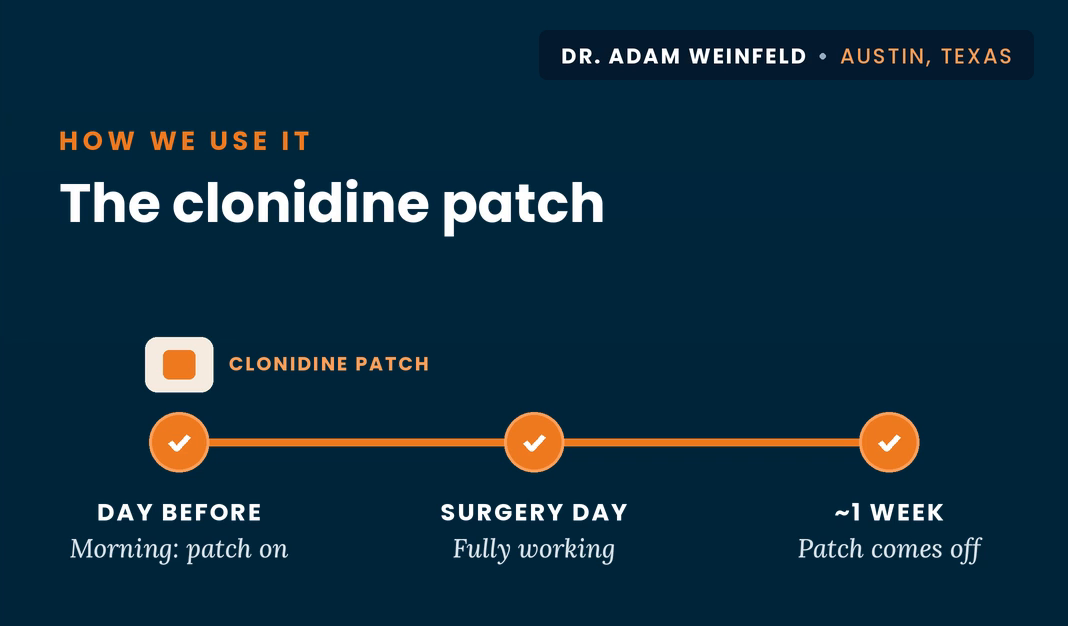
Patients take it either as a patch or as pills, depending on the specifics of their clinical scenario. Usually, when a patient is going to undergo facial surgery, we’ve noted high blood pressures and there’s no reason not to do it, we have them put the patch on the morning of the day before surgery. It starts to really kick in by the time we do surgery. They wear it for a week, and it really helps.
Steady beats perfect: blood pressure during surgery
Blood pressure during surgery is really important too. We work with a very tight, small group of anesthesia providers who are really excellent, and there are some we specifically request for our facial procedures because blood pressure management during surgery is so important. See also general anesthesia vs. IV sedation for a facelift.
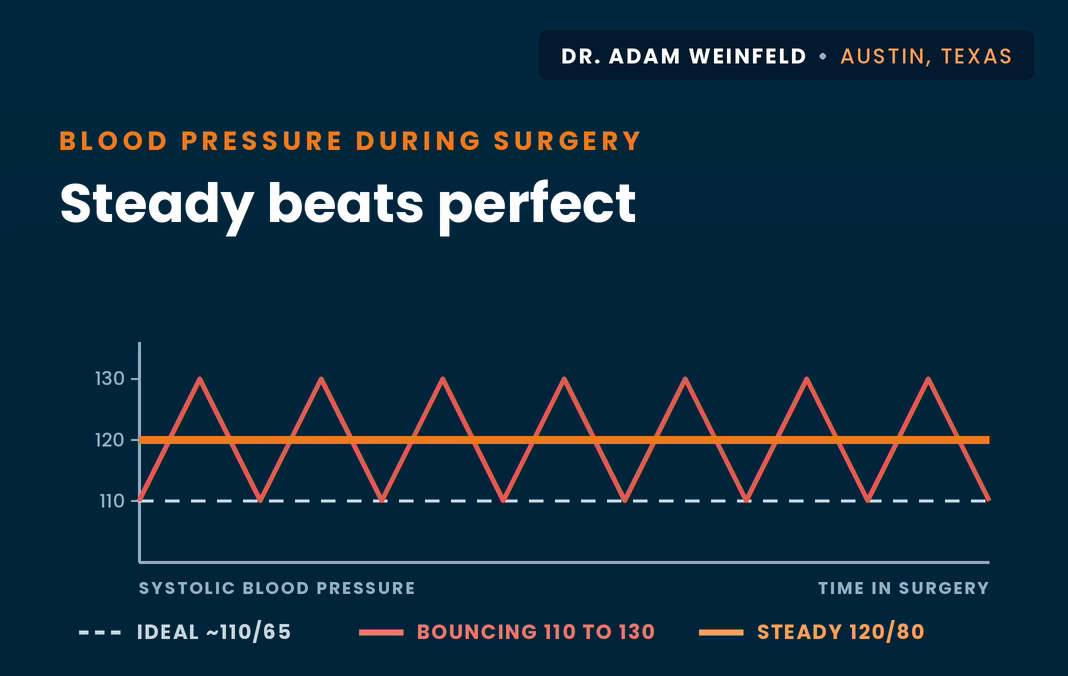
We seek a low normal: in the normal range, low normal or just below normal for these facial procedures, because that helps decrease oozing. In some patients, you can’t keep what would be ideal. Then what’s more important is a consistent blood pressure.
If we had an ideal of, let’s say, 110 over 65 or 70, but we just can’t keep it there, I’d much rather have a 120 over 80 than a pressure bouncing back and forth between 110 over 65 and 130 over 90, because we’re trying to chase something we’re never going to catch.
A smooth wake-up and nausea prevention
One of the most important skills is waking a patient up without abrupt motions, like retching or gagging. That causes a temporary increase in venous pressure through a Valsalva maneuver (straining against a closed airway), plus clenching and a general increase in blood pressure, and that can force blood underneath the skin when we’ve just operated. So we want an anesthesia provider who makes the wake-up a very smooth transition, without that retch, that clench or biting on the breathing tube. We have hand-selected the ones who do this really, really well.
Postoperative nausea control starts even before the operating room, with medications to prevent nausea. Those are supplemented by the medications our anesthesia providers give during surgery, and by the way they use their anesthesia cocktail: gases, propofol, ketamine, Precedex, a mixture tailored to the patient that gives the best anesthesia with the lowest exposure to medications that cause nausea, such as narcotics and even some of the gases. See also the link between nausea and bruising in rhinoplasty.
Why do we care about nausea? Because the last thing we want is someone to wake up and throw up. Throwing up creates a lot of pressure: back pressure, venous pressure and sudden motions. That can create oozing and bleeding under the skin: more bruising, more swelling, more discomfort. We want you to get back to your life as soon as possible.
How does surgical technique reduce bruising in a facelift or rhinoplasty?
In a rhinoplasty, by dissecting in the right plane, shaping bone with a piezotome, using epinephrine and IV TXA, and obliterating dead space. In a facelift, by careful dissection under magnification, bipolar cautery, TXA and a steady blood pressure. Here we’ve got to look at the man in the mirror: what can I contribute to make your healing and your recovery the best it can be? This is all about technique. Experience leads to technique, customized to the patient.
Dissect in the right plane
In rhinoplasty, we dissect as deep as we can, adjacent to the cartilage and bone: in most people, the subperichondrial plane (just under the perichondrium, the thin lining over cartilage) and the subperiosteal plane (just under the periosteum, the lining over bone). If it’s a boundary between layers, it bleeds a little bit less.
Some patients’ anatomy just doesn’t permit it. In rare patients, say a thick-skinned patient with really flimsy, floppy cartilage, you have to leave some of that perichondrium on. But the better we’re able to achieve that dissection, the less bruising we will have.

Piezo osteotomies
Another factor is the choice of tools. I use a piezotome (an ultrasonic bone instrument) for most of my osteotomies, the controlled bone cuts in a rhinoplasty. Not all of them; sometimes I still use an osteotome. You don’t want to be rigid in your thinking and your technique.
A piezotome can cut, move and reduce bone in a very precise way while minimizing collateral damage to the soft tissues and the blood supply within them. That helps decrease bleeding, because you’re not injuring the stuff that bleeds. Bone, especially in the nose, doesn’t bleed that much. It’s the soft tissue around it, like the overlying skin and the underlying mucosa.
Epinephrine and IV TXA
Something else helps limit the bruising by limiting the oozing. I inject a mixture of anesthetic medications with a sequential increase in the amount of epinephrine, which clamps down on the blood vessels. The patient also gets IV TXA (tranexamic acid), which also helps reduce bleeding. Re-dosing the local anesthesia with epinephrine gets us through the phase where the initial bleeding can occur.
Obliterating dead space
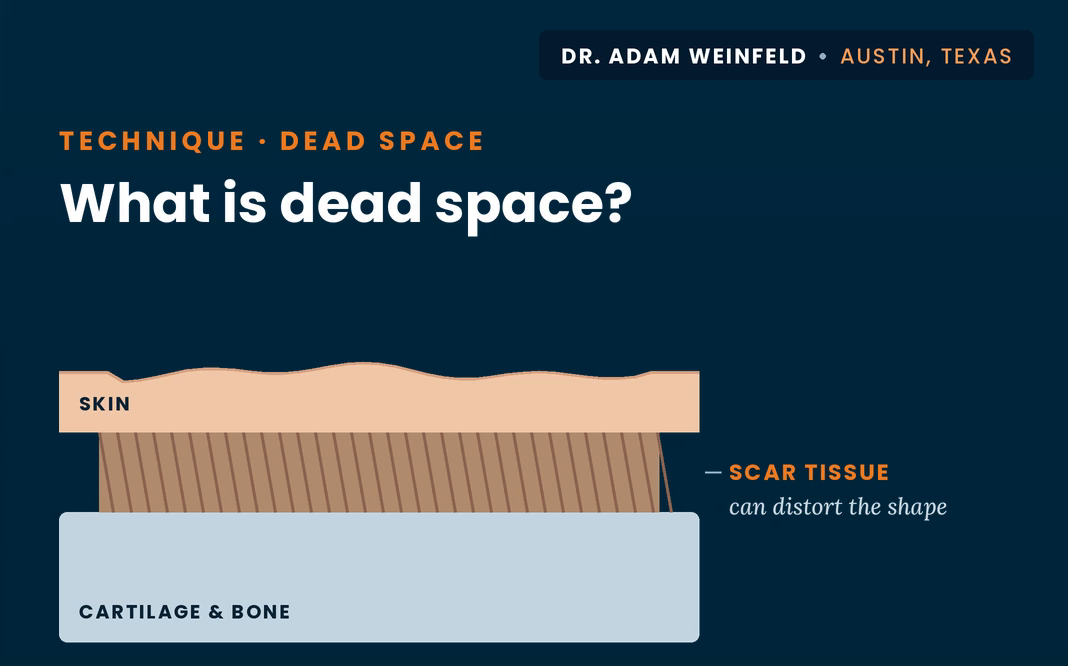
Dead space is a surgical term for a potential space: a space that’s not occupied by anything. It exists in a surgical plane, a space created between two tissues that used to be joined together. In a rhinoplasty, we lift the skin off the cartilage and bone to modify them, which brings the shape we see through the skin. That creates a lot of dead space.
That dead space can fill with blood. That blood can create bruising. It can also become fibrotic, replaced with collagen, and that can distort the appearance. It can rob the patient of the beauty we were trying to achieve. So we need to control dead space. I like to say obliterate, because it’s a fancy word. Who doesn’t like fancy words?
How I control dead space after rhinoplasty:
- Surgical taping
- Cushions under the splint that help squeeze the skin down
- Bolstering or quilting sutures under the surface, such as the supratip stitch
- Repairing the scroll ligaments
- Transcutaneous sutures (through the skin) that bring the layers together, removed at seven days
In a facelift or neck lift
In a deep plane facelift or neck lift, I decrease oozing with:
- Careful dissection of the skin and deep planes under loupe magnification (surgical magnifying lenses)
- Bipolar electric cautery, a precise cautery that seals small blood vessels
- Intravenous TXA, plus topical TXA as needed
- Rigorous maintenance of a stable blood pressure in the low range of normal
- A gentle wake-up without bucking or retching, and nausea control
- In the neck, direct dissection and direct excision with scissors instead of liposuction
Those are the three pillars: the patient, the anesthesia and my technique. Sound, proven techniques can help minimize oozing during surgery and after surgery; both are important. If we can control oozing, we can control bruising. Reduce oozing, reduce bruising.
How long does bruising last after a facelift or rhinoplasty?
Bruising usually peaks at about 4 to 7 days. After a rhinoplasty, patients usually feel comfortable socially or going back to work at about 7 or 8 days. After a facelift, it’s more likely 10 to 14 days.
I have facelift outliers who go back to work between 5 and 8 days. As early as 5 days is a significant outlier, but I’ve had people go back at 7, 8 and 10 days. For more on what the first days feel like, see rhinoplasty recovery: pressure, discomfort and getting social.
What helps bruising after surgery?
- Head elevation is good.
- Arnica or bromelain: we start these 3 days before surgery.
- Cold compresses after a rhinoplasty: I don’t love them, because the condensation can make the splint come off. If patients are very careful and hold them on the cheeks and over the eyes, not near the splint, I’m OK with that.
- No cool packs on facelift skin: they can decrease blood supply, which can lead to necrosis of the skin (tissue loss) and decreased healing.
- Makeup: OK on the central face, away from the incisions, almost immediately, and certainly by 2 or 3 days. In the areas of the incisions, it’s between 7 and 14 days, whenever there’s no more crusting.
We see patients frequently, so we can clear them as needed.
Frequently asked questions
How long before surgery should I stop turmeric and fish oil?
Dr. Weinfeld generally asks patients to stop supplements at least two weeks before surgery. Turmeric is well understood to decrease the body’s ability to create clots a little, and fish oils affect normal, healthy clotting at a microscopic, microvascular level. Both may be good for your health, but not for a great facial plastic surgery recovery. Tell your surgeon every supplement you take.
Should I stop my SSRI before a facelift or rhinoplasty?
Not without your prescribing doctor. SSRIs affect platelet function and can cause a little extra bruising, so Dr. Weinfeld has an honest conversation with each patient about whether stopping is advisable. If it isn’t, the patient keeps taking it and bruising is controlled in other ways. If it is, he has them stop about two weeks, sometimes a month, beforehand. Never stop a prescribed medication without your prescribing doctor.
Can I use ice or cold compresses after a facelift or rhinoplasty?
It depends on the surgery. After a rhinoplasty, Dr. Weinfeld doesn’t love cold compresses, because the condensation can make the splint come off. They’re OK if patients are very careful and hold them on the cheeks and over the eyes, not near the splint. After a facelift, he doesn’t want cool packs on the skin, because they can decrease blood supply and lead to skin necrosis and decreased healing. Head elevation is good.
When can I wear makeup after a facelift or rhinoplasty?
Makeup is OK on the central face, away from the incisions, almost immediately, and certainly by 2 or 3 days after surgery. Over the incisions, it’s usually between 7 and 14 days, once there’s no more crusting. Dr. Weinfeld sees patients frequently after a facelift or rhinoplasty, so he can clear each patient for makeup as soon as they’re ready.
Will I have black eyes after rhinoplasty?
Usually not all the way across. Some rare rhinoplasty patients get no bruising under the eyes. Many have a little in the lower corners of their eyes, and sometimes it reaches halfway across the lower eye region. Bruising all the way across is rare, and when it happens, it’s usually because the patient got nauseated and threw up. That’s one reason nausea prevention is a big part of the plan.
What is a clonidine patch, and why use it before facial surgery?
Clonidine is a blood pressure medication that blunts the way blood pressure responds to stress. It can also ease anxiety and help with pain control afterward. For anxious patients whose blood pressure pops, or patients with high blood pressures, Dr. Weinfeld has them put the patch on the morning of the day before surgery, so it is working by surgery, and wear it for about a week.
About the author
Adam Bryce Weinfeld, MD, is a board-certified plastic surgeon in Austin, Texas, with 19 years in practice. His practice is exclusively aesthetic, with an emphasis on the face. He is double fellowship-trained in facial aesthetic surgery and oculoplastic surgery, a Clinical Associate Professor at Dell Medical School and the author of 33+ peer-reviewed publications and multiple book chapters. He sees patients in Westlake and North Austin.
Considering a facelift or rhinoplasty in Austin?
Book a consultation with Dr. Adam Weinfeld, board-certified plastic surgeon in Austin, Texas.
Request a consultation512-559-1376 · drweinfeld.com
This article is for education only and is not medical advice. Individual results vary. Never stop a prescribed medication without your prescribing doctor. Written by Dr. Adam Weinfeld from his video and dictated answers; edited and formatted with AI assistance. Watch the full video on YouTube.
Full video transcript
Does oozing cause bruising after surgery? Oozing leads to bruising. We’re not talking about life-threatening bleeding, but we are talking about recovery-threatening bleeding. Remember, just a couple of extra drops of blood underneath the surface of the skin can contribute to having a little bit more bruising than would be desirable and prolonging that recovery.
Why bruising slows facial surgery recovery Patients are concerned about a lot of things when it comes to recovery, especially recovery in the face. When we think about rhinoplasties, when we’re thinking about comprehensive cervicofacial rejuvenation, facelifts, neck lifts, other procedures around the eyes. Bruising can definitely delay the healing process, the recovery process, and especially the process of social reintegration. People want to get back to work, get back to social engagements without having evidence of surgery as soon as possible. And bruising is one of the telltale marks of having had surgery, in addition to swelling. When we have bruising underneath the skin, that’s blood that is collected underneath the skin from the process of surgery. There’s going to be bleeding during surgery, we know that. And that bleeding and a little bit collected under the skin leads to bruising. It also can lead to swelling because blood underneath the skin, outside of the blood vessels, is actually inflammatory. Not to mention the fact that it can also increase pain because of the fact that it’s inflammatory and it inflames nerves. So the name of the game is to reduce the amount of blood that collects underneath the skin during surgery and also after surgery during the recovery. It’s particularly important in surgery of the face. Noses and faces because a small amount of blood has a bigger impact because it’s a tighter space, a smaller space.
The 3 pillars that control bruising Now, how do we control that, right? Well, to control it, we have to know what are the contributing factors that lead to bleeding. All surgeries have bleeding. We want to try to control it, minimize as much as possible. So you’ve got to understand those factors. These are the three factors. There’s patient factors. Second, there are technique factors. And third, there are anesthesia factors.
Does alcohol cause more bruising? Patient factors are really important. What are patient factors? Well, some of them have to do with things that we can modify. For example, drinking alcohol, especially excessive amounts, within two weeks of having had surgery can potentially impact the ability of the liver to make the proteins that help create useful clotting during surgery to minimize bleeding, to minimize oozing that leads to bruising.
Supplements to stop: turmeric & fish oil Another thing are supplements. Supplements that people take can have a big impact. So you need to tell me, you need to tell your doctor what supplements you’re taking before surgery. And we generally ask patients to stop at least two weeks before. What are two supplements that a lot of people take? And they think that they’re good for health and they may very well be good for their health, but they’re not good for their health if what they want is a great facial plastic surgery recovery. What are the two that I’m thinking of right now? And there’s many of them, but turmeric is one. Turmeric is very well understood to cause a little bit decrease in our body’s ability to create clots and therefore can lead to oozing. Now, we’re not talking about life-threatening bleeding, but we are talking about recovery-threatening bleeding. Remember, just a couple of extra drops of blood underneath the surface of the skin can contribute to having a little bit more bruising than would be desirable and prolonging that recovery. Nobody wants that, right? The second supplement: fish oils. Fish oils are good for the heart for a variety of different reasons. Some of it’s speculated might have to do with its impact on the ability to form unneeded clots. Fish oils also impact just the formation of normal, healthy, important clotting during surgery at a microscopic, microvascular level that’s important to decrease oozing during surgery. There’s a whole host of them, and we’re not going to go over each one, but it is important to be aware of those.
Aspirin, SSRIs and bruising before surgery What’s a second patient factor? A second patient factor is medications. Now, there are some medications that we can ask a patient to stop if we have medical clearance to do so, like aspirin. That’s an important one that some people take for heart health, but many people take it, don’t have to take it. We like patients to stop two weeks before surgery. Another thing, and this is a common one, is SSRI, mood-regulating medications like Prozac and some of the same medications in that family. Those medications are well established to impact platelet function. So, platelets are the little tiny micro-blood cells that are one of the components that help form the important clots to prevent bleeding and therefore bruising associated with surgery. It’s important to understand if a patient’s on SSRIs. So I talk to my patients like, hey, listen. We know that this can cause a little bit extra bruising. It may impact sort of your recovery, but we need to have an honest conversation about whether it’s advisable for you to stop. And so I always ask: hey, if you stop this, is this going to really kind of wreck your life? Is it going to make you depressed? Is it going to change your motivation level, your enjoyment of life? Like, is it not advisable? Because if it’s not advisable, then we should just acknowledge that some medications people have to continue to take, and we have other ways of controlling bruising and bleeding. And we just have to, take the cards that are dealt to us. But if it’s someone who says, I only take it because it helps me sleep and I have mild anxiety, I’ve gone off of it before for a variety of different reasons, and it ain’t an issue, then it ain’t an issue. And we have them stop. About two weeks and sometimes a month beforehand, patient-specific reasons.
Why some people bruise more: screening Another patient-related factor are genetic variations. There’s a range of how our platelets and our coagulation cascade proteins function, there’s microscopic differences that have to do with genetic variations. And some patients just ooze a little bit more, some a little bit less. Those platelets and the proteins function in different ways. And those are things we can’t necessarily control. But it is important to know if someone has a disorder like hemophilia, or even a hemophilia trait, or has a relative who has hemophilia or von Willebrand’s disease. These are all things that are basic screening when we ask some very simple questions. Do you always bleed when you’ve lost your teeth? What’s dental work like? What happens if you’re shaving your underarms or your legs or your beard or whatever it may be and you nick yourself? Does it stop bleeding in a normal period of time, or does it seem like it takes half an hour, an hour to stop oozing. These are important indicators that indicate to us that we may need to order some labs to get further information about how your blood functions when it needs to clot. So those are patient factors.
Anesthesia, anxiety & the clonidine patch Second thing has to do with anesthesia factors, and the perioperative experience and how we can regulate that. Blood pressure is really important. So when we have a patient who’s undergoing facial surgery who tends to be the type who’s very anxious and their blood pressure pops when they get anxious, which we know will happen around surgery, we actually give them clonidine, which is a specific blood pressure medication that has a really wonderful impact on the way people’s blood pressure responds to stress. And in fact, it can also make people feel less anxious. So it’s like two different impacts on blood pressure. And so it also helps with pain control afterwards. It sort of supplements the other things we do. So that’s one way we can monitor or rather impact blood pressure. After surgery, and we have a patient take it either as a patch or pills, depending on specifics of their clinical scenario. Usually, we have a patient who’s going to undergo facial surgery. We’ve noted high blood pressures, and there’s no reason not to do it. Then, we have them put the patch on the morning of the day before surgery. So, it starts to really kick in by the time we do surgery. They wear it for a week, and it really helps, and that’s generally all we need to do.
Why steady blood pressure matters in surgery Blood pressure during surgery is really important too. We work with a very, very tight group, a small group of anesthesia providers who are really excellent. And we have some anesthesia providers that we specifically request for our facial procedures because blood pressure management during surgery is so important. So there are a couple things we seek. We seek a low normal, so in the normal range, low normal or just below normal for these facial procedures. We want that because that helps decrease oozing. Another thing that is important to know is that some patients, you can’t keep what would be like ideal. So then what’s more important is to have a consistent blood pressure. So if we had an ideal of let’s say 110 over 65 or 70, but we just can’t keep it there, I’d much rather have a 120 over 80 as a blood pressure than bouncing back and forth between 110 over 65 to like 130 over 90 because we’re trying to chase something we’re never going to catch. So blood pressure regulation and having skilled anesthesia providers is really important.
A smooth wake-up from anesthesia One of the most important skills is to be able to wake up a patient without them having abrupt motions, abrupt like retching or gagging. We don’t want that because that’s a temporary increase in venous pressure through a Valsalva maneuver and clenching and increasing blood pressure in general, and that can force blood underneath the skin when we’ve just operated. So it’s really important that we have an anesthesia provider who is able to help regulate the way we wake up a patient and have it be a very smooth transition so we don’t have that abrupt like that retch or that clench or biting on the endotracheal tube. We want to avoid that. There’s a lot of wonderful recipes to make this work. Each one has their unique skills, but we have hand-selected the ones who do this really, really well.
How to prevent nausea after surgery And then post-operative nausea control, which starts even before the operating room, we give medications to prevent nausea, and then those are supplemented with the medications that our anesthesia providers give during the surgery, and also the way in which they use their anesthesia cocktail. Gases, or whether it be propofol or ketamine or a variety of Precedex, a bunch of different sort of mixtures of these in a patient to bring about the best anesthesia, but also do it in a way with the lowest exposure to medications that will make them nauseated, such as, let’s say, narcotics and even some of the gases. Doing that and making it very patient-specific, and customized can help decrease nausea. Why do we care about nausea? Because the last thing we want is someone to wake up and throw up. What happens when you throw up? You go, ooh, right? And it creates a lot of pressure, that creates back pressure, venous pressure, sudden motions, and that can create oozing and bleeding under the skin, more bruising, more swelling. More discomfort. We don’t want that. We want you to get back to your life as soon as possible. So those are some of the anesthesia factors.
Rhinoplasty technique: the right plane Now, we got to look at myself. We got to look at the man in the mirror, right? What can I contribute to make your healing, your recovery the best it can be? This is all about technique. Experience leads to technique, customizing it towards the patient. Let’s take rhinoplasty, for example. Dissecting as deep as you can adjacent to the cartilage, and most people, subperichondrial plane, subperiosteal plane. If it’s a boundary between layers, it bleeds a little bit less. That’s number one. So, doing that to the best of one’s ability, and some patients, their anatomy just doesn’t permit it. And there are rare patients, let’s say you’re a thick-skinned patient who have really flimsy, floppy cartilage, then you have to actually leave some of that perichondrium on. But the better we’re able to achieve that dissection, the less bruising we will have. Another thing is choice of tools that we use.
Does piezo rhinoplasty mean less bruising? When we use a piezotome for most of our osteotomies, not all of them, because sometimes I still do use an osteotome. You don’t want to be rigid in your thinking and your technique. Using a piezotome with its ability to cut bone, to move bone and vary and reduce bone in a very precise way with minimizing collateral damage to the soft tissues and therefore the blood supply within those, doing that helps decrease bleeding because you’re not injuring the stuff that bleeds. Bone, especially in the nose, doesn’t bleed that much. It’s the soft tissue around it, like the overlying skin and the underlying mucosa. Piezotome helps that.
Epinephrine and IV TXA to limit oozing There’s something else that helps limit the bruising by limiting the oozing. The way that I go about that is the mixture of anesthesia medications that I inject with a sequential increase in the amount of epinephrine which clamps down on the blood vessels, that plus having the patient be getting IV TXA, that also helps reduce bleeding. And then re-dosing the local anesthesia with the epinephrine that helps us get through that phase where the initial bleeding can occur. So that really helps reduce it.
What is dead space after rhinoplasty? And then also what we call reducing or controlling, or I like to say obliterating, because it’s a fancy word. Who doesn’t like fancy words? Obliterating dead space. What does dead space mean? Dead space means it’s a surgical term, meaning it’s also like a potential space. It means a space that’s not occupied by anything. And it exists in a surgical plane. What’s a surgical plane? A surgical plane is a space that is created between two different tissues that used to be joined together. So in a rhinoplasty, we’re lifting the skin off of the cartilage and the bone to make the modifications to the cartilage and the bone. That brings us the shape that we see through the skin. That creates a lot of dead space, right? And that dead space can fill with blood. That blood can create bruising, it can also become fibrotic, replaced with collagen, and that can distort the appearance, it can rob the patient of the beauty that we were trying to achieve. And so, we need to obliterate dead space, we need to control dead space. The way that I do surgical taping, the way I put certain cushions to help squeeze that skin down, the utilization of under-the-surface bolstering sutures or quilting sutures such as the supratip stitch, repairing the scroll ligaments, that helps decrease dead space. And also, I use some transcutaneous sutures that help bring the layers of the skin together that we take out at seven days. And that also helps reduce blood collecting in that dead space. So we’ve got the splint, the cushioning underneath the splint, we’ve got sutures under the surface, sutures through the different layers through the skin. And then we also have the application of the medications at different junctures.
Reduce oozing, reduce bruising: 3 pillars Those are the three pillars, the three principles, the three factors. We’ve got the patient, we’ve got the anesthesia, and we’ve got my technique, sound, proven techniques that can help minimize oozing during surgery and after surgery, both important. So, if we can control oozing, we can control bruising. Reduce oozing, reduce bruising.