
Better and Yourself or Better and Different? Planning Your Rhinoplasty
November 09, 2026 | Rhinoplasty
By Adam Bryce Weinfeld, MD · Board-certified plastic surgeon · Austin, Texas · Updated November 7, 2026
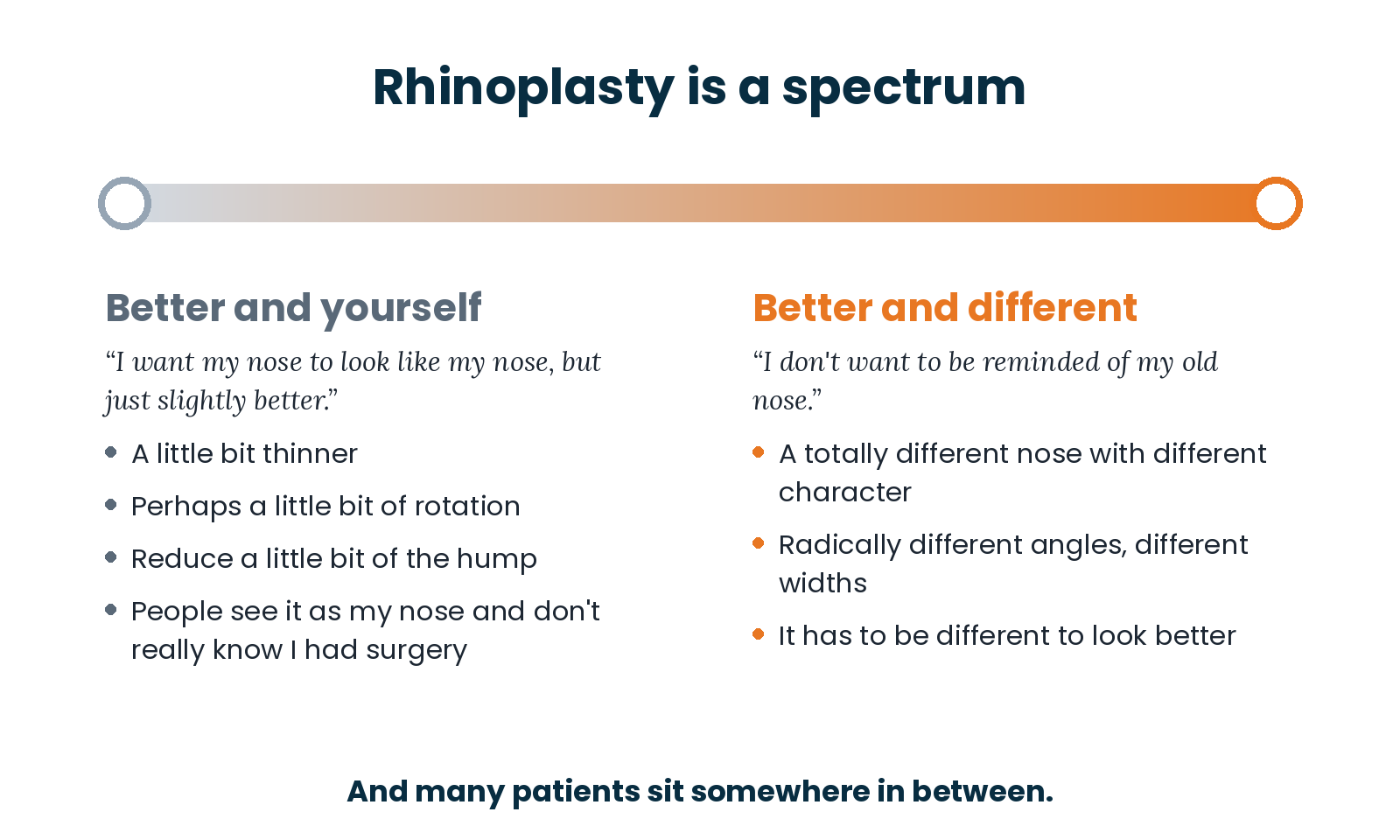
Some patients want a rhinoplasty that makes them look better but still like themselves: a little thinner, a little rotation, a little less of the hump, and nobody knows they had surgery. Others want a nose that looks better and different. Both are right, and it’s a spectrum. Part of my job in a consultation is understanding where you sit.
Key takeaways
- “Better and yourself” and “better and different” are two ends of a spectrum, and many patients sit somewhere in between.
- The first question I often ask is why you want a rhinoplasty, and then I let you tell me.
- Bring inspiration photos of noses you like and noses you don’t. One or two is great; beyond ten gets challenging.
- AI-generated photos tend to change the whole face, which can set expectations that are out of the realm of possibility.
- My Photoshop simulations only show what I honestly believe I can create in real life.
Will I Still Look Like Myself After Rhinoplasty?
That depends on what you want, and both answers are right. Some patients tell me, “I really want my nose to look like my nose, but just slightly better.” A little bit thinner, perhaps a little bit of rotation, a little less of the hump, and they want it to retain its natural identity. They want people to see it as their nose and not really know they had surgery.
For these patients it’s often about internal self-confidence: something that has always bothered them, not terribly, but enough to have surgery, such as a slightly wide tip or a little bit of a hump. You have surgery, you recover, and people might think, “Hmm, she looks a little bit different,” but they don’t know what happened.
What Is a “Better and Different” Rhinoplasty?
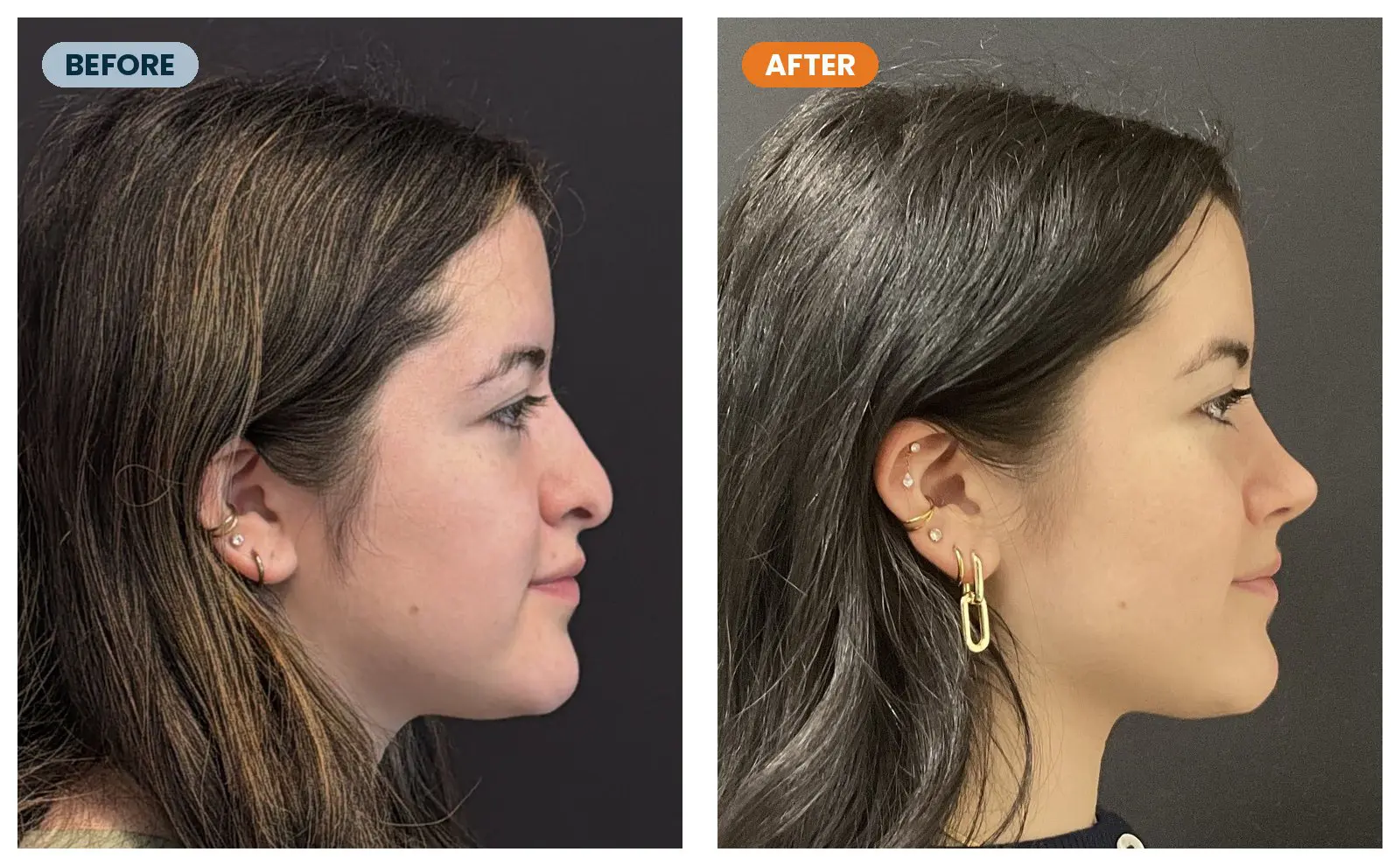
That’s a whole different ballgame, and an important one to understand. Some people have such displeasure with their nose, for good cause, that there’s no way it can look better if it looks the same as it did before. It has to be different: a totally different nose, with different character, radically different angles and different widths.
These patients are very unhappy with the overall character of their nose. It has often made them insecure, and they don’t want it to resemble anything they had in the past. They’re paying good money, they want something for that good money, and they do not want to be reminded of their old nose.
A real example
The patient in my Different, But Better case study is a good example. She would have been disappointed if she had the same nose. About three and a half months after surgery, she says the change was so drastic, she’s so happy.
How Do You Figure Out Where I Sit on That Spectrum?
You don’t have to have one or the other. It’s a spectrum, and you can have something in between. That’s where the magic of a consultation comes into play.
The first question I often ask is, “Why do you want to have a rhinoplasty?” And then I stop talking and let you tell me what you’re looking for. I can learn so much when I just give patients time to tell me. Then I ask some more probing questions, and inspiration photos and simulations help us get the rest of the way.
| Better and yourself | Better and different | |
|---|---|---|
| What patients often say | “I want my nose to look like my nose, but just slightly better.” | “I don’t want to be reminded of my old nose.” |
| Why | Internal self-confidence: something that has bothered them, not terribly, but enough to have surgery | Real displeasure with the nose, which has often made them insecure |
| Typical changes | A little thinner, a little rotation, a little less of the hump or a slightly wide tip | A totally different nose: different character, angles and widths |
| Afterward | People may think you look a little different, but they don’t know what happened | A nose that looks different from before |
Should I Bring Inspiration Photos to My Rhinoplasty Consultation?
Yes. A picture paints a thousand words, and I love it when patients bring me photographs. Sometimes they bring one or two, sometimes ten. Beyond ten it starts to become a little bit challenging, but I do like it when patients bring a bunch.
Bring photos of noses you like and noses you don’t like, whether or not those people have had rhinoplasties. Both are valuable information, and both are great ways to show me what you’re looking for.
What if my inspiration photos aren’t realistic?
That’s valuable too. Sometimes a patient brings a photo that’s way out of the realm of possibility. I don’t see that as a failure of the process, because at least I know what’s in their mind, and I can say, “Hey, this is not reasonable.” If you go into surgery expecting that, I don’t predict you’ll be happy, and I never want to take someone’s money for a surgery I don’t predict will make them happy.
For example, someone may show me a nose on a person with very thin, fair skin when they’re starting with thicker, darker skin. That doesn’t mean it’s a no-go. It means I explain why, surgically, in terms of the tissues and what can be done, and that they’re looking at a nose on a different face. Often patients have backup photos that are more reasonable, which tells me their head’s in the right place.
Are AI-Generated Nose Photos Realistic?
Often not, and we have to be really careful with them. I sometimes use AI to help, and I’m not against it, and patients clearly bring me AI-generated photos too. But AI models love to change everything on the face: the skin tone, the proportions. They make the patient look different, and often better, in a holistic way. Of course, they’re changing the nose too.
The challenge is that you’re looking at a nicer nose on an arguably more attractive face, and that sets an expectation that is way out of the realm of possibility. I don’t want anyone’s expectations to be above the level of what I can deliver, because then they’ll be dissatisfied.
Why Do You Make Your Own Photoshop Simulations?
That’s why I like to do two-dimensional morphs in Photoshop. I meet with you, understand what you’re looking for, take the photographs myself, and then work on them on my computer.
Looking at still images, front and side, without the patient in the room forces me to see proportions I might not have observed while you were moving. Seeing a patient move is clearly important, but still images help too. I go incrementally, subtracting a little and adding a little, and I only make morphs that I honestly believe I’ll be able to create in real life. If I know in the back of my head that I can’t deliver something, I won’t show it to you.
Making simulations also forces me to think through the whole operation: what will I do surgically, and what can I reasonably achieve? Then it gives me a tool to show you.
How should I look at my simulation?
Simulations are not surgical results; they’re a little bit of an appetizer for what we’re trying to achieve. You may find the front view or the side view most satisfying, but it’s unlikely you’ll love both. If you need a morph that shows exactly what’s in your mind’s eye, I’m not going to coach a simulation toward something unrealistic. I want to show you something realistic, I want you to like it, and I want you to recognize the limitations. Then we move forward.

It’s about triangulation between reality, your vision and my vision. Once we have that mind meld, that’s when we have the true communication that leads to a successful consultation and a successful surgery. I go deeper on how accurate morph photos are in how to prepare for a rhinoplasty or facelift consultation.
How Else Can I Prepare for My Rhinoplasty Consultation?
Think in advance about the three big things you’d like to change, such as a hump, a wide tip or an asymmetric nose, then add the details and write them down. If someone’s opinion matters to you, bring them or get them on the phone. Know which days you can take off work: most people go back to work at about seven to eight days, in person or virtually. I cover all of this, plus what happens during the visit, in How to Prepare for a Rhinoplasty or Facelift Consultation.
Frequently asked questions
How many inspiration photos should I bring to a rhinoplasty consultation?
One or two is great, and ten is fine. Beyond ten it starts to become a little challenging. A picture paints a thousand words, so bring photos of noses you like and noses you don’t like, whether or not those people have had rhinoplasties. Both tell me what you’re looking for, and even unrealistic photos are useful, because they show me what’s in your mind.
Can I bring an AI-generated photo of myself to my consultation?
Yes, but be careful with it. AI models tend to change everything on the face, including skin tone and proportions, so you end up looking at a nicer nose on an arguably more attractive face. That can set an expectation that is way out of the realm of possibility. We can look at it together, along with a simulation of what I honestly believe I can deliver.
Will a rhinoplasty simulation show exactly what my nose will look like?
No. My morphs are simulations, not surgical results; they’re a little bit of an appetizer for what we’re trying to achieve. I only make morphs I honestly believe I can create in real life. You may find the front view or the side view most satisfying, but it’s unlikely you’ll love both, and I won’t show you something unrealistic just because it matches your mind’s eye.
What is the first question you ask in a rhinoplasty consultation?
Often, “Why do you want to have a rhinoplasty?” Then I stop talking and let you tell me what you’re looking for, because I learn so much when I give patients time to explain. After that I ask more probing questions, look at your inspiration photos and, when it helps, make simulations, so we can figure out where you sit between better and yourself and better and different.
About the author
Adam Bryce Weinfeld, MD, is a board-certified plastic surgeon in Austin, Texas, double fellowship-trained in facial aesthetic surgery and oculoplastic surgery, and Past President of The Rhinoplasty Society. In 19 years of practice he has authored 33+ peer-reviewed publications and multiple book chapters, and he is a Clinical Associate Professor at Dell Medical School. His practice is exclusively aesthetic, with an emphasis on the face.
Considering a rhinoplasty in Austin?
Book a consultation with Dr. Adam Weinfeld, board-certified plastic surgeon in Austin, Texas.
Request a consultation512-559-1376 · drweinfeld.com
This article is for education only and is not medical advice. Individual results vary. Patient photos are shown with permission and are unretouched. The patient quoted was not paid; her comments are her own, given spontaneously and without prompting, and she is not a medical professional. Written by Dr. Adam Weinfeld from his own recorded remarks; edited and formatted with AI assistance.