
Why I Became a Plastic Surgeon: It Started on a Monorail at Age 8
November 02, 2026 | Choosing Plastic Surgery
By Adam Bryce Weinfeld, MD · Board-certified plastic surgeon · Austin, Texas · Updated November 2, 2026
Why did I become a plastic surgeon? It started with a question I first asked at age eight, on a monorail ride at Disney World: why is that face attractive? At 12, a documentary about ear reconstruction for microtia showed me how plastic surgery can let a patient’s life speak. I still ask that question about every face.
In this video
- 0:00 How a monorail ride shaped a plastic surgeon
- 0:10 How a plastic surgeon analyzes every face
- 1:03 Let your lives speak: a Quaker principle
- 2:01 Why do patients choose plastic surgery?
- 4:14 Why I became a cosmetic surgeon
- 5:03 Self-conscious about my ears as a kid
- 6:29 Microtia ear reconstruction that inspired me
- 9:56 From Swarthmore to plastic surgery residency
- 12:03 Facial and oculoplastic surgery fellowships
- 13:30 Reconstructive experience in cosmetic surgery
- 16:03 The monorail ride: why I study every face
Key takeaways
- The question started at age 8 on a monorail at Disney World: why is that face attractive? I still ask it about every face, before surgery and after.
- At 12, a documentary about a high school student with microtia, whose ear Joseph E. Murray rebuilt from rib cartilage, showed me how surgery can let a patient’s life speak. I’ve since done at least 100 microtia reconstructions myself.
- I care about each patient’s why, often a mismatch between what they see in the mirror and how they feel on the inside.
- Two fellowships, facial aesthetic surgery with Bahman Guyuron and oculoplastic and cosmetic surgery, shaped how I operate today.
- Facial trauma surgery taught me what the inside of a face is made of, and hundreds of microsurgical breast reconstructions meant hundreds of abdominoplasties.
Why did I become a plastic surgeon?
Because I have been analyzing people’s faces for as long as I can remember, and plastic surgery lets me use that to help people. It started with a monorail ride at Disney World when I was eight. I’ll come back to that at the end.
I’ve always asked myself what’s attractive, what’s less than attractive, what makes a face work, and what the key feature is that drives someone’s identity. Every time I’m out, I’m looking at people’s faces. I’m doing surgeries on their faces in my mind, whether they like it or not.
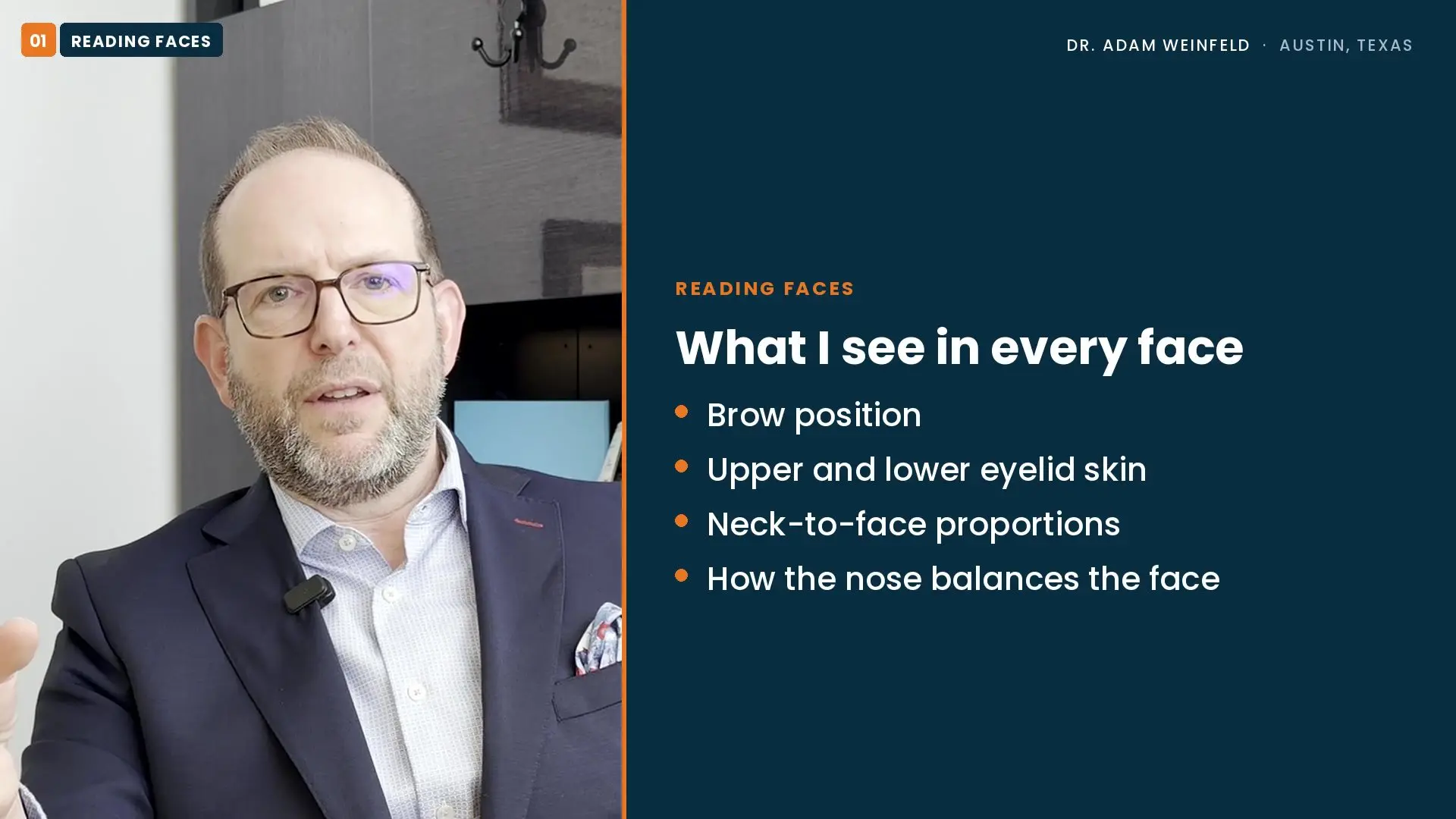
I look at a face and think about how it would benefit from a facelift. Are the brows low? Is there too much excess skin in the upper and lower eyelids? What are the proportions between the neck and the face? I do the same thing with noses: how does that nose balance with the rest of the face, and what needs to change to complement it?
What does “let your lives speak” have to do with plastic surgery?
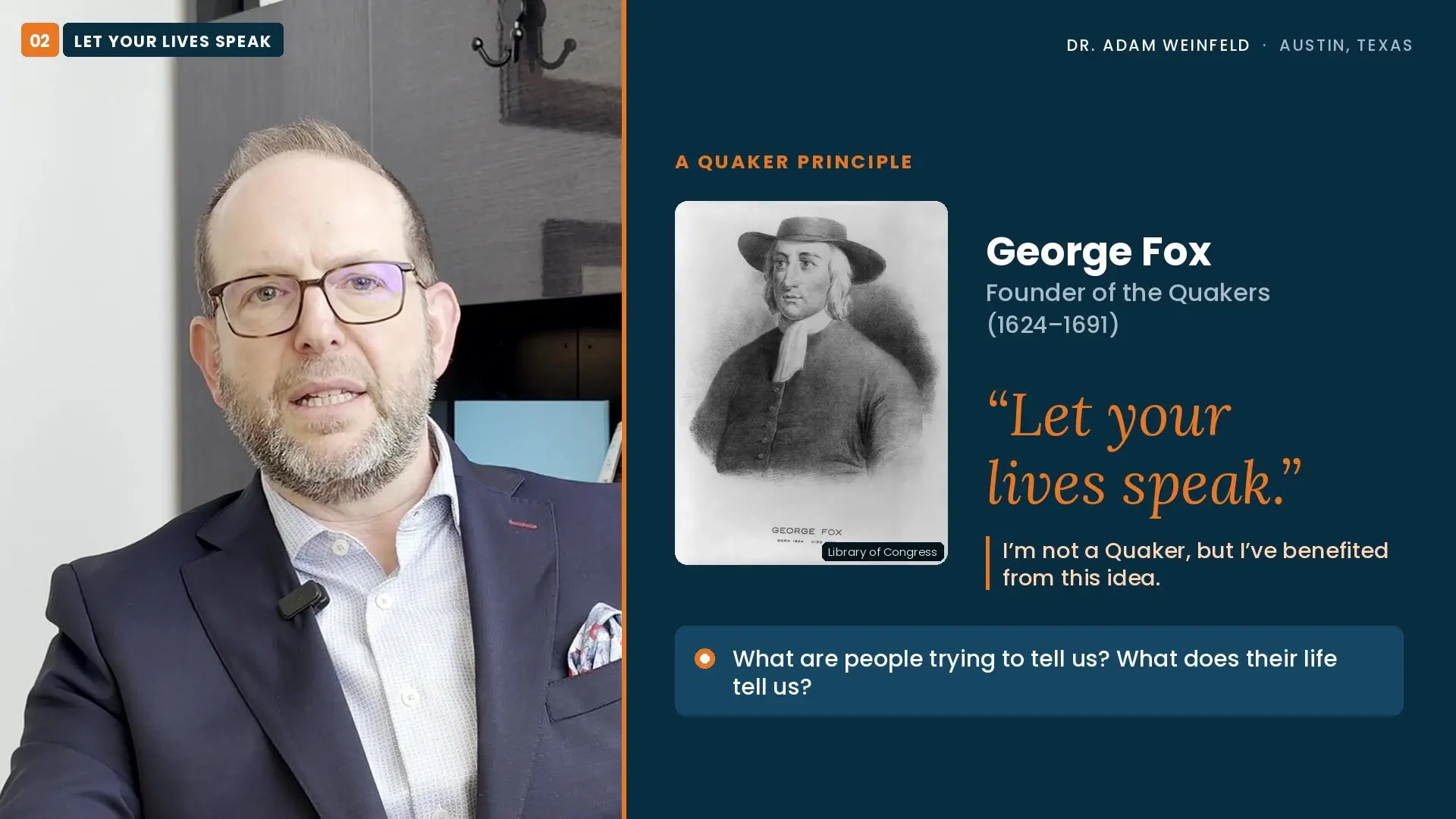
It’s how I try to understand patients: what is a person’s life trying to tell us? The phrase is a Quaker principle that goes back to George Fox, who started Quakerism.
I went to a small high school that happened to be a Quaker high school, Sandy Spring Friends School in Maryland. I’m not a Quaker, but I’ve benefited from this idea. I’ve always felt it’s an important way we should understand people. What are they trying to tell us? What does their life tell us?
I also believe that everybody’s life is essentially a universe of experiences, of interactions, and of impact on other people’s lives. As plastic surgeons, we have a very important role in people’s lives. We alter their appearance, and we do it in the context of people trying to reimagine the way they project themselves to the world. This is really important work, and I treat it very seriously because of those reasons.
Why do patients choose plastic surgery?
Often because of a mismatch between what they see in the mirror and how they feel on the inside. That why matters to me as much as what a patient wants changed.
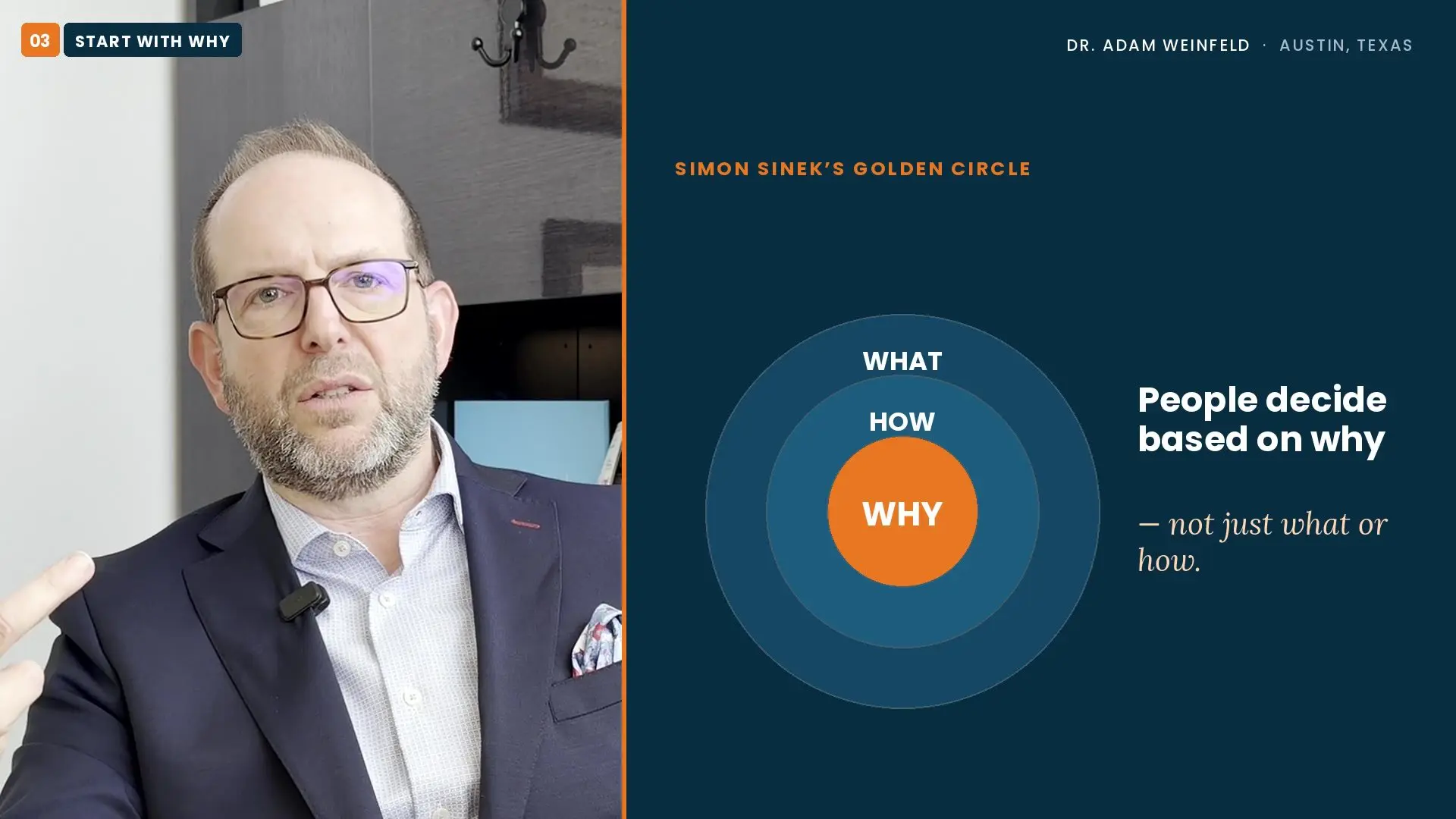
Simon Sinek, a thought leader in business and psychology, describes something called the Golden Circle: the things that drive people’s decisions aren’t necessarily the what or the how, but the why. I really care about the why when I’m with patients. Why is it they’re sitting in front of a plastic surgeon? Yes, I care about the what, like which features they don’t like, and I’m going to help them work through the how. That’s my role. But a common understanding of their why is really important, especially when a patient is going to undergo something serious, such as a facelift, a rhinoplasty, a breast augmentation or an abdominoplasty.
What does a patient’s why usually sound like?
Let’s say for the face: people see that their facial features, and perhaps what aging has done to their anatomy, make them look more tired, less engaging and less happy than they really feel on the inside. They recognize that can have an impact on the people around them. They find it difficult to let their lives speak, whether or not they can put their finger on it.
I know this is philosophical, and perhaps a little bit of an overreach, but I really do believe it. So I need to understand what’s motivating someone to have surgery. In what aspects of their life do they feel they lack confidence? In what way do they feel a change in their appearance would impact their life? It’s really important to investigate that.
In a consultation I ask very basically: Why are you having surgery? What are we trying to achieve? What problem are you trying to solve? Those questions are the heart of how I approach a consultation.
And what is my why?
There are the simple things. I love working with my hands, and I like helping people make changes in their appearance that they can see almost immediately. I love being a part of that. But more profound than that, I want people to feel easier in their skin. I want them to look in the mirror and truly see themselves, and to go about their day projecting outward what they feel on the inside.
What made me decide to become a plastic surgeon at 12?
A documentary about a high school student born with microtia, whose ear was rebuilt by Joseph E. Murray. What her classmates said afterward convinced me. Hook, line and sinker, I knew I was going to become a plastic surgeon.
Self-conscious about my own ears
Shortly after that monorail ride, I started, as we often do, to become aware of my own appearance. My ears stick out a little bit. It’s not terrible, it’s a little bit. When I was 10 or 11 it bothered me, not enough that I even talked to my parents about an otoplasty, the surgery that sets back ears that stick out, but enough that I noticed it. I worked through it without surgery. Still, I remember looking in the mirror at my great aunt’s house and recognizing how being preoccupied with your appearance can affect the way you feel.
The documentary
My father is a doctor, an OB-GYN, so being a doctor was a potential reality for me. I did well in school, I liked the sciences, and I liked working with my hands. In art class I was especially good at the projects where we built things out of clay.
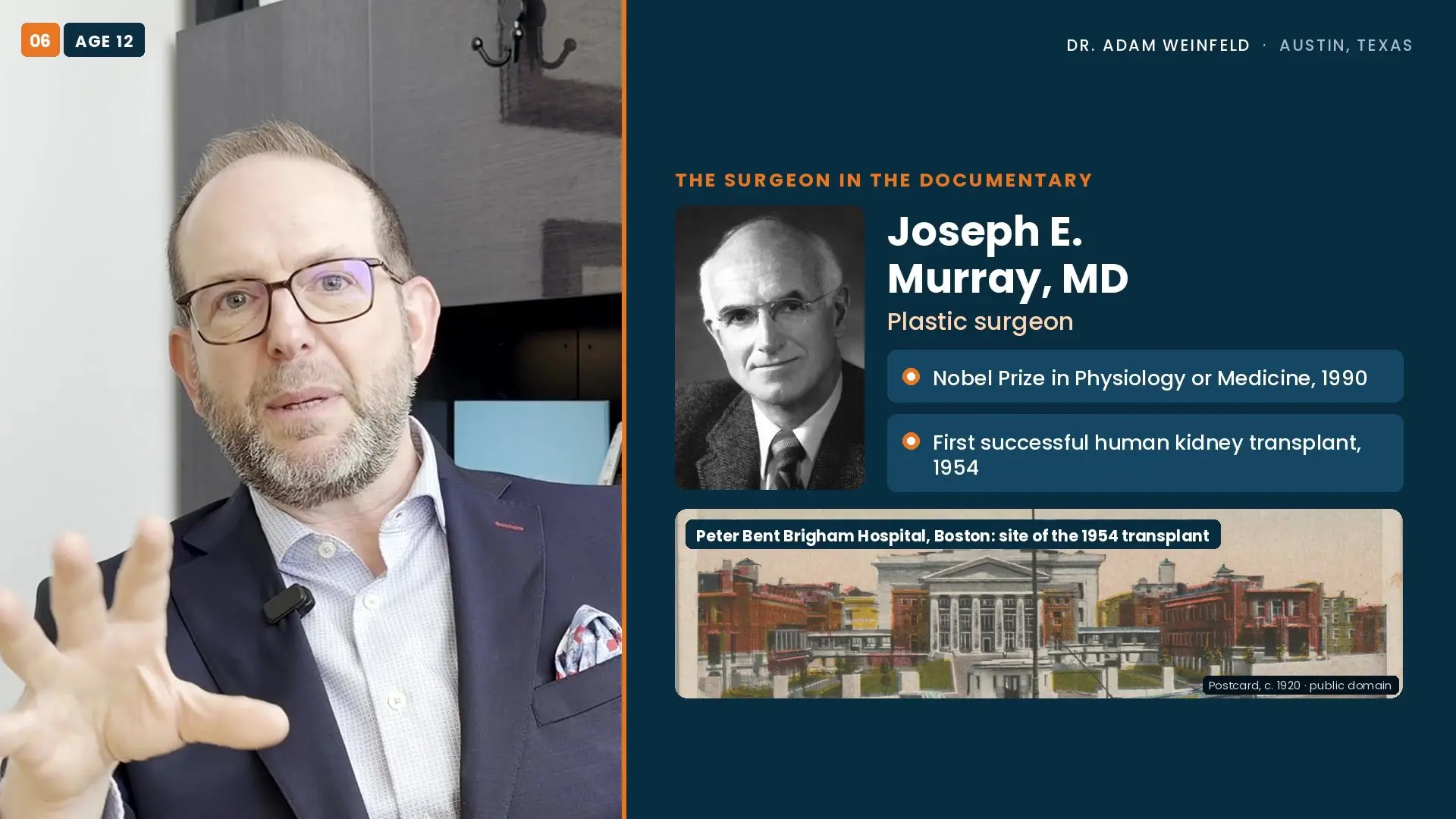
Then one evening a documentary came on TV about a young woman in high school who was born with very small ears, essentially without ears. She had microtia, a condition I ended up taking care of in young kids later in my career; I’ve probably done at least 100 microtia reconstructions. The documentary followed her ear reconstruction by Joseph E. Murray, a plastic surgeon who performed the first successful human kidney transplant, in 1954, and shared the 1990 Nobel Prize in Physiology or Medicine. Plastic surgery happens to be a super innovative discipline of medicine. It lets people think outside of the box and solve really challenging problems. Hearing about the process of taking someone’s rib and building it into an ear underneath the skin was amazing.
What her classmates said
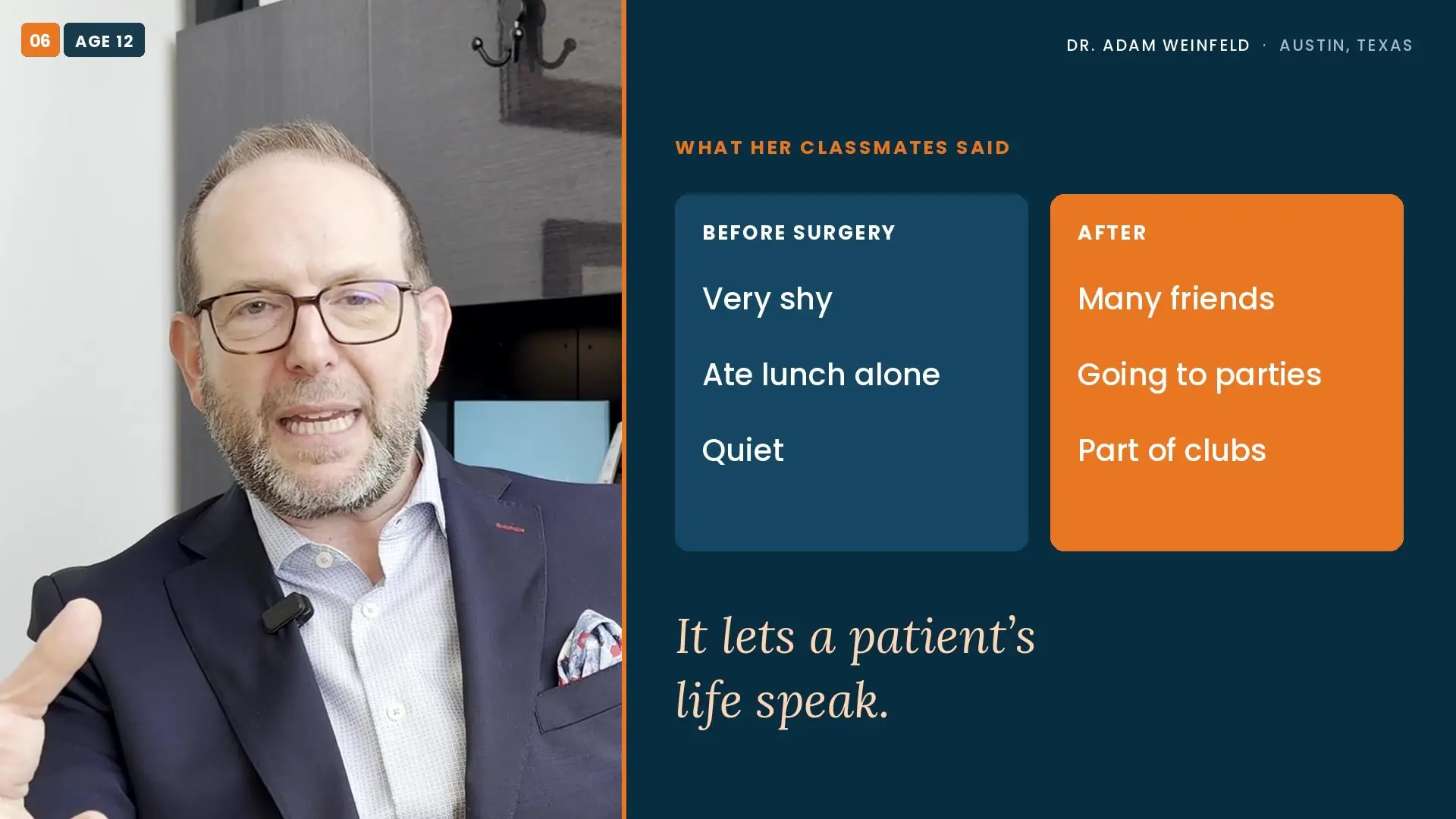
What impressed me most were the interviews with her classmates. Before surgery, they said, they didn’t really know her. She was very shy, she ate lunch alone, and she didn’t interact with many people. After the ear reconstruction, she was an active part of the class. She had many friends, she went to parties, and she was part of clubs.
That said a world to me. When someone who isn’t the patient can describe what happened from the outside, we know that this surgery, like many plastic surgery and cosmetic surgery procedures that change the way people look, lets a patient’s life speak.
What training shaped my approach to plastic surgery?
A biology degree from Swarthmore College, Baylor College of Medicine, plastic surgery residency at Baylor, and two six-month fellowships: facial aesthetic surgery with Bahman Guyuron, and oculoplastic and cosmetic surgery at Paces Plastic Surgery in Atlanta.
Swarthmore College
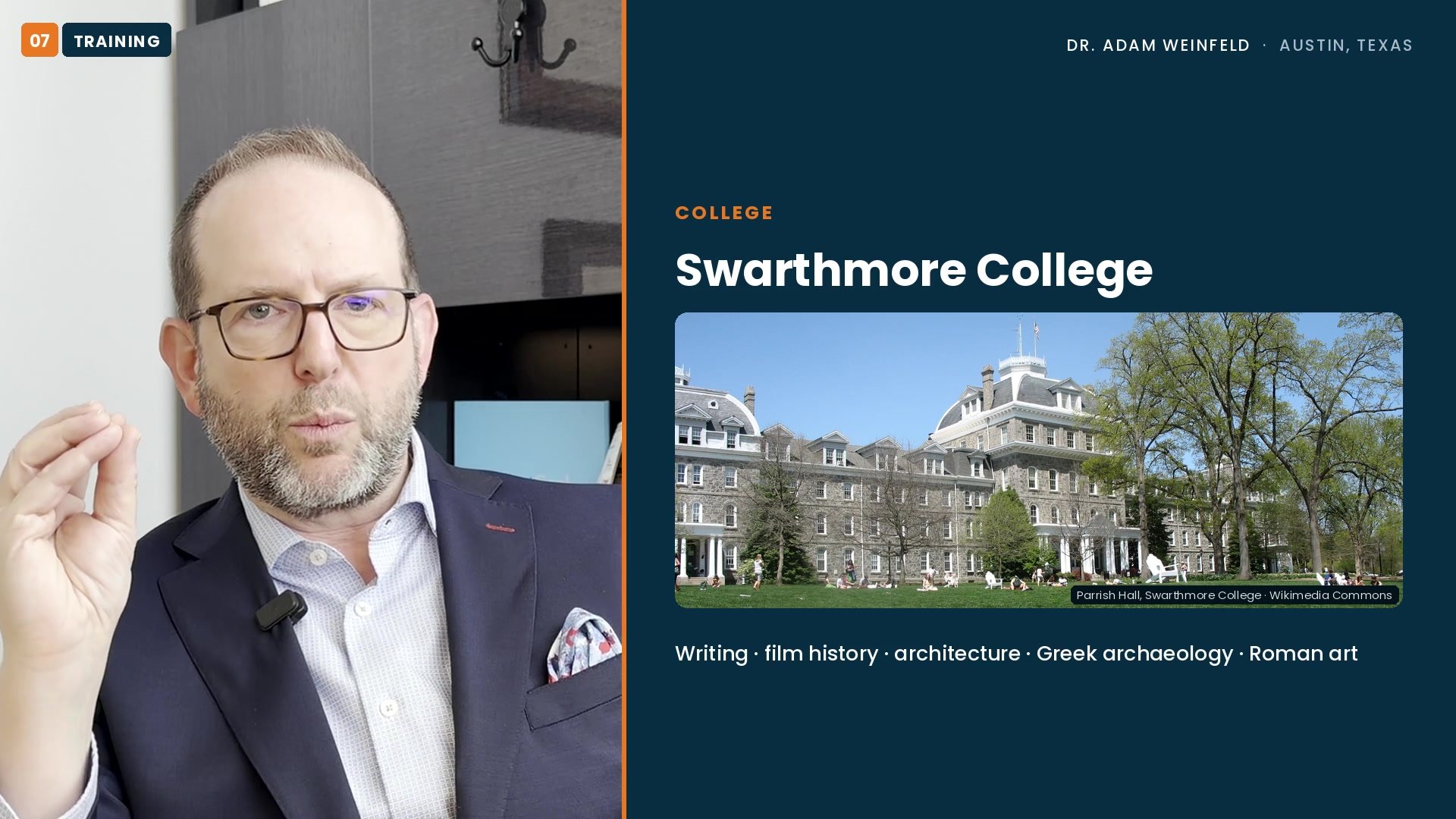
Swarthmore is a really intense liberal arts institution, where I was exposed to all sorts of different trains of thought and disciplines of study. Believe it or not, I did equally well in English classes and writing. I took film history, architecture, Greek archaeology and Roman art, along with my core sciences, and I did well enough to go on to medical school.
I majored in biology. I did really interesting research on fiddler crabs, to understand the difference in male and female feeding patterns, given that the males have only one feeding claw. That meant going to the New Jersey shore, sleeping in the tidal basin area, and waking up with each low tide to count the male and female crabs feeding at different intervals, to see how the males made up for having only one feeding claw.
Also in college, I did an internship at St. Elizabeths Hospital, a psychiatric hospital in Washington, D.C. I found it fascinating how our psychological world can shape our entire life.
Why I chose Baylor College of Medicine
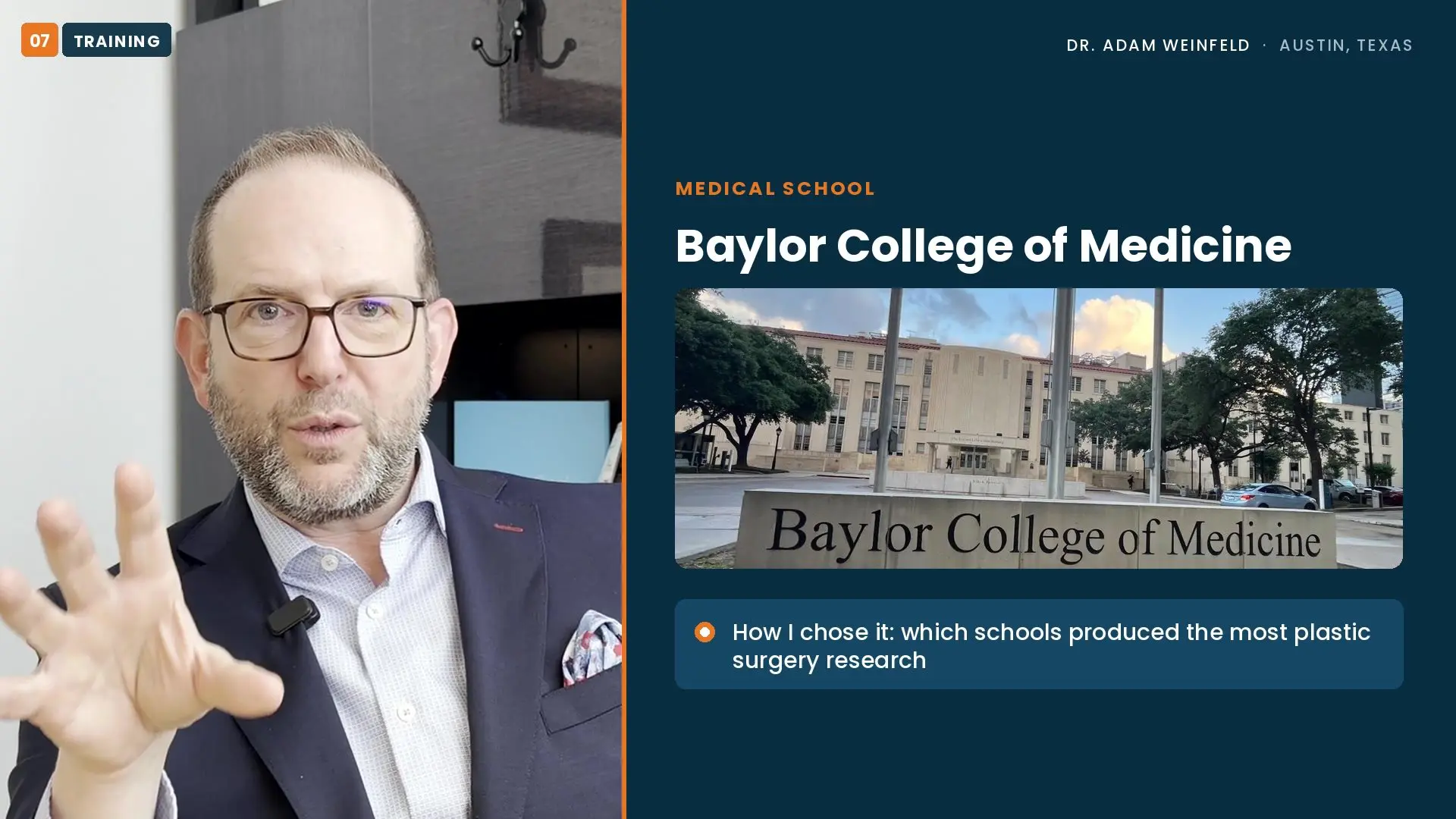
This was before you could use Medline to research journal articles. I used a computerized index to cross-reference plastic surgery with every medical school I was applying to, so I could see which ones were producing the most plastic surgery literature. If a school was producing a lot of papers in plastic surgery, I figured it was a good institution. That’s what led me to Baylor, and I’m so glad it did, because it was such a well-rounded education for plastic surgery.
I got involved with plastic surgery from the very beginning. As a medical student I was already doing research on fat cell biochemistry, bioengineering and how to work with fat cells for fat grafting. The department knew me well, and they took me into their plastic surgery residency. Some of my favorite early experiences were cleft lip and cleft palate rhinoplasties and cosmetic rhinoplasties with Dr. Stal, and facelifts with Dr. Steve Hamilton, a plastic surgeon in Houston, that were modeled at the time after Bruce Connell.
Two fellowships
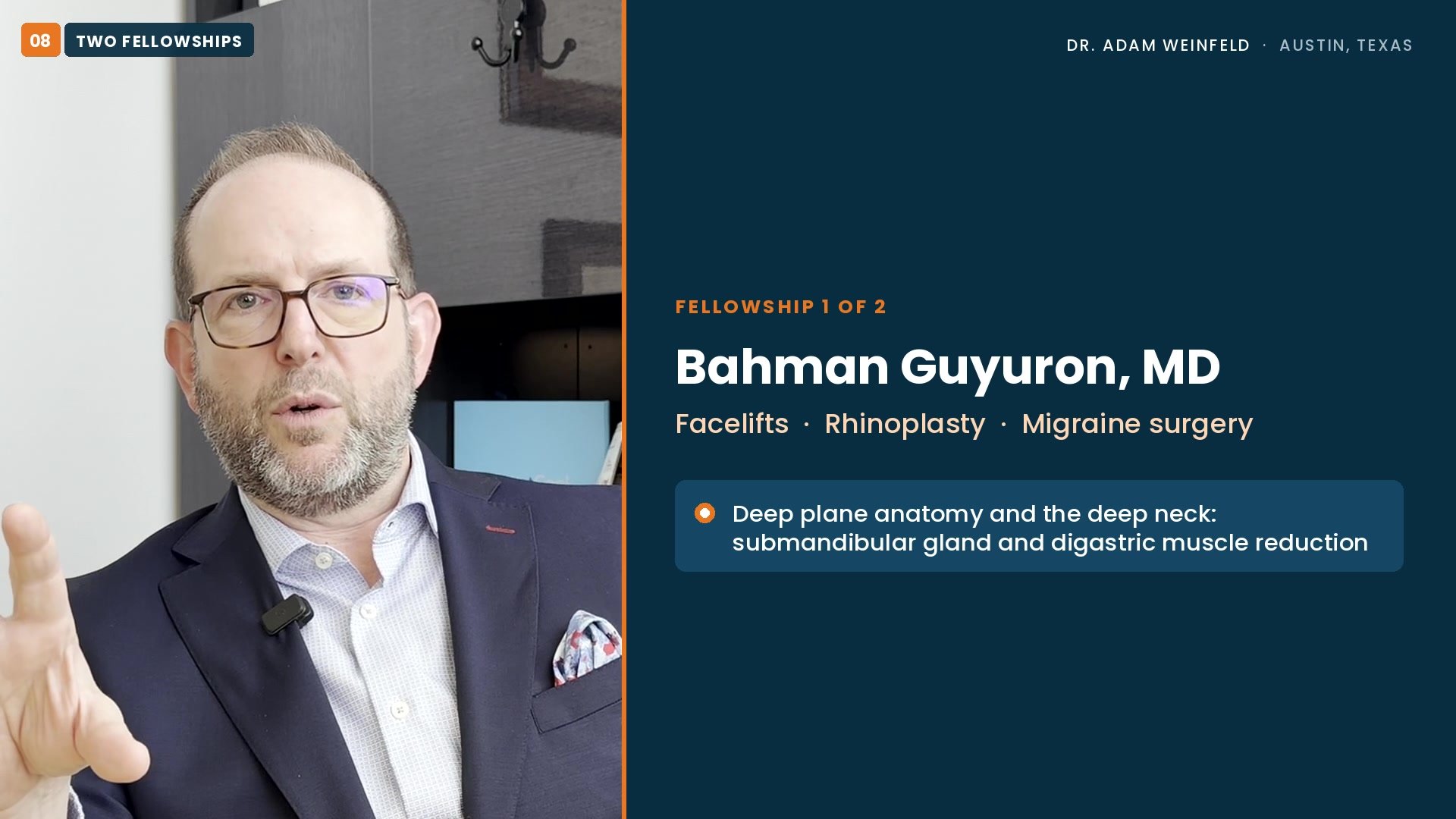
When I finished residency, I wanted to deliver patients the highest level of care I could, so I did two fellowships of six months each. The first was with Bahman Guyuron, a world-renowned leader in facelifts, rhinoplasty and migraine surgery. That’s where I really started to understand deep plane anatomy for facial rejuvenation, and the anatomy of the deep neck: reducing the submandibular gland (the salivary gland under the jaw) and the anterior belly of the digastric muscle (a small muscle under the chin), long before it became so popular. I’ve been doing it for more than 19 years. (More on the neck lift.)
The second was a mixture of oculoplastic surgery, which focuses on the eyes and brows, and cosmetic surgery with a lot of breast and body work, with Clinton McCord, Mark Codner and Foad Nahai, a world leader in plastic surgery education. It was a very well-rounded education.
Why does reconstructive experience make a better cosmetic surgeon?
Because reconstructive surgery taught me anatomy and skills I use in every cosmetic operation: what the inside of a face is made of, the anatomy of a breast, and the fine motor control that microsurgery demands.
I came back to Texas and ended up in Austin. It’s been 19 years overall, 18 of them here in Austin, Texas. From the very beginning I had a meaningful, boutique cosmetic surgery practice, and I also did a lot of reconstructive surgery, much of it trauma surgery on the face.
Facial trauma surgery
If you have seen a face that has been dismantled by a car accident or a fight, you understand what the inside of a face is made of. That helps when you’re a cosmetic surgeon, because there’s nothing you’re going to be afraid of. You really understand the anatomy, and you really understand how bone and tissue interact.
Breast reconstruction and microsurgery
I also did a lot of breast reconstruction for women with breast cancer: with implants after mastectomy, and with microsurgery, moving tissue from the abdomen to the chest and suturing together tiny blood vessels, a millimeter or two, an eighth of an inch at the most. If you can build a breast that way, you really understand the anatomy of a breast and what it takes to create a beautiful, attractive breast. All of that microsurgical work also fine-tunes your motor skills and your ability to concentrate.
Did you know that every breast reconstruction that transfers tissue from the abdomen involves an abdominoplasty? I’ve done hundreds of abdominoplasties because I’ve done hundreds of microsurgical breast reconstructions. Today my practice is fully dedicated to cosmetic surgery: the face, including facelifts and rhinoplasty, and the breasts and body.
| Experience | What it taught me | Where it shows up today |
|---|---|---|
| Facial trauma reconstruction | What the inside of a face is made of, and how bone and tissue interact | Facelift and rhinoplasty |
| Microsurgical breast reconstruction | The anatomy of a breast, plus fine motor skills and concentration | Breast surgery |
| Abdominal-tissue breast reconstruction | Every one includes an abdominoplasty: hundreds in all | Abdominoplasty (tummy tuck) |
| Fellowship with Bahman Guyuron | Deep plane anatomy, the deep neck, submandibular gland and digastric reduction | Deep plane facelift and neck lift |
| Oculoplastic and cosmetic surgery fellowship | Surgery of the eyes and brows, with breast and body work | Eyelid and brow surgery, breast and body |
| Baylor residency | Cleft lip and cleft palate rhinoplasty and cosmetic rhinoplasty | Rhinoplasty |
Why does a monorail ride still matter in my consultations?
Because it was the first time I looked at a face and asked why it was attractive, and I still ask that about every face: in the consultation room, before surgery and even after surgery.
On that monorail at Disney World, I was eight years old. I looked across the center aisle at a young girl about my age, probably eight, and there was something I found striking about her face. For a couple of seconds I just sat there and asked myself: why? Why do I find that attractive?
Now I ask what’s attractive, what’s less than attractive, and what features a patient wants to change. And that is my origin story.
Frequently asked questions
Was Joseph E. Murray really a plastic surgeon?
Yes. Joseph E. Murray was a plastic surgeon. He performed the first successful human kidney transplant, in 1954, and shared the 1990 Nobel Prize in Physiology or Medicine. Plastic surgery happens to be a super innovative discipline of medicine; it lets people think outside of the box and solve really challenging problems. Later in his career he went back to more traditional plastic surgery, including the ear reconstruction I watched in a documentary when I was 12.
What is microtia?
Microtia means small ears: a child is born with very small ears, essentially without ears. One way to reconstruct the ear is to take cartilage from the patient’s rib and build a new ear framework underneath the skin. I watched that surgery in a documentary when I was 12, and microtia is a condition I ended up taking care of in young kids later in my career: probably at least 100 reconstructions.
Is Dr. Weinfeld a Quaker?
No. I went to a small Quaker high school, Sandy Spring Friends School in Maryland, but I’m not a Quaker. I have benefited from the Quaker principle "Let your lives speak," which goes back to George Fox, who started Quakerism. To me, it’s an important way to understand people: what are they trying to tell us, and what does their life tell us?
Did Dr. Weinfeld have otoplasty for his own ears?
No. My ears stick out a little bit, and when I was 10 or 11 it bothered me, but not enough that I even talked to my parents about an otoplasty, the surgery that sets back ears that stick out. I worked through it without surgery. It did show me how being preoccupied with your appearance can affect the way you feel, and that stayed with me.
How long has Dr. Weinfeld practiced in Austin?
It’s been 19 years overall, 18 of them here in Austin, Texas. From the very beginning I had a meaningful, boutique cosmetic surgery practice, and I also did a lot of reconstructive surgery, much of it trauma surgery on the face, along with breast reconstruction. Today my practice is fully dedicated to cosmetic surgery of the face, breasts and body.
About the author
Adam Bryce Weinfeld, MD, is a board-certified plastic surgeon in Austin, Texas, with 19 years in practice. He is double fellowship-trained in facial aesthetic surgery and oculoplastic surgery, a Clinical Associate Professor at Dell Medical School, a Past President of The Rhinoplasty Society, and the author of 33+ peer-reviewed publications and multiple book chapters. His practice is exclusively aesthetic, with an emphasis on the face. Training and scientific contributions.
Considering plastic surgery in Austin?
Book a consultation with Dr. Adam Weinfeld, board-certified plastic surgeon in Austin, Texas.
Request a consultation512-559-1376 · drweinfeld.com
This article is for education only and is not medical advice. Individual results vary. Written by Dr. Adam Weinfeld from his video; edited and formatted with AI assistance.
Full video transcript
How a monorail ride shaped a plastic surgeon. How can a monorail ride taken at Disney World at the age of eight impact the rest of someone's life? I'm gonna tell you at the end of this video. What you're gonna see is a journey. Let me tell you something.
How a plastic surgeon analyzes every face. I have been analyzing people's faces for as long as I can remember. Analyzing them, asking myself what's attractive, what's less than attractive, what makes their face work, what is the key feature that drives their identity. I've been thinking about this for so long. So long. I think about it. Every time I'm out, I'm looking at people's faces. I'm doing surgeries on their faces, whether they like it or not in my mind. I'm looking at their faces and thinking about how would they benefit from a facelift. Are their brows low? Do they have too much excess skin in the upper and lower eyelids? What are the proportions between the neck and the face? I do the same thing with noses too. I ask, how does that nose balance with the rest of the face? What are the features that need to be changed to complement the rest of the nose and the rest of the face.
Let your lives speak: a Quaker principle. I went to a small high school, happened to be a Quaker high school. Not many people know what Quakers are, but Quakerism was started by someone by the name of George Fox. He had a principle in mind, and it was called “Let your lives speak.” And I've always, always felt that that's an important way that we should understand people. What are they trying to tell us? What does their life tell us? I also believe that everybody's life is essentially a universe of experiences, of interactions, and it's also a universe of impact on other people's lives. We as plastic surgeons have a very, very important role in people's lives. We alter their appearance and we do it in the context of people trying to reimagine the way they project themselves to the world. This is really important work. It's really important work, and I treat it very seriously because of those reasons.
Why do patients choose plastic surgery? I don't know how many of you know who Simon Sinek is, but he's a thought leader, both in the business community realm, but also from a psychological standpoint or a psychological evolutionary biology framework. And he has something called the Golden Circle. And what he says is, things that drive people's decisions aren't necessarily the what or the how, but it's the why. And I really care about the why when I'm interacting with patients. I really care about it. I try to understand the why. Why is it they're sitting in front of a plastic surgeon? Yes, I care about the what, like what features don't they like? And I'm gonna help them work through the how. Obviously, that's my role. But the why, a common understanding of their why is really important for me to understand. When I'm engaging with a patient who's going to undergo a really serious thing, such as a facelift, such as a rhinoplasty, such as a breast augmentation or abdominoplasty, that's really important. Really, really important. Now, the why. The why. The why is often that patients feel a discordance, a lack of coordination between what they see in the mirror and how they feel. Let's say for the face, people see themselves and they feel that their facial features and perhaps what aging has done to their anatomy, they feel that that makes them look more tired, less engaging, less happy than they really feel on the inside. And they recognize that can have an impact on the people around them. They find it difficult to let their lives speak. They find it difficult for whether they can put their finger on it and understand it. They find it difficult for their universe of possibilities to be expressed outward, to have a positive impact both in their lives and other people's lives, to have meaningful experiences. I know that this is really philosophical, and I know perhaps it's a little bit of an overreach, but I really do believe this. And I need to understand people's why. What is it that's motivating them to have surgery? In what aspects of their lives do they feel they lack confidence? In what way do they feel making a change in their appearance would impact their life? It's really important to investigate that.
Why I became a cosmetic surgeon. And it's important for patients, for future patients, to understand my why. My why. Why am I doing this? Well, there's the simple things. I do love working with my hands, and I like to help people make changes in their appearance through surgery, things that they can see almost immediately, these sort of immediate moments of gratification where you can really see something has changed. I love being a part of that. But more profound than that is in terms of my why. Like, why am I doing plastic surgery? Why do I do cosmetic surgery? It's because I want to have people feel easier in their skin. I want them to look in the mirror and truly see themselves. And I want them to know that they can go about their day projecting outwards what they feel on the inside. Those things are really important to me.
Self-conscious about my ears as a kid. Let me tell you a little bit more about my pathway to becoming a plastic surgeon. Okay. I told you about a monorail ride. And I'm going to tell you a little bit more about that at the end of this conversation. Shortly after that, age of eight, shortly after that, I started, as we often do, become aware of our own appearance. And believe it or not, you probably can believe it because you're looking at me, that I used to be very self-conscious about one particular aspect of my appearance, and that was my ears. Arguably, my ears stick out a little bit, right? A little bit, okay? It's not terrible, it's a little bit. Stop focusing on them. A little bit, okay? My ears stick out a little bit. And when I was younger, it bothered me a little bit. Not enough, actually, that I even talked to my parents about an otoplasty, because even then, you kind of research these things, understand these things. But it wasn't that much, but it was enough that I noticed it. And I remember kind of how I felt about it. You know, for me, I was able to kind of work through that, if you will, without surgery. But I kind of recognized how being preoccupied with your appearance can have an impact on the way you feel sometimes. So that was another factor that contributed to sort of my understanding of what plastic surgeons do, what they have the potential to do, what they have the potential to do for other people, and what I would like to do with the rest of my life. Believe it or not, that was like when I was 10 or 11 years old. I can remember at my great aunt's house looking in the mirror thinking this. It's true, I'm not making this up. Okay, now fast forward to the age of 12.
Microtia ear reconstruction that inspired me. All right, age of 12. Now, let me give you a setting. My father's a doctor, he's an OB-GYN. And so, being a doctor was something that was, you know, a potential reality to me. And another thing that was true is I did pretty well in school and I liked the sciences. And I liked working with my hands. I was actually really good in art class. In particular, I was good in the projects where we were working with clay, kind of building things with our hands, really did quite well on that. Really loved it, really enjoyed it. Okay, so father's a doctor, I like working with my hands. And something came on TV one evening, and it was this documentary. It was a documentary about a woman, a young woman, she was in high school at the time of this documentary, who was born with very small ears, essentially without ears. She had what is called microtia, or small ears. It's a condition that I actually ended up taking care of young kids for this later in my career. All right, and this documentary chronicled her ear reconstruction by someone by the name of Joseph E. Murray. Now, Joseph E. Murray, and you can look this up, Joseph E. Murray is a plastic surgeon, get this, who won a Nobel Prize, right? What in the world would a plastic surgeon be winning a Nobel Prize for? It's actually really interesting. He is the first one who did a kidney transplant. That's right. Yeah, plastic surgeons, plastic surgery happens to be a super innovative discipline of medicine. And it allows people to think outside of the box and solve really challenging problems. Anyway, so later in his career, he went back to doing more traditional plastic surgery and he was building an ear for this young woman in this documentary, this young high school student. And that was really cool. And just hearing about the process of taking someone's rib and building it underneath the skin, and, you know, it's just amazing surgery. And that's why I ended up actually doing this kind of stuff later in life. And, but what I was most impressed with, and again, this gets back to the why, this gets back to what motivates me to do plastic surgery and gets back to make me feel like it's like a compulsion to understand why people are undergoing plastic surgery. In this documentary, they interviewed her classmates in school, and what they revealed was so fascinating. They said that this young woman, that she, they didn't really know her before she had surgery. She was very shy. For the most part, she ate lunch alone. She was quiet. She didn't interact with many people. Now, afterwards, during this documentary, after they showed the ear reconstruction, the present time of the documentary, they're saying, like, she's like an active part of the school class. She's got many friends. She's going to parties, you know, she's part of clubs. And that said enough to me. I mean, that said a world to me. If you hear someone else's, you know, someone who's not the patient, being able to say what happened to a patient from the outside, we know that this surgery, like many, many plastic surgery procedures, cosmetic surgery procedures that change the way people look, we know that it lets a patient's life speak, their life speak, right? Remember, I was telling you, they barely interacted with this young woman. And then here she is, at the time of the documentary, is like fully integrated into social circles. So that I was 12 years old. Hook, line and sinker, I knew that I was going to become a plastic surgeon.
From Swarthmore to plastic surgery residency. So I finished high school and then I went on to go to Swarthmore College, which is a really intense liberal arts institution where I was exposed to all sorts of different trains of thought, different disciplines of study. Believe it or not, I did equally well in my like English classes with writing. I love like, I did a class in film history, amazing architecture, archaeology, Greek archaeology, Roman art. I mean, just art history, like really incredible stuff. But of course, I did my core sciences. And fortunately, I did well enough that I went off to medical school. Now, I chose Baylor College of Medicine because, and this is before you could use Medline to research journal articles, I used sort of a computerized index, if you will, where you could do some very simple cross-references. So what I did was for every medical school I was applying to, I ended up cross-referencing plastic surgery and that medical school so I could determine what medical schools I was applying to were producing the greatest amount of plastic surgery literature in a particular year. And I used that as a guide. I figured like if they're making a lot of, if they're producing a lot of papers in plastic surgery, that's a good institution. And that's what led me to Baylor College of Medicine. I'm so glad that it did because it was such a well-rounded education for plastic surgery, right? Okay, and so then what happened is from the very beginning, I became very involved with plastic surgery. I started as a medical student already doing research into fat cell biochemistry, to bioengineering and how to work with fat cells, fat grafting very, very early. Other work involved with plastic surgery, got involved with the department. And because they knew me so well, they ended up taking me as a plastic surgeon. I did that. And some of my early experiences that I so enjoyed were working with Dr. Stal doing cleft lip, cleft palate rhinoplasties, cosmetic rhinoplasties, Dr. Steven Hamilton doing facelifts that at the time were really modeled after Bruce Connell.
Facial and oculoplastic surgery fellowships. When I finished my residency though, I knew I really wanted to be able to deliver patients the highest level of care that I could. And so I went on to do two fellowships each six months. I went on to do a fellowship focused on facelifts and rhinoplasties, but also migraine surgeries, believe it or not, with Bahman Guyuron, a world-renowned leader in all three of those areas in addition to others. And that's where I really started to understand deep plane anatomy for facial rejuvenation, facelifts, deep neck anatomy, submandibular gland, anterior belly digastric muscle reduction before it became so popular and trendy. So I have very early exposure to that, been doing it for many, many years, greater than 19 years now. And then I went on and I did a fellowship that was a mixture between oculoplastic surgery and cosmetic surgery. So oculoplastic surgery focused on the eyes and then also focused on the brows. In addition to that, there was a lot of body work as well. It was a breast and body heavy cosmetic surgery fellowship as well. So very, very, very, very well-rounded education. Clinton McCord, oculoplastic surgeon, Mark Codner, oculoplastic surgeon, plastic surgeon, Foad Nahai, who needs no introduction from anyone, world leader in plastic surgery education, both in reconstructive and cosmetic surgery. So then I came back to Texas, ultimately ended up in Austin.
Reconstructive experience in cosmetic surgery. This has been 19 years overall, but 18 years here in Austin, Texas. And from the very beginning, had a very meaningful cosmetic surgery practice, really kind of a very boutique practice, but also did a lot of reconstructive surgery, some of it being a lot of it actually being trauma surgery on the face. Now, you may be wondering, how does that play into what I'm doing now? Well, if you have seen a face that has unfortunately been dismantled, if you will, from a car accident or a fight, God forbid. You understand what the inside of a face is made of. And it helps you when you're a cosmetic surgeon because there's nothing you're going to be afraid of. You're going to really understand the anatomy and you're really going to understand how bone and tissue interact. So a really important part of my development as a cosmetic surgeon. I also did a lot of breast reconstruction and not just regular breast reconstruction with implants. This is breast reconstruction for women with breast cancer. Not just that, but also breast reconstruction using microsurgery, where we disconnect parts of the tissue, the abdomen, transfer it to the chest. Now, why am I telling you about that when I'm telling you about cosmetic surgery? Well, first of all, because if you can build a breast with an implant after a mastectomy for breast cancer, if you can build a breast out of someone's abdominal, excess abdominal tissue using microsurgery, suturing together little tiny blood vessels, little tiny blood vessels, a millimeter, two millimeters, eighth of an inch at the greatest together. Then you really understand the anatomy of a breast. You understand what it takes to create a beautiful, attractive breast. Not only that, all of that microsurgical work really, really, really fine-tunes your motor skills, your ability to concentrate. Really, really important preparation for what I'm doing now, where I'm in a practice that I'm fully, fully dedicated and focused on cosmetic surgery, both of the face, facelifts, rhinoplasties, all the things that go along with that, but also body surgery, surgery of the breasts, surgery of the abdomen. Did you know that every single breast reconstruction where you transfer tissue to the breast, every single one of those involves an abdominoplasty? I've done hundreds of abdominoplasties because I've done hundreds of microsurgical breast reconstructions. An immense wealth, an immense wealth of experience and expertise in not just facial surgery, but in surgery of the breast and the body as well. Having said that, I think you've got a full picture of my origin story.
The monorail ride: why I study every face. Now, I'll bet you forgot, I almost forgot that monorail ride. Why was that monorail ride so important? That monorail ride was the first time at the age of eight years old where I looked at someone's face and I thought, that's an attractive face. And I asked myself a question: why? And I do that every single time that I look at someone's face. Now in a consultation room, before surgery, even after surgery, I ask what's attractive and what's less than attractive. What are the features a patient wants to change? In that monorail ride, Disney World, age of eight years old, I looked across the center aisle. There was a young girl about my age, probably eight, and I looked at her face and there was something that I found striking about it. And I just sat there, and just for a couple seconds, I asked myself, why? Why do I find that attractive? And that is my origin story.